Root Collar Excavation

There were 11 trees total. All of them container bound and planted too deep. Damn shovel operators planting trees, leave it to us professionals.

Sent from my SAMSUNG-SM-G891A using Tapatalk
 
I am curious about these new methods you mention. I would dare to say %100 of the new trees I have seen around DFW, both B and B as well as container grown, are root bound before they ever get to me. How am I supposed to deal with this issue, every tree, from every source seams to be girdled.

Sent from my SAMSUNG-SM-G891A using Tapatalk
 
From our end, it's basically to shave off the outer layer of the containers stock if it's kind of bad, tease out circling roots and train out into the planting hole if it's kind of ok, or reject the plant and talk to the nursery manager if it's completly circled. Find the root flair via excavation and plant appropriately or reject.

With B&B, you'll want them to be more freshly dug, remove most of your cage, and see if you see any tangentially growing outer roots and prune off. Find the root flair as above and plant or reject.

There's nothing particular new about what I just wrote other than the rejection part. Go to the nursery, inspect the plants yourself, and be a nursery manager's worst nightmare. Besides rhe root system, how's the structure of the trunk(s) and canopy? Tell them what's good and bad. If they wont play ball, tell them why and move onto their competitors.

There's also nothing per se new about proper planting procedures but how often is it actually done? How often is the pit 2 to 3 times the ball diameter? How bout the flair being located? I consistently see holes being augered or dug just wide enough for the plant to be dropped in and declared done.
Amendments? Usually not necessary or even detrimental for a single tree planting unless your dealing with a land reclamation project. However, we do exclusively high end residential where very large mixed borders where amending the whole big bed can make sense predicated upon some soil test results....

"Right plant in the right place" is the catch phrase but I believe it should read "Know thy site, then pick the right plant for the right place." Ever argue with an LA about their plant selection? Good luck. Ive read the work of and met some fantastic landscape architects and designers but far too many have far too much design theory and not enough plant science. Frustrating as all get out when were expected to maintain these installs after the fact.

As far as nursery production is concerned, newer ideas include root pruning between each stage of container production and/or using a mesh style container to help prevent root proliferation at the margins. B&B production, perhaps the best method is to simply grow them in the field without any digging and moving until the final dig.

I'm sure I'm forgetting things here and others are welcome to chime in accordingly. Perhaps what could really be seen as proper and "new" is actually following proper planting procedures from the jump as well as monitoring for sgrs early on.
 
Tyler, those circling roots could be straightened maybe. Lots of work to widen planting areas, but worth it for the plant. The trick of course is to convince the owner it's worth paying for. displaying evidence of girdled catastrotrees is the best way i know to open their eyes to the need. That's why the writeup begins with Nat Sperry's pic.

JD I agree, and add that "root pruning between each stage of container production" is *standard* in Europe. That concept is suppressed here; yet another example where the corporate machine in the US screws up this industry.
 
There's a good point that I missed. Wider planting holes being dug along with root pruning at planting is time consuming and would have to be considered on an installation bid.
 
Tyler, those circling roots could be straightened maybe. Lots of work to widen planting areas, but worth it for the plant. The trick of course is to convince the owner it's worth paying for. displaying evidence of girdled catastrotrees is the best way i know to open their eyes to the need. That's why the writeup begins with Nat Sperry's pic.

JD I agree, and add that "root pruning between each stage of container production" is *standard* in Europe. That concept is suppressed here; yet another example where the corporate machine in the US screws up this industry.
Again we can look to bonsai here for a corroboration of these methods! When collecting "wild" trees, transplanting and repotting i follow the same rules via bonsai and have had really good success.
 
Haven't had a chance to read through the whole thread but in my experience the roots that grow above the root flare on a buried trunk are there as a reaction to being buried. Sort of like epicormic growth in a way, and maybe it is, I'm just not sure that's the right term. But it's like the tree is trying to create a new hairy root system due to being choked out. Again, this is just the way my mind sees it and i might be explaining it wrong.

But then the cycle starts; those roots begin to girdle and wrap around the trunk. What are girdling roots great for? We're trained that they're good for nothing, but they're really good at creating cupped areas that collect more soil and eventually bury the flare even more. So get em out sooner than later if possible.

Another issue I've seen with buried flares on larger trees is too many understory plants near the trunk. As run off occurs it carries sediment down, builds up around these plants, and over time gets packed down. When pulling these plants out, their root systems usually carry a good chunk of earth out with them, in effect helping out a great deal with the excavation.

It's amazing how many trees I've seen quickly get happier because buried flares were corrected. Most of the diseased or pest-riddled trees I've seen were also buried. Coincidence? I think not. Much like the way that we're more apt to have secondary health problems when we have a compromised immune system.

Hope i didn't repeat anything already said and hope all my buzz friends are doing well.

Take care,
TL
 
Hi guys,

I'm curious whether fruit trees have any differences in root collar / flare excavation, compared to shade trees. I just picked up a Seto Satsuma Orange yesterday. I'm not sure what the likelihood of it being a clone is; or if the changes anything compared to a non-clone.

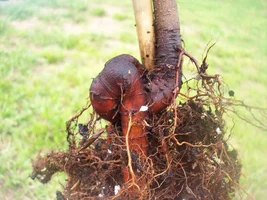
I should have done more digging before I took it home in hindsight. Today when I excavated it, I was a little bummed out with what I found. I'm no expert, but the huge swell seems to indicate this is a grafted clone, yes? There is one buttress root above that, which takes a hard turn and sort of lays back against the bulge. This concerns me for the future, so I'm considering swapping it out.

What are your thoughts?

 
i know nothing about satsuma but oranges are grafted a lot so i wouldn't be surprised. not necessarily a bad thing though. where did you get it?
 
The prodigal returns. Good to hear.from you. GAA TCC is first weekend in April near Madison GA I-20 east of Atlanta GA if you an make it. 3 day event. Day 1 are workshops, 2 and 3 are comp.
 
Hi guys,

I'm curious whether fruit trees have any differences in root collar / flare excavation, compared to shade trees. I just picked up a Seto Satsuma Orange yesterday. I'm not sure what the likelihood of it being a clone is; or if the changes anything compared to a non-clone.

I should have done more digging before I took it home in hindsight. Today when I excavated it, I was a little bummed out with what I found. I'm no expert, but the huge swell seems to indicate this is a grafted clone, yes? There is one buttress root above that, which takes a hard turn and sort of lays back against the bulge. This concerns me for the future, so I'm considering swapping it out.

What are your thoughts?

To my knowledge, and based on a lifetime of being around citrus species in Florida, all commercially available citrus fruit trees are grafted. Your Satsuma scion is probably grafted onto root stock of sour orange, which is much more resistant to root diseases.

Citrus, like many other fruit bearing trees, does not grow true to seed.

As to the root system, bear in mind that the life cycle of citrus trees is about 20 years, and they're optimized for fruit production when they're kept pruned to orchard size. Fruit trees produce two significant outputs, wood and fruit, or one in abundance. You want to prune to encourage your fruit trees to make fruit, not big wood. Pruning will also reduce risk of root plate failures.

I'd break out hand pruners, snip a few of the worst of the circling roots, and get that rascal in the ground.

 
Last edited:
i know nothing about satsuma but oranges are grafted a lot so i wouldn't be surprised. not necessarily a bad thing though. where did you get it?


The grafting doesn't bother me, if that's the case. I'm just worried that the first buttress root I uncovered does a hard 180 and lays back against this trunk bulge. Looks like it could girdle the tree down the road. Wondering if I should cut my losses and try to exchange before planting. I got it at the local nursery, so I might be able to sweet talk them.


To my knowledge, and based on a lifetime of being around citrus species in Florida, all commercially available citrus fruit trees are grafted. Your Satsuma scion is probably grafted onto root stock of sour orange, which is much more resistant to root diseases.

Citrus, like many other fruit bearing trees, does not grow true to seed.

As to the root system, bear in mind that the life cycle of citrus trees is about 20 years, and they're optimized for fruit production when they're kept pruned to orchard size. Fruit trees produce two significant outputs, wood and fruit, or one in abundance. You want to prune to encourage your fruit trees to make fruit, not big wood. Pruning will also reduce risk of root plate failures.

I'd break out hand pruners, snip a few of the worst of the circling roots, and get that rascal in the ground.


Thanks for the reply!

Maybe I'll dig a bit deeper and make sure that is the only girdling root. It's just so big relative to the trunk, that I was reluctant to cut it.
 
The grafting doesn't bother me, if that's the case. I'm just worried that the first buttress root I uncovered does a hard 180 and lays back against this trunk bulge. Looks like it could girdle the tree down the road. Wondering if I should cut my losses and try to exchange before planting. I got it at the local nursery, so I might be able to sweet talk them.


Thanks for the reply!

Maybe I'll dig a bit deeper and make sure that is the only girdling root. It's just so big relative to the trunk, that I was reluctant to cut it.
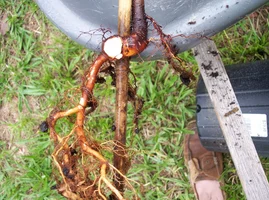
When trees are young, they can bounce back from much more rigorous doses of pruning (canopy or roots) than adult or older trees can withstand. I removed the majority of the root system of a Carambola sapling in a pot, that I won as a door prize at a workshop, about five and a half years ago, in the process of chasing girdling roots. It's still in my backyard today, growing with a vengeance.

I'll insert a caveat that I wouldn't have done this for a client, but since I had time to monitor it and to keep it irrigated while it reestablished a root system, I decided to give it a go. As an aside, I put the excised root portion in another pot and irrigated it as well. After about 3 months of sitting there looking dead as disco, it popped up a shoot too.
 

Attachments

  • 100_3184.webp
    100_3184.webp
    328 KB · Views: 20
  • 100_3187.webp
    100_3187.webp
    412.6 KB · Views: 20
Spread out and/or prune the roots. Doubtful you will find much better in the nursery--but worth a try!--to at least alert them that a buyer is paying attention. Slip them a copy of the FL grower standards, while you're there. :)
 
As far as I understand, if the plant roots above the graft, it may lose the traits of the root stock it was attached to. In other cases, the root stock can reject the grafted material, or out grow it with sprouts originating below the graft.
 
As far as I understand, if the plant roots above the graft, it may lose the traits of the root stock it was attached to. In other cases, the root stock can reject the grafted material, or out grow it with sprouts originating below the graft.

Would you say definitively that this is a grafted tree?

Sent from my 0PJA2 using Tapatalk
 

New threads New posts

Back
Top Bottom