Muggs
Been here much more than a while
- Location
- Canuckistan
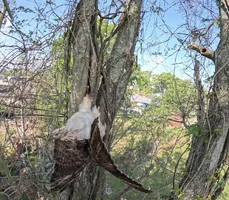
Interesting climb this afternoon

Follow along with the video below to see how to install our site as a web app on your home screen.
Note: This feature may not be available in some browsers.


I've dealt with so many dead and dying owls and hawks, some hung up most of them secondary rodenticide poisoning, I've had to put aside omens of death. It's about their suffering not mine. I had a streak for awhile where a raven would fly over and croak every time I was on a particularly difficult climb to a sketchy spot to get a cat. I always feel a wave of relief "It's going to be ok" when the raven croaks at me. We all have our own relationships with nature and what it's saying for sure.omen of death... be careful everyone
These are valid concerns on paper. In actuality for arbs very low probability. When in doubt wear gloves and a mask. A lot of this is common sense, don't inhale when a cloud of "bat dung dust" blows in your face out of a tree cavity. A friend (not an arb) got a lung infection from the Cryptoccus from excessive exposure to drought enabled soil dust during yard work. It was successfully treated. Diagnosis is the challenge for that. A lot of docs will blow it off if symptoms don't seem to them severe enough etc.This is probably going to seem kinda out there but . . please be careful handling dead animals/ birds. They can carry a bunch of human pathogens - from a search engine (nowadays the ultimate source of an online MD??) - "(Arborist tree workers are at risk of exposure to several human pathogens associated with birds. These pathogens can lead to serious health issues if proper precautions are not taken.
Key Pathogens
Pathogen Disease Caused Transmission Method
Cryptococcus neoformans Cryptococcosis Inhalation of spores from contaminated soil or droppings
Histoplasma capsulatum Histoplasmosis Inhalation of spores from contaminated bird or bat droppings
Chlamydia psittaci Psittacosis Inhalation of aerosolized droppings or respiratory secretions from infected birds
Years ago we had an occupational health case of a non declared asthmatic working around bird droppings/ nests etc. who went home in the afternoon feeling poorly and ended up passing away that night from pulmonary oedema (lungs filled with fluid). It was a complete waste of a nice young man starting out his working life. So it does happen. Disposable gloves and a good dust mask if it's dry?
There's also some viruses circulating in magpies and crows (Corvus) in Europe I think it was, that have been infective in humans, causing pulmonary symptoms. As Sarge said - Let's be careful out there!
Addenda: There's also videos out there with tree guys coming home in working clothes in the family van? Makes me wonder about contact with kids (esp. small ones) and laundry, etc. OK Paranoia session is complete now . . .

There is a story about somebody who got lost while hiking and confessed when he was found that he ate an eagle to survive. The ranger stressed that is not OK, but given the circumstances he wouldn't file charges....but asked "just out of curiosity, I gotta know: was it any good?" "It was OK, but not as good as spotted owl."It was delicious
Ha. Poor spotted owl, the butt-end of every joke ;-)There is a story about somebody who got lost while hiking and confessed when he was found that he ate an eagle to survive. The ranger stressed that is not OK, but given the circumstances he wouldn't file charges....but asked "just out of curiosity, I gotta know: was it any good?" "It was OK, but not as good as spotted owl."
Thx for documenting that owl disaster so well! Good to see your face. Onward!Interesting climb this afternoon
The challenge when a bird gets hung up like that is they can severely break their leg as they struggle to escape. Birds have interesting bones very unlike mammals, super efficient structurally, they can’t be heavy like a ground-based mammal. When a compound fracture happens to a leg rehabbers and vets can’t fix it. Euthanasia is the only option.How sad! I hate to think how long that owl suffered like that before he died. I don't understand how he was not initially able to free his talon. This is very similar to a case I had two months ago. Someone reported a hawk stuck in a tree for three days. I found the hawk with one foot caught in a long, vertical, tight void in the stem. It was wide enough at the top for his foot to fit, but once he slid down to where it narrowed, he was no longer able to remove it. He was still alive when I rescued him. I took him to the local vet school where they have a raptor rehab program, but from what I heard when I dropped him off, he was probably euthanized. At least he didn't suffer any longer.