
RopeShield
Carpal tunnel level member
- Location
- Ontario, Canada
No keep pruning them out or if flexible pull to the side out of way. root flare needs to go out radially. like spokes of a wheel

Follow along with the video below to see how to install our site as a web app on your home screen.
Note: This feature may not be available in some browsers.

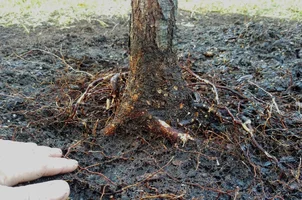
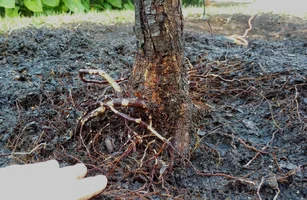
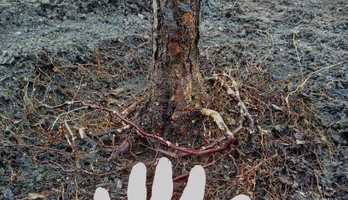
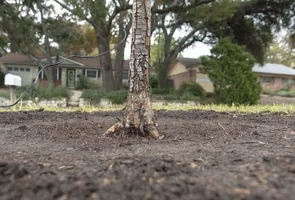
Right; they look adventitious, but being radial are keepers imo. No girdling seen; good news!I found the flare a couple inches down. Planting height looks good.
There is definitely some confusion in these roots. I'm going to read through that material before I go further. The root on the left takes a hard right turn and goes behind the tree (not down). These aren't the buttress roots though, right?

Really hard to tell, but the main buttress roots are probably still below soil. A stem of that diameter will (should!) have larger buttress roots than what's exposed in the photo.I found the flare a couple inches down. Planting height looks good.
There is definitely some confusion in these roots. I'm going to read through that material before I go further. The root on the left takes a hard right turn and goes behind the tree (not down). These aren't the buttress roots though, right?

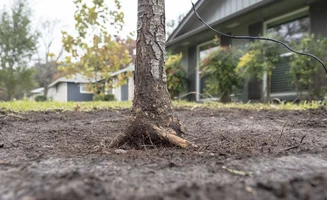 View attachment IMG_8542.jpg
I hear ya but I have a "fairly precise" phobia to the point of AR/OCD...Haven't used a chisel for atleast 15yrs.
Try chainsaw it makes quick low impact and fairly precise work.
I think I have it about wrapped up. Just going to dust a little more compost on top and a healthy layer of mulch. Thanks for all the advice guys, I really appreciate it!
Lol, never accused of being vague are you. Solid information thanksDepends on available equipment. http://www.historictreecare.com/wp-...LBG-III-Managing-Stem-Girdling-Roots1.doc.pdf
Excerpts from the US and German standards:
“Mulch, soil and foreign material should be removed as needed to allow inspection.”
Bark” tracing of wounds shall remove only dead, loose, and damaged tissue.”
Evaluate decay, callus and woundwood growth, and response growth in trunk and crown.” Investigation produces explicit and exhaustive specifications.
Cost-benefit analysis considers ornamental ecological cultural and functional significance of the tree. Objectives are to improve vitality and extend life. Consider supporting instead of pruning, Predict the trees reaction to the work…ability to compartmentalize…Coordinate any works on roots, stem and crown with each other.
83.3.9 The flare and buttress roots should remain visible...
Specify the method, area, depth, tools, equipment and limitations of excavation. Diagnose detectable flare and root diseases and disorders. Protect root and stem tissue newly exposed to sunlight where needed.
Sample specifications Root Collar Examinations using hand tools
Scope: Trees with fill contacting the trunk.
Objective: Avoid damage to the tree from the effects of fill on the trunk. Lessen risk and maintenance needs, improve health. Provide maximum vitality health and safety.
Specifications:
Specifications for monitoring and maintaining tree health and stability should be
- Rake any coarse woody debris or fresh mulch away from the root collar area.
- Press the blade of a shovel or a trowel against the trunk. Slide it carefully downward until resistance is met.
- Push the handle toward the trunk, moving the blade away from the trunk.
- Remove individual adventitious roots <1 cm and stem-girdling roots <1/10 trunk diameter. Manage larger roots per A300 (Part 8), 83.4 and 84.4. Avoid contact between the trunk and any remaining adventitious, girdling, and circling roots.
- Lift the fertile material away from the trunk and set aside.
- Separate and dispose of any infertile soil and debris. Retain the fertile soil, fine roots, mycorrhizae, and decomposed mulch.
- Repeat until trunk and flare are clear, down to the root collar, where buttress roots divide. Use hand tools, or compressed water or air, to clear the root collar.
- Consider replanting the tree, if the flare is over 2” below grade and the tree has been in the ground for less than 5 years.
- Consider installing a device to control erosion, or remove soil and fine roots outside of the root collar to make a gradual slope.
- Apply 2-4” of mulch over the root collar. Avoid mulch contact with the flare.
- Incorporate the fertile material into the rootzone where practical near the dripline.
- Specify that future management will keep the flare visible.
established.When root loss is unavoidable, selective pruning shall be preferred.
ANSI A300 Standard 84.4: Selective root pruning – girdling roots
84.4.1 Roots that encircle or contact (girdle) the trunk or a buttress root should be considered for redirecting or pruning.
84.4.2 Girdling roots should be exposed before pruning cuts are planned or made.
84.4.3 (Girdling roots that provide more benefit than damage should be retained.)
84.4.4 Roots that cross other roots outside the root crown should be retained.
84.4.5 (Avoid damage to the trunk and buttress roots beyond the scope of the work).
84.4.6 If more than one large girdling root is present, root pruning over time should be considered.
Trees in urban areas often show signs of low vitality, which depends on the aboveground and belowground parts. Each tree should be examined individually. If soil aeration, moisture, and nutrients are not available, then improve the growing environment!

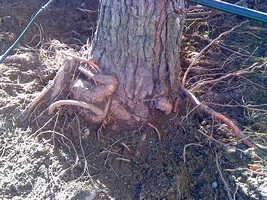
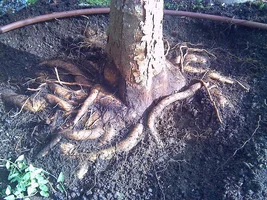
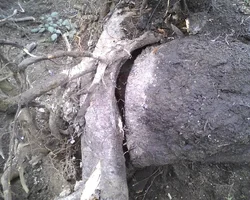
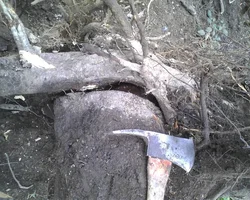
Nice pics thanks!Shore pine--looks like more dirt needs to come off?
View attachment 41639
Dogwood--not too bad; just a snip or two needed?
View attachment 41640
Wind throw cherry, no tension roots due the girdling--Yikes! That buttress root was stopped in its tracks!
View attachment 41641 View attachment 41642


