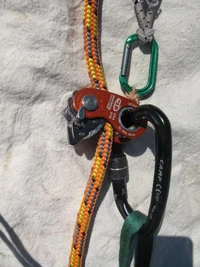
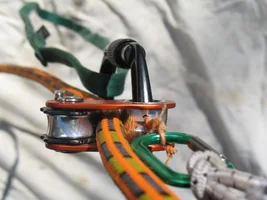
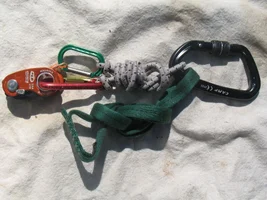
Saka vs Velox?

Thanks for all the input guys! Steve and Reed - I really like the clipping across the back/top of the saddle for stowage - nice! Sounds like SAKA over regular Haas. I'm just wondering if the Velox might run a little smoother than the SAKA with an even longer overall run of bungee.
the SAKA clips perfectly across the back of my Onyx
 
THIS is not the case! Doubling the bungee over does not make it 2 times as strong, it makes it 2 times as elastic. Which it does need in order to serve its purpose and remain as compact and self contained.

you are 100% wrong here. when you fold it over and lock down both ends like the" saka" you have 2 lengths in parallel they could literally be two separate pieces. the legs act independent of each other.. the "saka" is a haas with twice as much bungee force as it needs plane and simple. why not 3 pieces all tied up like that or 4.. we could do 6 and it would be like a jane fonda work out video from the 80's with a resistance band!

you don't need more force to lift, its only a tiny little ascender. rember when you step down that thing is tied to your foot and to your harness. equation looks like this:

the force you have to exert down to advance up= your weight+ the resistance added by your rope walker

so the more band force you need to elongate its like carrying that weight with you when you advance.


more bands or stronger bands actually make your system less efficient. and the energy you put into the bands is release when pick your foot back up into lifting the ascender.


I cannot seem to upload a video of this.. but I assure you what I said here is correct. if you have access to Facebook I have a video posted there.

if anyone wants to try a loaner I'll send it out. it makes sense when you see and use it.

M
 
I wince as I jump into this, but here goes...

Clearly identifying the common issue with bungee use in ascenders is the key to figuring out the best solution. I believe the issue we all face is- as the bungee contracts, pulling strength decreases, limiting the range of vertical motion.

The SAKA compensates for this by adding initial forces that transfer into momentum, but do not extend the range of the bungee. Over-the-shoulder systems add more length of the bungee, which increases amount of stretch, giving a longer range of contraction. This decreases potential of bottoming out too soon. The Velox (which I've not used yet, but hope to soon) seems to incorporate the ots advantage into a more compact setup.

So the SAKA is more explosive, while the Velox and other long systems increase bungee stride. I personally use a diy doubled bungee system, and have used both the SAKA and original HAAS. Between those I believe the burst of the doubled bungee to be superior, but it is still only compensation and not an increase in stride. I now am interested to try a longer system in a single and doubled configuration.

Honestly, before thinking this through I assumed the Velox was just another crank out piece for the sake of selling more kit, but now I think it may be the best compact solution for the real issue of bungee stride. I emphasize best COMPACT solution, as the ots and other long systems have also addressed the issue, but are not as compact, though some are admittedly more versatile.

So, kudos everyone for applying yourselves to advancing a system that promotes better ergonomics and longer careers for climbers. My hip really appreciates the innovation, as it doesn't scream at me every day now that I'm rope walking.
 
you are 100% wrong here. when you fold it over and lock down both ends like the" saka" you have 2 lengths in parallel they could literally be two separate pieces. the legs act independent of each other.. the "saka" is a haas with twice as much bungee force as it needs plane and simple. why not 3 pieces all tied up like that or 4.. we could do 6 and it would be like a jane fonda work out video from the 80's with a resistance band!

you don't need more force to lift, its only a tiny little ascender. rember when you step down that thing is tied to your foot and to your harness. equation looks like this:

the force you have to exert down to advance up= your weight+ the resistance added by your rope walker

so the more band force you need to elongate its like carrying that weight with you when you advance.


more bands or stronger bands actually make your system less efficient. and the energy you put into the bands is release when pick your foot back up into lifting the ascender.


I cannot seem to upload a video of this.. but I assure you what I said here is correct. if you have access to Facebook I have a video posted there.

if anyone wants to try a loaner I'll send it out. it makes sense when you see and use it.

M
Why do you keep putting quotation marks on, "saka"? It's just SAKA.
HAAS, not " haas". Velox not "velox", (assuming it's a name).
 
Okay, after your post, yoyoman, I did some more thinking. Loss of pulling strength as the bungee contracts is still the issue, but I was amiss in saying the SAKA only used a stronger burst to compensate. In fact, if you double the strength of bungee (not length), then, though the loss of pulling power is the same in each leg, together they double the pulling power so the weight of the system and rope friction do not stop the ascent as quickly as they would a single leg version in the same configuration.

The conclusion is, in my best estimation, that both versions successfully address the same issue in different ways, with different "side effects". The SAKA does add more resistance, though in my experience it is unnoticeable. A long, single leg may not have the same speed as the SAKA. I say may because I have yet to try one. On that note- treehive, may I try out a Velox system to get a feel for it? I like the idea of the doubled section in the system, adding force while streamlining attachment with the exiting single leg.

I have learned my lesson in promising video reviews- life with four children and production climbing at work don't lend themselves to making videos. However, I will gladly post a rant and rave review of all the ones I've tried. Any other configurations I can add to the comparison?
 
you are 100% wrong here. when you fold it over and lock down both ends like the" saka" you have 2 lengths in parallel they could literally be two separate pieces. the legs act independent of each other.. the "saka" is a haas with twice as much bungee force as it needs plane and simple. why not 3 pieces all tied up like that or 4.. we could do 6 and it would be like a jane fonda work out video from the 80's with a resistance band!

you don't need more force to lift, its only a tiny little ascender. rember when you step down that thing is tied to your foot and to your harness. equation looks like this:

the force you have to exert down to advance up= your weight+ the resistance added by your rope walker

so the more band force you need to elongate its like carrying that weight with you when you advance.


more bands or stronger bands actually make your system less efficient. and the energy you put into the bands is release when pick your foot back up into lifting the ascender.


I cannot seem to upload a video of this.. but I assure you what I said here is correct. if you have access to Facebook I have a video posted there.

if anyone wants to try a loaner I'll send it out. it makes sense when you see and use it.

M

I'm not an English major and this is certainly not an English grammar forum, but it's driving me nuts, can you just one time capitalize the beginning letter of a sentence.
 
Not to go off on a tangent, but I just thought I'd share an over the shoulder system that I've been messing around with at work, thanks to the suggestions of Reed, Derrick, the venerable Mr. Beranek, etc, etc. This is obviously nothing super original. I'm just after a system that is fast, compact, and multifunctional (not just an ascent system). I did drill holes in the CT Roll'n'lock for a throw line attachment loop for the bungee, and a couple other little "warranty voiding" modifications.
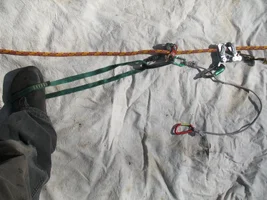
IMG_0186.webp IMG_0187.webp IMG_0188.webp IMG_0189.webp
I did finally get a chance to try the Velox, and it is definitely super smooth (very low resistance), yet positive advancing. A supreme piece of work by any measure. For my own purposes, I still would like something a little less bulky, and more multifunctional.
Some initial observations on my hodgepodge system:
Pros:
-With pantin and open loop 24'' sling on knee ascender, both feet can be quickly slipped off hands free (like aid climbing w/ etriers).
-Roll'n'lock can be left on the rope with the cam latched open (in pulley mode), so it slides freely for quick, short climb/work/descend transitions.
-Because Roll'n'lock is a couple inches vertically shorter than typical chest/basic ascender, it allows a slightly longer stride.
-As a combined pulley & ascender, The R'n'l makes a super fast/affective hauling set up, 3:1 or 5:1 M.A. system (w/revolver or micro double sheave pulley & prussic), all with solid progress capture built in.
-Advances well as a knee ascender with bungee, as it is even lighter/smaller.

Cons:
-Not as positive camming action as chest/basic ascenders - has ridges rather than teeth. On average slips a couple inches once or twice per ground to top ascent. Not a competition set up, and not for everyone.
-Requires removal of 'biner to remove/attach climbing line.

 
I find the history of modern climbing techniques quite interesting and it's really cool so many involved are here on the buzz and that it's happening right now.

Tim... this is the earliest I'm aware a rope walking system appeared on YouTube. Posted by G. Beranek. I'd like to read some of his books one day.


But of course the world existed BG (before Google) so maybe there's earlier use. If not, it's pretty cool this was posted online and even more cool, it's still available!
I think you may be right here. This was Jerry's own idea as far as I know. Jerry always did some innovative stuff.

First time I ever used a rope walker with a bungee system was actually with Jerry on the Tree House Project in 2003. When he graciously asked me to come out to join him for this amazing climb, I looked high and low for a system that made sense for this type of climb. Jerry was using something a bunch of the guys used out there called a gleasy system. I didn't know what it was, so I looked for anything I could find.

What I found was a caving site that talked about a competition they did on a treadmill almost. The winner was using this rope walker. That's when I went online to caving stores and pieced together my system. Bungee through the chest roller. I remember Jerry and I speaking about it in great length when I used it out there. That gave me a smile and a little confidence to settle in with the group. Anyway, as they say, the rest is history. Still smiling too!
 
There's another option as well, the over the shoulder knee ascender. Lots of people appreciate this because it packs down to the size of your fist.
I have an original Haas and have found that it works best on my right. I like that my foot ascender lives on my left, to help strengthen my "off" leg. I usually leave my haas on my foot and clip it to my right 'd'. Lastly, my spurscender is set up on my right so for removals I switch it up. I constantly try to balance the use of each side of my body, whether it's at work or having fun playing soccer...

Reed Wortley
CTSP #01739
ISA CA #SO-6953A
What is this over the shoulder Knee ascender that you speak of sir?
 
At 11:30 in this video I show a bungee over the shoulder configuration.

Thanks, Richard, for the great video. I always appreciate your thorough design approach. Your comparison of the Roll'n'Lock and the Duck was also very helpful, while I was putting together my current system. I know this is an evolutionary step backward in rope ascent for you, but I'm curious about the over the shoulder set up in your video. Is that stiff tubing over the bungee to help reduce friction and increase efficiency? If you don't mind sharing, what type of material did you use for the tubing?

-Thanks
 
It added more bungee to the system but with some loss due to friction, same as other means when the bungee takes a bend.
As long as it is not vinyl there are lots of tubing choices. It depends also on the size bungee used. I now have my own made along with the webbing and bungee.
 
Somewhere around 1987 I picked up the first edition of ON ROPE [second edition came out in 2000]. This was the beginning of SRT for me. What I realized then is that the cavers had all of the SRT systems configured back in the 1960's. What's happened since then is the gear has gotten better and the systems are oh...so....much more efficient. Like the carabiner that was invented in the early 1900's which has lead to what we have now. All improved variations on a theme.

From my view of SRT history the only major innovations were multi-cenders, devices that go up and down a rope without a changeover. AND!!! The coolest thing about this is that all multi-cenders [that I'm aware of] have come from arborists!!!

Way too cool! Big smiles :)
 
Somewhere around 1987 I picked up the first edition of ON ROPE [second edition came out in 2000]. This was the beginning of SRT for me. What I realized then is that the cavers had all of the SRT systems configured back in the 1960's. What's happened since then is the gear has gotten better and the systems are oh...so....much more efficient. Like the carabiner that was invented in the early 1900's which has lead to what we have now. All improved variations on a theme.

From my view of SRT history the only major innovations were multi-cenders, devices that go up and down a rope without a changeover. AND!!! The coolest thing about this is that all multi-cenders [that I'm aware of] have come from arborists!!!

Way too cool! Big smiles :)
So true about multiscender which took us to all the positioning aspects and the 3D world of tree climbing.
 

New threads New posts

Back
Top Bottom