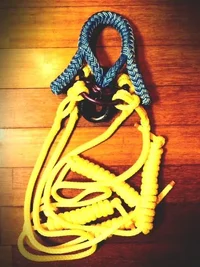
X-rigging rings

Tom, very simple and brilliant. I'm thinking... this might work moving material in the air across a long wet yard maybe? or a yard with lots of bushes and obstacles. Two guys could run that really slick.
 
do all the xrr have the same swl or is it different for each size of ring. I thought I saw the different slings changed the ratings?

Also can you run 5/8" tenex around the large ring instead of 3/4" for a sling or does it need to be full size capacity?
 
Kevin,
The rings have different SWL, roughly doubling for each size up. I think the numbers are in this thread somewhere or maybe X can re-post. JD?

If you're putting the rings in an eye splice, I don't see any particular problem going a little undersized in cordage. If you're putting them in a girth hitch, however, you will loose the ability of the lips to hold the ring secure when not under load.

OF
 
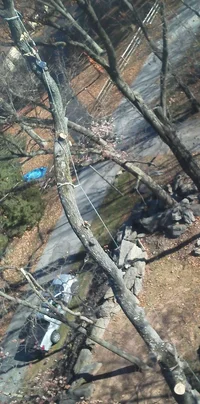
love them Xrings ! Love the Bone too ! Put them together , Sounds like a porn movie . I got my Bone and My X rings ! Slow down brush fire ! I'm dealing with Hard wood . Not a movie just tree work , pg13 at best. I used these rings for almost a year , so strong , nothing I wouldn't use them for , with In reason . Did this yesterday , mad leaning Oak over a garden .Bone and the X rings, I don't like the closed option on the rings , but I have learned to work around it , and I use the Rings almost every day , no lie . The Bone is for Bone Heads . ( another porno)
 

Attachments

  • 375865-XRINGOAK.webp
    375865-XRINGOAK.webp
    125.8 KB · Views: 187
Found a new use for the ring(s)...'The Squid' .

http://youtu.be/Db8m4lHgxUc

Pre-tieing the main section of the to-be-rigged section lets you cut out un-wanted branches, either into the Squids Belly (hub) on the deadeyes or straight to the ground if you use the ring as a floating anchor point.

Because of the 20000 volt wires we used the ring as a 2:1 to lift the over-extended cherry limbs UP onto the speed-line. It gave an overhead pick like balance to the section which stopped any drop into the bank/wires as it transferred onto the speed-line.
 
thanks for the still photo because I couldn't see any XRR in the video at first. Now I do.

I am still not understanding the use of the XRR yet though, sorry. Please explain further because I want to understand and so do many others.

Thanks.

BTW, I have some very exciting new stuff to share soon on new applications of the X-Rigging Rings.
 
Yeah I don't understand the video either? Was the video recording a training session of some kind? Are you just using the X-rigging ring as a stopper knot for lifting the rigging hub?
 
1.17 minutes shows the ring lowering a limb while the hub is being used to crane out the first tree & 4.27 shows the ring being used to lift up the branch onto the speed-line. The hub could've done this too but the shape and smoothness of the ring optimises the MA.
Yes, it is a stopper to help the hub remain horizontal. A stopper with benefits!
The Squid cuts down on the back and forth nature of rigging, sling, cut, lower, raise, sing, cut, lower etc. You can sling and cut a bunch in one hit. Nothing new idea-wise I know but the Squid is a new take, maybe more refined, certainly more novel take on a vertical rigging plate.
Tr33Climb3r, next July I will visit a site in Tokyo where gardeners will use a 400 year old technique to dig out, move and transplant a 70T cinnamon tree .. by-hand. If you'd like details I can give them to you. UK based Canopy Spirit are organising their first trip to Japan next year (2014). This may include traditional tree pruning study.
https://www.facebook.com/CanopySpirit?fref=ts
The video was made as an explanation and given to our employers. Arboreal Rope Access and tree work is still very much an oddity over here.
X, we have sold over 60 rings since we last spoke, they don't say X RIGGING RING though....:o(
 
For anyone loving the XRRs and learning to use them more David just uploaded a vid to his YouTube channel, “thexmanjdd”. Sure he will weigh in and post about it properly when time permits. I know he worked on the vid all night and was off and gone to the airport by the time his computer finally got finished uploading.
 
Props to X and his guys: they put in a long, cold day to prove something … two (2) Beasts do just fine for top rigging even under the most brutal test conditions.


Driver deploys the two XRR Beasts with a new Alpine Butterfly idea … video <u>here.</u>


Here’s my old 2-Beast configuration using a whoopee … video <u>here.</u>


OF
 
David, I have watched your video many times. Basically, I’m awestruck … I NEVER work at that weight. So you have to take these comments with a grain of salt!!

As a rig setup to test the 2-Beast top rig, I very much like the two sling/butterfly arrangement. By using two slings, you double the cordage and put all the focus of the test on the two Beasts and what they do to the rigging line. Excellent test arrangement.

But I’m puzzling whether I’d use that for production, because you don’t have a choking grip on the spar.

To my un-experienced eye, the most dramatic event was that bark stripping. In fact, the only reason it stopped sliding was the protrusions below the tie point. Check it out. On a smooth spar, that puppy could have slid a long way. You can also see the lack of choke on those top view slo mos. It’s nice to get the 2:1 when you tighten the sling initially, but those gripping forces are tiny compared to the shock load.

Even if the safety of controlling the load were not an issue, all that crap on your slings comes from the sliding not from the shock load.

I’m preposterously un-qualified to speak here and I’d like to hear from others …


OF
 
What you're seeing in the first negative blocking scenario in the video is a combination of a little bit of stretch, a little bit of sliding, and a little bit of slack coming out of the alpine butterfly and the timber hitch. All of these things occur in the sling during negative blocking. The first one shown in the video looked very normal for regular rigging scenarios. David tried to show the other end of the spectrum by shock loading a large amount of weight during negative blocking. That was when the excessive sliding and bark scraping occurred. This kind of shock loading should never occur during normal rigging operations. It appeared to be sort of a worst case scenario test. I think the point was to show how the rings and slings would hold up in that configuration during that kind of worst case scenario. You very astutely recognize that there are many other concerns and dangers in a worst case scenario like that one, including but not limited to rope strength, tree/anchor point strength, and physical shock to the climber. There are limits to every aspect of what we do and every component we use. The real skill is to maximize our team, our tools, and our scenario without introducing unnecessary danger. That unnecessary danger was introduced here, in a controlled environment, for the sake of experimentation.
 
[ QUOTE ]
I wanted to clean up an inaccessible (for equipment) shoreline area and I needed a special rigging solution. I grabbed my new XRR Beast Whoopie and reconfigured it to give one (1) travelling re-direct and one (1) choking re-direct.


<u>XRR Travelling Re-direct</u>


The rings continue to amaze me with their versatility.


OF

[/ QUOTE ]

Tom,
I just re-watched your video on this. I see you used a girth-hitch to attach the two X-Rings together. Not that it really matters, but do you think using clove-hitches would be a better knot ? No bend radius and non-directional in clove as you have with girth... Just a thought :-)

BTW, once again, nice job putting this together.

-Michael
 

New threads New posts

Kask Stihl NORTHEASTERN Arborists Wesspur TreeStuff.com Teufelberger Westminster X-Rigging Teufelberger
Back
Top Bottom