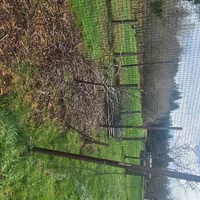
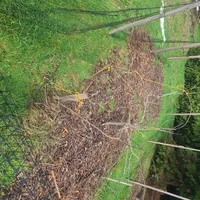
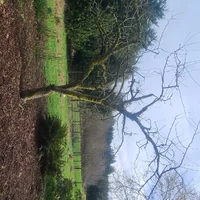
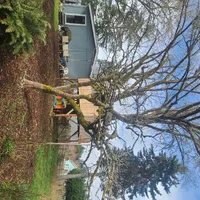
Fruit tree holding on by a thread, client wants to get another year out of it. Thoughts?

@evo That’s awesome. Quite the ingenuity!

I already quoted the project but honestly pouring concrete never occurred to me.

But I guess maybe for a smaller tree like mine and only one or two smaller limbs it might not be as big of a deal if it’s not anchored into the ground? Or maybe I could rest a board on a cinder block or paver? And perhaps I tell her we should come back the following year to re-evaluate?
 
I saw Sean mention it briefly, but I really wanna emphasize how important fruit thinning is. On a tree that has gotten so heavy with fruit that it breaks it's own branches, it will be necessary to remove most of the fruit set once it's recovered a bit; one to three years. I like to thin to no more than one fruit per cluster, sometimes removing entire clusters when it's very dense with fruit setting. Sometimes there is a good gap between clusters, so I leave two fruit on a lonely cluster. I have removed as much as 80% of the fruit set in heavy years. Every production fruit grower I know that focuses on quality does the same. I know they thin less intesively for max production per acre, but that is not the goal for most homeowners.
 
Last edited:
I saw Sean mention it briefly, but I really wanna emphasize how important fruit thinning is. On a tree that has gotten so heavy with fruit that it breaks it's own branches, it will be necessary to remove most of the fruit set once it's recovered a bit; one to three years. I like to thin to no more than one fruit per cluster, sometimes removing entire clusters when it's very dense with fruit setting. Sometimes there is a good gap between clustera, so I leave two fruit on a lonely cluster. I have removed as much as 80% of the fruit set in heavy years. Every production fruit grower I know that focuses on quality does the same. I know they thin less intesively for max production per acre, but that is not the goal for most homeowners.
This is a great thread! Matias, are you referring to thinning to favor the "king" or terminal fruiting bud? I think that's what you're talking about. This is done chemically in most orchards. I do think OP and tree owner are on the right track by preserving this tree. I think we often tend to look at trees with a "what's wrong" (decay, broken branches...) lens instead of a "what's right" (awesome fruit, part of the landscape/history) lens.
 
I saw Sean mention it briefly, but I really wanna emphasize how important fruit thinning is. On a tree that has gotten so heavy with fruit that it breaks it's own branches, it will be necessary to remove most of the fruit set once it's recovered a bit; one to three years. I like to thin to no more than one fruit per cluster, sometimes removing entire clusters when it's very dense with fruit setting. Sometimes there is a good gap between clustera, so I leave two fruit on a lonely cluster. I have removed as much as 80% of the fruit set in heavy years. Every production fruit grower I know that focuses on quality does the same. I know they thin less intesively for max production per acre, but that is not the goal for most homeowners.

I would consider myself to still be in the learning phase of this, but more or less my line of thinking and approach by “thinning” those end clusters would be removing verticals, branches growing inwards or sharply downwards, crossing or rubbing branches, etc. Not removing all, but just creating a little more air flow and space. Preserving branches that are more horizontal or at a bit of on angle, but not vertical. Which to my understanding, is what you’re generally looking for when pruning fruit trees. Granted every tree structure is different. And that would also take some weight off.

And in that video, that’s essentially what they’re doing with those trees, which appear to have a similar structure.
 
I am not talking about cutting stems at all, but rather waiting for the fruit to start swelling a bit after fruit set, and then removing the smaller fruit as well as any bug damaged fruit; literally thinning the fruit. If you have never seen it done, you will almost certainly be inclined to leave more on the tree than you should if you are chasing fruit quality. As far as the king bud goes, I don't remember that term, but I was simply taught to look first for the largest, and then for the best positioned of the fruits, imagining them swelling up to full size, and ensuring that they won't physically press on each other.

I seem to recall both stonefruit -peaches, plums, etc.- and pommes -apples and pears- making clusters of fruit that seem to emerge from virtually the exact same point, quite different from how drupes, and aggregate drupelets - grapes and berries- which clearly have a larger terminal fruit, and a linear-ish arrangement.
 
@evo That’s awesome. Quite the ingenuity!

I already quoted the project but honestly pouring concrete never occurred to me.

But I guess maybe for a smaller tree like mine and only one or two smaller limbs it might not be as big of a deal if it’s not anchored into the ground? Or maybe I could rest a board on a cinder block or paver? And perhaps I tell her we should come back the following year to re-evaluate?
Maybe verbally call it a temporary prop. IMO a prop should be a near permanent installation
 
I saw Sean mention it briefly, but I really wanna emphasize how important fruit thinning is. On a tree that has gotten so heavy with fruit that it breaks it's own branches, it will be necessary to remove most of the fruit set once it's recovered a bit; one to three years. I like to thin to no more than one fruit per cluster, sometimes removing entire clusters when it's very dense with fruit setting. Sometimes there is a good gap between clustera, so I leave two fruit on a lonely cluster. I have removed as much as 80% of the fruit set in heavy years. Every production fruit grower I know that focuses on quality does the same. I know they thin less intesively for max production per acre, but that is not the goal for most homeowners.
I never go methodical, but I have heard:
1-2 fruit per cluster, a max of 1-2 per 6”, or a min 6 leaves upstream per fruit
 
And sometimes, you just remove all the fruit from the end of the branch, when you don't want to deform it from being bent over hard the whole season; mostly a skinny branch issue.
 
Last edited:
  • Like
Reactions: ATH
And sometimes, you just remove all the fruit from the end of the branch, when you don't want to deform it from being bent over hars the whole season; mostly a skinny branch issue.
That’s the hardest to get across. Ever tell a client that they should pick all the flowers off their newly planted tree for the next year or two?
 
Maybe verbally call it a temporary prop. IMO a prop should be a near permanent installation
A secure footing is key. Maybe not so much permanent but heavy. Probably wouldn’t take more than a five gallon bucket of concrete for this apple.
My father in law had a boxelder that had a prop, cradle style not thru bolt, that fell out in some wind events. He poured a footing and cemented it in.
 
Fenced vs. Above deer height pruning
 

Attachments

  • 20260316_120053.webp
    20260316_120053.webp
    582.9 KB · Views: 3
  • 20260316_120105.webp
    20260316_120105.webp
    631.9 KB · Views: 2
  • 20260316_120032.webp
    20260316_120032.webp
    389.9 KB · Views: 2
  • 20260316_120042.webp
    20260316_120042.webp
    538 KB · Views: 2
That’s the hardest to get across. Ever tell a client that they should pick all the flowers off their newly planted tree for the next year or two?
Even my wife was hard to convince. She's still on the fence about it. We just planted some more and she saw the flowers and got excited that we might get fruit the first year. I assured her they would not make fruit this year if I have a say in it, and she rolled her eyes and said "oh....yea."
 
Even my wife was hard to convince. She's still on the fence about it. We just planted some more and she saw the flowers and got excited that we might get fruit the first year. I assured her they would not make fruit this year if I have a say in it, and she rolled her eyes and said "oh....yea."
Tell her you'll make some calls and try find someone who knows something about trees...a common phrase in our household LOL.
 
For a light weight prop, I've drilled about 8-10" in and put a 3' piece of rebar into the end of the prop board, then the rest driven in the ground. Not saying that's always a good answer, but worked well when I used it. (As far as I know.... I'll revisit a tree we did last spring. Just had 50MPH winds and 70 MPH gusts last week. Haven't heard otherwise so I assume it's still up.
 

New threads New posts

Back
Top Bottom