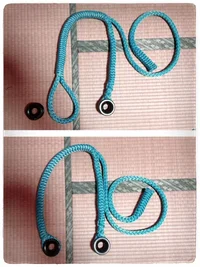
X-rigging rings

[ QUOTE ]
.

So, what were you thinking since you see so many warnings and instruction? What were your original thoughts?

[/ QUOTE ]

I know my sailing and engineering...dangers are everywhere and things are made with great skill.

I first spotted these rings in 2011, and wanted to use them for easy setups.

I just cannot see one failing on everyday jobs, although I bet you have tested to breaking, as is everything in this world.

I have complete faith in them. :)
 
Bix, you got it … pucker up for the Beast!


This video shows a total re-work of the XRR Rigging Whoopie using the Beast. It is cheaper, stronger, lighter, faster … and leaps tall trees in a single bound.


<u>XRR Beast Rigging Whoopie</u>


The vid is long (14 min) but, even if you have no interest in the Whoopie, there are a few new X Ring ideas that might grab you.

I’m putting this out in the spirit of a “work in process”, looking for suggestions before I do the “construction details” video. I’ve done light rigging on it with a ½” stable braid and it works great. But I see a problem coming with heavier rigging: the girth hitches are jamming into the grooves of the XRRs at the cordage gets thinner and tighter with work. On the “locking” prussik, this is actually desirable because that ring never needs to come off the loop. On the “rigging” prussik, the girth hitch has jammed so tight I needed a marlin spike to get it off. On what you guys would call “heavy” rigging, I’m guessing it will set that girth hitch really hard.
Any suggestions? Worst case, I could always buy another Beast (stop smiling, X) and leave it permanently on the “rigging” prussik, I suppose.
 
@oldfart (tom - i prefer :))

At the end of the video, showing the bungee and twist tie for recovery/non-recovery - you could do this...thus allowing the bungee method to be recovered.

A double wrap with a standard slice of bicycle inner tube is 6lbs of pressure for it to release, 3 wraps is over 16lbs.
1.jpg
 
Guys, thanks for the kind comments and the enthusiasm for the <u>Beast Whoopie</u> .


As I use it, I’m seeing I have some details to work out before the “construction” video:

1) I had hoped that the X-Ring “lips” would make the girth hitches secure. When God want to punish you, he sends you what you ask for! With use, I’m finding that the girth hitches are more like permanent than secure. Repeated impact pinches the cordage between the lips. This doesn’t change the concept but it means that you’ll need another Beast instead of doing that transfer trick. I’m open to ideas on this.

2) As the cordage goes from “new rope” to “old rope”, the locking prussik gets too long. I’ll handle this with a length recommendation in the next video. This will just mean you build to a shorter new length and then “set” the prussik with some big pulls before you put it in service.


Thanks again. Watch for the next “construction” video.


<u>Additional comments on using the Beast</u>


As is, the Tenex-tec gives me everything I, personally, want in a rigging whoopie (except of course the picking issue). After all, in the basket configuration, this whoopie will break a double-ended pull from ¾” Stablebraid(!). Plenty strong for me!

However, when I was noodling through the design, I realized that that the Beast (two of them together in a basket) was way stronger than the cordage. In fact, they’re way stronger than anything in the market. The really big blocks are truly impressive in their design and capacity. But they all share one simple thing in common: you can only use one (1) at a time. With the Beast, you can, and must, use two (2).


So consider these numbers:


“Big As* Block”
Tensile=68,000 Weight=7.7 lbs Cost=$400

Two (2) “Beasts”
Tensile=44,000 x 2 Weight=0.75 lbs x 2 Cost=$46 x 2


Wow. If you start thinking about this, you go immediately to high-modulus cordage. All in, it could make an incredibly light, strong package for really “big as* rigging”. From a cost point of view, you’d have money to pour into high-tech cordage, for sure.

Gentlemen, this is where I leave this part of the discussion. You couldn’t find anyone less qualified to talk about rigging at these levels. I just don’t have the human capacity! This is for the young guys to discuss and experiment. But here is something directly from X: don’t use Dyneema! In professional use, the X-rings get hot. Dyneema does some things incredibly well, but temperature isn’t one of them! You need something with strength and heat, maybe like Tech 12.

Just Sayin’ …


Thanks for the rings, David.

OF

 
I dont usually go for hollow braid with my top anchor sling but it struck me that the very useful db eye and x-ring combo would be furthered with a whoopie. This has been designed with a 1/2" lowering line in mind so max SWL of 500kg.
 

Attachments

  • 368668-photo1.webp
    368668-photo1.webp
    179.9 KB · Views: 111
Thanks for posting this idea, SoftBankHawks.

This is a nice simplification if the application is well-served at the shortest native length of the whoopie.

In that circumstance, you’ve created two (2) more options for the Beast Whoopie:

1) By inserting the 38/28 (without using the locking prussik), you’ve got two rings that can handle ¾” SB with eyes in a basket configuration. Previously, that was only available single-ended.

2) By inserting the 28/20, you’ve got a simpler rR saver, albeit with a slightly smaller bend radius.


Good stuff. Thanks again.


OF
 
I love the new ideas coming out about using XRR’s in the whoopie sling configuration as I want that choice for a terminal rigging point sling. One thing keeps haunting my mind though. Are two rings providing enough bend radius? Or, is the bend radius on two rings the same as one ring? David made an excellent colored drawing earlier in this thread to illustrate the point, one ring/two rings vs three rings. (Page 11of the thread)

TreeCo posted (countered?) that Physics says that two rings are not the same as one. I’m not sure, David’s drawings made more sense to me - and it would, if wrong, err on the side of caution.
 
Would you use a single ring as a climbing anchor? Are you happy with a ring+ring friction saver? Why do climbers choose pulleys over rings. These ideas are pretty solid, ground into the firmament.
Something I'm yet to explore is 800kg+ rigging with the rings, but I wonder if I ever will, I have blocks for this! For me the rings function differently....they work wonders around my impact block and they rule for vsl works.
 
What a great question: rings vs. block.

Absolutely, the arbblock has a long, historical tradition behind it. But the tradition was built during a time when there was no ring available in appropriate scale. By far, the arbblock was the best thing for the task.

But that’s going to change. The numbers are just too compelling.

I’ll make two (2) ballzy predictions and then try to back them up:

1) In ten years, the Beast Whoopie will be a forgotten remnant in the dustbin of history. It is a first-pass design around brand new hardware. Over time good climbers will bring better ideas and this embodiment will become barely recognizable.

2) But, in ten years, when two climbers get together, the most common question you will hear is: "Why are you still carrying that old block around?”


<u>FACTORS FAVORING PULLEY</u>

Lower Friction

Rings will never replace blocks for generalized rigging. Ever. Low friction is important, especially in lifting and MA systems. But for tree work, it’s not much advantage. In fact, we buy specialty equipment to make more of it.


<u>FACTORS FAVORING RIGGING RINGS</u>

Strength

Huge strength-to-weight, plus a failure mode that deforms slowly and still contains the running rope.

Double Cordage Strength

You can only use one (1) block at a time. Using two (2) rings together can deploy cordage in a basket, doubling the delivered strength for any given piece.

Weight

The lighter weight is almost shocking, considering both the device and the more efficient cordage.

Safer Rope Handling

If the rigging lead becomes unexpectedly “unfair”, the rings present an intrinsically safer bearing surface than a block.

Cost

Can you say cheap? Really, really cheap?


OK, so how will this marvelous future unfold? One climber at a time:

“Hey, lemme see that thing.”
”Wow! It’s light.”
“Did you say HALF the cost? Are you kidding?”


OF
 
Hoffman, I always look forward to your posts. I can easily see a handful of these XRR in every bucket truck as well... At least in the future. Cool! What a great time to be in this line of work.
 
Those thoughts came to mind too, when I first spotted them, always got shot down in flames because they were from the marine industry.

I ignored them, and still kept the faith.

I am going to test one 20x28 (yes thats 1 ring!)spliced to 6mm vectran in a light rigging setup to test its capabilities.
 
[ QUOTE ]
Brilliant, you old fart !!!! Absolutely brilliant.

--------------------
X
aka J. David Driver


[/ QUOTE ]


X, you don't fool me ... You like the <u>Beast Whoopie</u> cuz it sucks up four rings!


About the girth hitches jamming too tight:
When forming the prussik loops, pull the tails out about 2" above the X rings, leaving a segment opposite the cross-over as unstuffed cordage. Perfect. The hitches are held snugly by the ring lips, but don't jam. Problem solved.

Also, don't be too eager to bury the two tails. As long as you keep them out, you can move the prussik back and forth between your bench and the Whoopie, fine tuning the length to be just right, especially for the locking prussik. When you're happy, lock stitch and finish the buries.


OF
 
Cheap is relative. Cheap generally means disposable and in the long term is costly. I hate that word and has been the most destructive thought to the planet. Its a vain pursuit.
What is important is rings are used as intended,
Not as a replacement for frictionless/near frictionless rigging but where space is minimal and the compactness and lightness promotes safety.
Their 1st time use, paid back in full
smile.gif
Cheers
 
I have really been falling in love with the rings but the block isn't going anywhere I think. I like how with the block, the rope just comes back to me. With the rings I have to pull it back. Because of this a block can make a simple removal move faster. There are so many applications for the rings though. As for three rings vs two, I think I'm going to side with tree co on the physics. I don't know, I just can't see two rings being the same as one. No math or tests to back that up.
 

New threads New posts

Kask Stihl NORTHEASTERN Arborists Wesspur TreeStuff.com Teufelberger Westminster X-Rigging Teufelberger
Back
Top Bottom