southsoundtree
Been here much more than a while
- Location
- Olympia, WA
INTERESTING

Follow along with the video below to see how to install our site as a web app on your home screen.
Note: This feature may not be available in some browsers.

Yes! The quest continues, thx GordonINTERESTING


YesssssssI was thinking something like this ontop the hitchhiker2 would be the ticket.
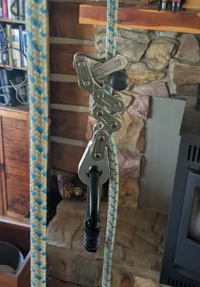
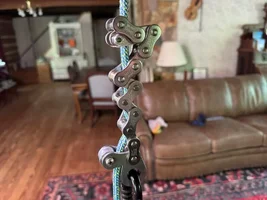
Looks like a winner!These size 60 ss links lend themselves to the 10mm beeline. The top rope wrench style link is 30 thousands narrower gap the the lower links, which causes it to engage well.View attachment 101412
how does it perform on 11.7mm (yale blue moon for ex)? does it srt and ddrt?These size 60 ss links lend themselves to the 10mm beeline. The top rope wrench style link is 30 thousands narrower gap than than the lower links, which causes it to engage well.View attachment 101412
It's designed for SRT 10mm lanyard and/or Captain Hook line as I understand it. Bulldog Bone is the bee's knees for Yale 11.7mm double-braids.how does it perform on 11.7mm (yale blue moon for ex)? does it srt and ddrt?
Thx for the clarifications. Beeline is tough but it is a relatively soft cordage. It needs to be soft enough (small bend radius) to function well as a hitch cord, not surprised it is flattening under load through the Lynx.11.7 is too fat for the lynx, however I did make a device 10+ years ago using the next size larger link, which was essentially a ZZ with a proprietary adjustable headstock which did SRT/MRT on Tachyon.
The beeline is a very tough rope, which holds its shape well. My short piece has been tested on to the point where it has flattened in some spots and so will sometimes slip SRT with my weight.
The Diggity OAR will do what you ask, and has the benefit of having the top tending teardrop, which self tends it along well in MRT (or SRT)
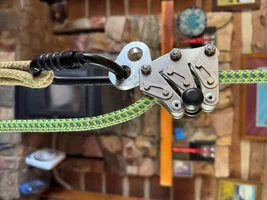 when I was searching for the 9mm. You can feather the release MRT if you hold down the bottom two arms and then feather the top arm. In SRT, if you hold down the bottom arm, then you can feather the release by pulling down the middle arm, while letting the top arm take the majority of the climbers weight.
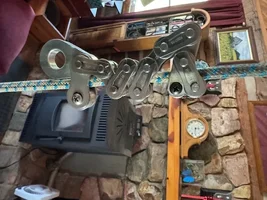 improves tending and keeps rope on the correct enter/exit path through the device.
While I don't doubt you at all Gordo, there is something about the link angles there that makes me feel so uneasy. How long is that fully extended on the skinny rope?By adding 1 link, the Lynx is now able to be used on this 8mm or 9mm View attachment 101718line.
That's not as long as I was imagining. I would really love to try that setup.In the picture, I have pulled down hard of the Lynx so it takes a sort of "set". When fully loaded the upper arm extends upwards and grips also on the rope, so fully loaded it binds on the rope a bit more at all 9 friction points. It ends up being a hands breadth long from the carabiner to the top extended arm. There are both a (solid) inner and outer bollard on the top link, then the first bollard down is also solid, while the bottom 3 bollards are nickel plated bollards which have a larger inner dia. which are pushed aside when weighted and form a sort of locked in place bollard which work in junction with the pins in the links. On a double 8mm rope, it releases much like a ZZ, and on a single line you have to modulate the top arm to release smoothly (with my weight) but it works surprisingly well. The bottom tending bollard also adds a bit of grip, by holding the rope against the bottom link pin. I will do a pull test at some point to see how much it will hold SRT on the 8mm.
would it be possible to make a an exact version for standard 11.7mm 24 strand climbline to be used ddrt and srt? This looks like it will perform very reliably sap or not.By adding 1 link, the Lynx is now able to be used on this 8mm or 9mm View attachment 101718line.