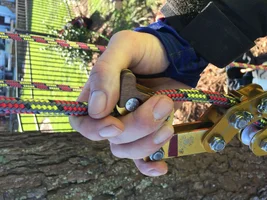
rope runner

I would say technique more than anything. Don't think of the beak as your only mode of control. Use the whole bird, thinking of pushing that lever down. Don't let the top slic pin get to far from the rope. Think stick shift, clutch. Break the bird just slightly and then accelerating by pushing down on the back of the bird. Jumpy is caused by jumping that front pin off the rope and you go fast so you let go.

Finally a got a good work climb in on the RR, super awesome, love the crazy good tending, I have to break the habit I didn't realize I had of flicking "the hitch" up anytime I stop ascending, obviously does not need that motion. Still need to improve on the one-handed control but I'm getting a better feel for it, love it.
-AJ
 
Finally a got a good work climb in on the RR, super awesome, love the crazy good tending, I have to break the habit I didn't realize I had of flicking "the hitch" up anytime I stop ascending, obviously does not need that motion. Still need to improve on the one-handed control but I'm getting a better feel for it, love it.
-AJ

Hey, Moss, thanks for re-posting Kevin's commentary on the best way to use the Rope Runner. I still do not own one yet, nor have I had the opportunity to try one out. So the thing I'm having a little trouble understanding is how pulling down on the back of the "bird" will help to release tension on the rope. I see how pulling down on the front of the "bird" would cause the gap between the slic pin and the bollard to open wider and release tension on the rope, but it seems like pulling on the back of the "bird" would do just the opposite. It almost looks like you'd have to push up on the back side of the "bird" in order to assist in releasing tension.

Can you straighten me out on this? Just trying to understand. I realize it might all be really obvious once I get a Rope Runner into my hands, but right now that's not in the cards.

Tim
 
You have to do both. When you push on the back of the bird you release the lever or the second friction point from the rope. The only friction point you don't have control over is the pulley
 
How are you guys gripping the Runner and working the bird; more like A or B?

A

fba54353625ed49e7bc476c6a10dd928.jpg


B

7ef646b6b3aa5b8413bf853f0306d7e2.jpg
 
How are you guys gripping the Runner and working the bird; more like A or B?

A

fba54353625ed49e7bc476c6a10dd928.jpg


B

7ef646b6b3aa5b8413bf853f0306d7e2.jpg

A, generally. B, if say you are in an awkward position with the runner wedged in the side of the branch where you can't get your whole hand on it. Walnuts cushions make option B work nicely in that scenario. But A is best for me
 
How are you guys gripping the Runner and working the bird; more like A or B?

A

fba54353625ed49e7bc476c6a10dd928.jpg


B

7ef646b6b3aa5b8413bf853f0306d7e2.jpg

Thanks for posting these great photographs and for asking the question, Teubor. Well lit, close up, really great. This might be the first time I've seen hand position on the Rope Runner shown like this, with the alternatives demonstrated. Thanks for going to the trouble.

Tim
 

New threads New posts

Back
Top Bottom