rope runner

....explain further the rational behind this approach to choosing the Runner or the Bone....

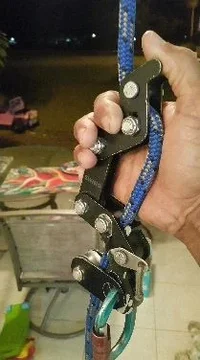
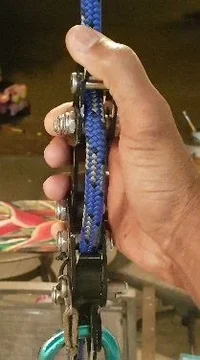
Tim, the two tools have distinct differences, in fact about the only thing they have in common is they are both fully mechanical. Either one will do a good job but the differences, for people that have both, can lead to trim vs removal preference.
The Bone can be removed from the rope with no finesse or worry of dropping it or a part. It self-tends slack easily when going straight up and down the rope. All these things make it particularly well-suited to the heavy and messy, and mostly, up and down removal jobs.
The Runner, with its bottom pulley, will tend slack effortlessly regardless of the work angle. This is huge in the convoluted and awkward angles often encountered on trim jobs. There are many "finesse" movements in trimming and this blends in well with the Runner's personality.
 
I rarely set a CA from the ground and when I do for a removal I don't bother with a pull down leg. I either spike up and tie off along the way with a choked steel biner or I through a line and remote or local based tie as I work my way up.

Reed Wortley
CTSP #01739
ISA CA #SO-6953A
I meant using throwline on each end of a short 75' line to completely eliminate the use of a pull down tail on canopy anchors. You would tie your running bowline around the throwline connected to the tail and then send it up for the canopy anchor.

Cause if you are base tying, I don't see how you are utilizing shorter lengths of rope unless your are hitting targets with your throwline, in say conifers or bushy trees, that are 2/3 of the way up, or something like that. Then working your way up to set the canopy anchor later.

I say this because I just knicked a 200ft line almost dead middle! So I am thinking of ways to utilize the hanks for removals (which I do mostly)
 
I meant using throwline on each end of a short 75' line to completely eliminate the use of a pull down tail on canopy anchors. You would tie your running bowline around the throwline connected to the tail and then send it up for the canopy anchor.

Cause if you are base tying, I don't see how you are utilizing shorter lengths of rope unless your are hitting targets with your throwline, in say conifers or bushy trees, that are 2/3 of the way up, or something like that. Then working your way up to set the canopy anchor later.

I say this because I just knicked a 200ft line almost dead middle! So I am thinking of ways to utilize the hanks for removals (which I do mostly)
Like I said, I normally don't set Canopy anchors from the ground, however, if I do I don't bother with a pull down leg because I'm heading up there any way. I typically choke a steel biner in the spliced eye. If I set an access line in a removal I use a base tie, ascend to the tip, tie in with a shorter rope (more manageable length tail), and have the ascent line pulled out and put away. I don't know if I'm answering your question Mike, because I don't really know what you're asking. I like short hanks, simple as that, 105' white pine removal = 95' hank of Cougar and the bone.

Reed Wortley
CTSP #01739
ISA CA #SO-6953A
 
Last edited:
Like I said, I normally don't set Canopy anchors from the ground, however, if I do I don't bother with a pull down leg because I'm heading up there any way. I typically choke a steel biner in the spliced eye. I find set an access line in a removal I use a base tie, ascend to the tip, tie in with a shorter rope (more manageable length tail), and have the ascent line pull out and put away. I don't know if I'm answering your question Mike, because I don't really know what you're asking. I like short hanks, simple as that, 105' white pine removal = 95' hank of Cougar and the bone.

Reed Wortley
CTSP #01739
ISA CA #SO-6953A
Haha, I am just thinking aloud Reed, don't mind me. I get what your saying, totally. And I don't set canopy anchors often either. You are base tying on one rope and bringing up a shorter length to bang out the removal on, totally get that.

In my mind I am trying to eliminate the need for the ascent line and do it all with the short length of rope without sacrificing a lower tie in off the bat. I think I got it figured out anyhow, sometimes it just helps to think aloud. Sorry for derail : )
 

New threads New posts

Back
Top Bottom