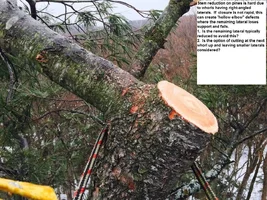
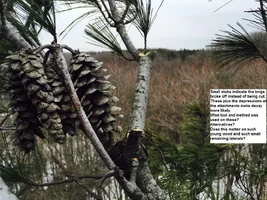
Reducing trees is unnatural?

5e80b25501dcc5715d4de4a92206efb5.jpg

Making good, non invasive progress on two codoms.


Sent from my iPhone using Tapatalk

 
Today's white pine
Removal requested
Previously reduced
Reduce again with more heavy application
Tree will continue to throw seed in a population low in white pine but good propagation and forest setting for success.
c62c399c52a7437ddba33ca1818b56a6.jpg

Before pic


Sent from my iPhone using Tapatalk
 
after heavy reduction
95f26d4a651562a57a152d1257116fb5.jpg

20 feet up
926417beadab7501dbd030f765409da5.jpg

Small old woodpecker holes, contained

Next pic
On the right at 25':
Section of old woodpecker holes, plus one fresh hole, not quite contained - creating a long, vertical exposure
On the left at 30':
large, deep woodpecker hole, creating a short vertical exposure.
10f311289d4ae6ba092b39f6c23c83d2.jpg

Luckily these two sections are isolated from each other, just barely, by the short distance between.


Sent from my iPhone using Tapatalk
 
Looks like after didn't work
Here it is again after before
c15cc1c2a6a665c074f7548289bd8528.jpg
0de5f834167430ab6968e087017645f1.jpg

Heavy application, assess every two years, homeowner will watch woodpecker progress.


Sent from my iPhone using Tapatalk
 
Natural vs thorough, a white pine perspective
Tree was thought to be a removal.
It can't stay the way it is, but semi invasive reduction is an option. For debate I started with a light reduction app, then cut more.
9fa2ee2e85f60cb5765d354babc3f6f0.jpg

This is the light, natural app. 4' reduction.
53547b4f7e5b4ce86f63b2e2266055b6.jpg

This is a light thorough app. 6' reduction off 80 foot tree. Not looking for significant height reduction. Just looking for sail reduction as well as inhibit growth. An attempt to strengthen newly exposed leaders in a high exposure setting. This would be appropriate if the woodpecker holes weren't as bad or as low on the stem.
1c6c1869be26781f7b26cebb6fcd7a57.jpg

This shows a slightly heavier application. I could also have finished with cut below the flipline. But I went even lower


Sent from my iPhone using Tapatalk
 
Final main cut around 6"
c1f1b26f288bd1094b433875d4f8b39e.jpg

Tools used including 2 sections of hyauchi saw and 36v chainsaw.
b4f5081c509d41156c6ff5766a6a951f.jpg


5e7ec4a6dcddd36b8ffc7595a0f8d81f.jpg

In a highly exposed area like this, this reduction of 10-12 feet substantially reduces the forces of leverage. Wind at the canopy top is higher velocity.
Tree is now good for a few a few more pecker holes. Good thing those birds work vertically. Only fear is a torsional twist. Remaining limbs were also tipped back which will help that. Also it will strengthen the remaining limbs, which are now more exposed.
Unable to execute without polesaw or pruner.


Sent from my iPhone using Tapatalk
 
Today's white pine
Removal requested
Previously reduced

To summarize:
1. Client wants tree gone
2. You convince client to retain tree

If I went to a doctor because something was eating holes in my foot, and the surgeon I was referred to decided to only amputate three toes, and have me come back every 6 months for a follow up evaluation, to mebbe lop off another toe, I dunno how good that would work out.
 
Last edited:
There seems to be no consideration for what the (Pileated) woodpecker created holes mean. Are these holes not indications that carpenter ants are present and the ants are excavating areas decayed by a cubical brown rot?
 
The pruning = amputation analogy would work, if trees could not grow.
But they can and do.

The bird -> ant -> brown rot -> remove theory might hold water, if those parts were connected. Even then, why not prune a tree with brown rot? CODIT happens; read Shigo!
 
The pruning = amputation analogy would work, if trees could not grow.
But they can and do.

The bird -> ant -> brown rot -> remove theory might hold water, if those parts were connected. Even then, why not prune a tree with brown rot? CODIT happens; read Shigo!
Which book, Guy?

Thanks!
 
Shigo talks about CODIT in a lot of books, and free articles.

Tree risk entrepreneurs can't omit that treehuggerish science stuff. Ants and brown rot are not making the world unsafe. Trees are good. Trees need care. Arborists care for trees.
 
Last edited:
Let's try again................
If I request estimates for a new roof, cause the shingles (or cedar shakes with lovely green moss growing on them) are old, cupping badly, and there is the odd pesky leak or three whenever it rains...........
And two reputable roofing contractors provide detailed and reasonable quotations for what I requested.........Estimate A and Estimate B

And a third guy comes along; a Certified Roofer and a member of Shinglers Unlimited, National Roofing Contractors Association, etc, (plus he seems sincere and is very earnest).......says I don't need to replace that roof. No sirree. He recomends replacing the worst shingles, fixing the leaks, and coming back every two years to inspect it, repair as necessary, and fix any new leaks.

What irrational arboricultural world are we living in that anyone should take that guy seriously?
Is it simply because trees are "alive" that we gotta prolong the lifespan of every one of them?
 
Trying again with a brick wall:

No one said "every tree". Certifications matter much less than service.

Roofs are not living, growing, adapting organisms. They are made of dead material.

Roofs do not increase in size and value as time goes by. trees can and do.

If all you do is kill trees, it's no wonder you think of them as dead. But they are living--look and you will see that. Whether or not you want to believe that is up to you.
 
But they are living--look and you will see that.

I thought he was talking about trees that are dying... not the living ones with minor injuries, that will snap out of it with a little CPR, Flintstones vitamins and a bandaid. I don't want to go all Zen about it, but I think the dying ones are required for the living ones to exist, in the grand scheme of things. This would all be so much easier if the damn things would carry around a Limb Donor card, with the little box checked for "Do Not Resuscitate" in the event they sustain terminal damage or disease. In the meantime, it would seem prudent not to gamble with the client's property/life in those cases when neither they, nor myself, feels safe just standing next to the tree. But, maybe that's just me.

I like to save them when it looks promising, but around here, it's pretty hard to sell a long term plan to save a tree that the property owner doesn't want to save. I find it easier to sell them on a removal and replacement with something that's less likely to end up being a hazard. I even go shopping for the right tree(s) for them, compare prices and quality and make a few recommendations about which one(s) I think they would be happiest with. I usually charge them $25 for the service, to cover my gas. Usually, I end up getting the tree(s) and planting them, so I make a little money on the removal and the replacement. And, I sleep better at night.
 
Guy, Not one of us knows what the world in general, or that grim pine tree in particular, is gonna look like in 5 or ten years. And that should matter, because there really is no guarantee of any perpetual continuum of care.
To me, it seems almost a shirking of responsibility; a cop out!; a denial of reality, to periodically allow an arborist, er, dentist to install larger and larger fillings in a decayed tooth instead of getting that bugger yanked out once and for all. Dentists are all for preserving teeth, too, at any cost! They want you to keep your pearly whites untill they can finally drill out and install a new filling no longer, and then they will try to sell you implants, and make a fortune off you.
Such is the sad state of Arboriculture these days.
 
From toes to roofs to teeth...let's go back to toes: "If I went to a doctor because something was eating holes in my foot, and the surgeon I was referred to decided to only amputate three toes, and have me come back every 6 months for a follow up evaluation, to mebbe lop off another toe, I dunno how good that would work out."

What if the doctor treats that 'something' so it eats no more flesh? Medicine. CODIT.
That takes away the 'perpetuity' myth. I looked at this tree last week:

http://www.treeoftheyear.org/Letosni-rocnik/Dub-na-fotbalovem-hristi.aspx

Eyewitness accounts say it has not been pruned since 1955 ( I was in kindygarten--where were you?).
CODIT happens; so does long-term retrenchment.
Gilman in Zone 9 and CYAing tends to exaggerate future needs without data.
Also Gainesville does not apply to Toronto!

Jeff I like your planning and planting, but I seldom get assigned to play God and make "Terminal" decisions that push pest pressure elsewhere. Owner's call, ain't it?
 
Last edited:

New threads New posts

Back
Top Bottom