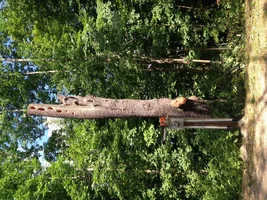
Reducing trees is unnatural?

To summarize:
1. Client wants tree gone
2. You convince client to retain tree

If I went to a doctor because something was eating holes in my foot, and the surgeon I was referred to decided to only amputate three toes, and have me come back every 6 months for a follow up evaluation, to mebbe lop off another toe, I dunno how good that would work out.
I agree, that's just the beginning of the woodpecker holes, they are not going to stop it will progress rapidly into more, trees on its way out and they are looking to eat the bugs and other pests lurking inside! Dave and I deal with white pines a lot up in our neck of the woods. I wouldn't let a tree like that remain in one of my customers properties. ( no offence to you) ticking time bomb right there.
 
What if the doctor treats that 'something' so it eats no more flesh? Medicine. CODIT.
That takes away the 'perpetuity' myth. I looked at this tree last week:

http://www.treeoftheyear.org/Letosni-rocnik/Dub-na-fotbalovem-hristi.aspx

Eyewitness accounts say it has not been pruned since 1955 ( I was in kindygarten--where were you?).
CODIT happens; so does long-term retrenchment.


I doubt that shooting the bird to prevent further excavations is the appropriate medicine. I also dunno if CODIT is effective on determined Pileated Woodpeckers either.
In 1955 my future existence was perhaps longed for, but not realized until '61
I didn't quite see the relevance of your cited oak to this decrepit pine tree? Did the oak sucessfully resist woodpeckers as well as tractors?
 
My point was that the tree cutter that "reduced" this tree seems to have jumped to reduction without investigating the extent of the decay and excavations that lay within the tree. Any arborist knows that Pileated Woodpecker feeding holes are an indication of carpenter ants and carpenter ants are an indication of decay.

Whether this tree can be retained or not requires investigation, preferably using something more in depth than a two second eyeball. At the least probing but preferably micro-resistance drilling and tomography. Viewing a couple photos gives us some info but not enough to make an informed decision.
 
Safe or not and without personal observation...
White pines saving grace is to shed small parts rather than whole tree failure even when considerably compromised.
Twigs, limbs, branches fail 1st..
Prune to mimic ice storm damage by hooking and snapping tips of limbs is natural.
Personally reducing the top to below the tree line or to 40 ft mark would make tree a low (r) hazard. Cycles to failure considered and greatest forces at greater heights
 
My point was that the tree cutter that "reduced" this tree seems to have jumped to reduction without investigating the extent of the decay and excavations that lay within the tree. Any arborist knows that Pileated Woodpecker feeding holes are an indication of carpenter ants and carpenter ants are an indication of decay.

Whether this tree can be retained or not requires investigation, preferably using something more in depth than a two second eyeball. At the least probing but preferably micro-resistance drilling and tomography. Viewing a couple photos gives us some info but not enough to make an informed decision.

Totally agree re an Inspection before work can be specified, to document response. I think Ryan did this already.
but if rot is the big concern, why prefer the most damaging method?
how is the drill the first tool out of the bag? Try a trowel first.
Plus, birds peck for a lot of reasons, and carpenter ants can be obliterated, and brown rot compartmentalized, or at least slowed down..

Rope's right.
 

Attachments

Last edited:
Safe or not and without personal observation...
White pines saving grace is to shed small parts rather than whole tree failure even when considerably compromised.
Twigs, limbs, branches fail 1st..
Prune to mimic ice storm damage by hooking and snapping tips of limbs is natural.
Personally reducing the top to below the tree line or to 40 ft mark would make tree a low (r) hazard. Cycles to failure considered and greatest forces at greater heights

The thing about white pines saving grace is it's a good lucky system for us, except for when it doesn't.
I've seen lots die from the top and the tips back in. However, I've also pulled tops off sheds and out of yards that have been alive but failed at woodpecker damage, co-doms tear out....
I know trees are resilient but you should never, blindly, trust deadwood, as well (and I know this will cause a ruckus) damaged, decayed, splits, etc. We all know that these are abnormalities that need attention paid to them.

Not saying everything found is a problem and not saying everything is ok. Just saying work through things logically sometimes multiple reductions over time is best, sometimes removal is the option, thinning, cabling, bracing are all tools to know and think through there isn't just one answer. Target is a big variable.
 
anyone that thinks that damage can be compartmentalized in the long term has a viewpoint that is different than mine... and of course I like my own view point. I often think that intelligence can be judged by how much other people agree with my viewpoint. (don't we all?)

On the other hand that tree has been reduced significantly at the tips, greatly reducing forces on the decaying trunk. I give th job a thumbs up, barring big wind and high value risks... so you have bought the tree a few more years. GREAT!. after that I'd take it down before another prune...
 
anyone that thinks that damage can be compartmentalized in the long term has a viewpoint that is different than mine... and of course I like my own view point. I often think that intelligence can be judged by how much other people agree with my viewpoint. (don't we all?)

On the other hand that tree has been reduced significantly at the tips, greatly reducing forces on the decaying trunk. I give th job a thumbs up, barring big wind and high value risks... so you have bought the tree a few more years. GREAT!. after that I'd take it down before another prune...
Helping a tree hang in there just a while longer is sometimes all that can be done.

As for, anyone that thinks that damage can be compartmentalized in the long term has a viewpoint that is different than mine...

I very much agree and disagree at the same time. I think it depends on the species how it holds up to the damage and what the damage is. I think a poplar with a wood pecker hole through 2/3 of the trunk diameter at the base of the crown would be worse than a sugar maple with a cavity from an old branch wound 3/4 the way up a less important codom.

So blanket statements as for tree condition and treatments are for gardeners and landscapers not arborists, imo, there is too many variables, is it a cavity on a declining elm, is it a tear on a willow on the edge of a pond.... what will be ok what won't be ok variables variable variables.

Don't you wisely agree with my point of view?
 
The biggest variable to consider is the tree's response, which can blow away all our guesses about 'buying time'.

I think Daniel was talking about the specific pine trunk in question, not saying generally that long term CODIT is not reliable--we've all seen way too many examples of just that!
 
Wow I've been out of the loop a while now. Great to see this discussion. Last time I checked in I had a few great questions from Guy July 15.
Yes that leading lateral coming from the 6-8 inch cut was reduced, and with several 1/4-1 inch cuts. And needs to be for a longer term effect and to prevent failure of the newly exposed leader. Cutting smaller and higher was considered but my best guess was go a little more retrenchment style as the structure is ok but not nearly as good as unwoodpeckered.
Yes those small cuts are dirty. Notice that anything over 1-1.5 inches is 'clean' cut. But as clean as that 7 inch cut is, it will always be much more damaging than 1/2 inch damage that mimics minor ice damage. The woodpecker inflicted the worst wound. The 'clean' 7 inch stem cut is almost as bad and the damage of snapping a few is like a mere scratch. So maybe the tool was my saw or maybe a falling top more likely, I forget. But I'm definitely not worried about those small wounds. I'm more likely to inspect the woodpecker damage and large cut. And yes by that time Daniel it might be wise to remove it.
In the mean time the tree casts its seeds over a large area. Thing of the trees I've inadvertantly planted through sparing this tree.
The challenge is to avoid a certain undefined possibility. The occurrence of failure when the strength of the tree is exceeded by the force of a storm. Undefined because we can't measure the strength of a tree and how that strength is changing through the progress of decay on the dark side and the progress of wound wood on the other. The extension added by growth is looked at as healthy but if too greedy, it assists the dark side. Also unpredictable because we do not know when or how severe the next storm will be. But it will be. The strength of the stem of the tree is hard to change. But the existing and long term extension can be incredibly manipulated to reduce forces of leverage applied during storms. Sometimes only a little is required. Sometimes removal is required but too often options and related risks are not properly presented. Just get rid of the problem and plant a new one, really? How about plant a new one, manage the old one to health or to removal at a later date once the new tree is established. Mitigation is key. Ignorance is not arboriculture, it is often business. But business can grow if you grow trees which need regular work, especially when the are in highly beneficial locations. Shading parked cars, west and south windows, a/c units, playgrounds, patios and decks. If it's a risky tree sharing s pool, cut it down. Win win. Or win win lose. I dunno. Am I detailing it must be midnight.
Hopefully the shocking retrenchment style causes growth lower down giving opportunity for further reduction of wounds progress. On the other hand perhaps the wounds will react well and decay will not progress. Then only light reduction will be required upon the next application
Now for crying out loud I'm tired of hearing how constant maintenance is a problem. It's the answer. Yes, this lone pine will require repeat visits. This is good business, good arboriculture, and good environmentalism. As a forestry practice a waste of time but as an urban forest practice, time well spent.
This cannot be compared to a roof, but good comparison I admit. A roof can be replaced, an 80 foot white pine not so much. The cost of fixing an old roof is USUALLY not as cost effective as replacement. Look at a house with life, a heritage house. They are rebuilt one board at a time, often over a long period, requiring regular maintenance.
I've got more to read and more to say. Thanks for the revival Guy.

 
Thank you mangoes, good reference. Wow as I type, a bunny literally hops across my campsite. Hoppity hop. What are the chances.? I see bunnies at home all day, not so much up here.
Lately I've mentioned I don't like the video but I do. After watching it, some things come to mind. The shear madness I like, because it's not quite shearing. What you don't see is that the lengths removed go up to 12 feet. We edited out a part that showed the range in length of cuts that are equal in diameter. The removal of slender pieces makes efficient gain, physically speaking, but well tapered pieces off the top are also often necessary. By the top I mean the top of codoms that reach the upper crown. the point is that 2" cuts are medium cuts that are 8-15 feet long. Dangly branches in the bottom of the crown may be even longer.
Nature requires slenderness for competition. In urban arboriculture, we need to transition trees over cities from slender and vulnerable to well tapered and dependable.
perhaps nature is greedy. People reflect that. How do we balance what we want and what we need? A white oak is wise, growing cautiously into the higher wind speeds. A cottonwood races for height, seemingly ignoring the norm of slowing growth with relative height.
Instead of saying small cuts I should have said medium and small cuts are made and large cuts, over 2-4 inch, are reserved for retrenchment applications. If the trees largest wound is 18 inches, it would be likely that 6 inch cuts are not only justified, they are necessary in order to prevent more 12-18 inch wounds. (Hey another one third rule maybe). Anyway, if the trees largest wound is 4", maybe the largest cut should remain below 4 inches? Or three? Or 2"? Or? This grey area can be swayed. if the tree is on a boulevard and the exposure is hot and signs of stress are present, possibly no pruning is necessary or a 1 inch limit OR maybe a maximum 2 inch limit makes sense due to a good likelihood of co Dom failure.
Is a 4" by 3' wound a 4" wound or a 3' wound.? The one on this Norway is manageable?
On shear madness and my comment about not necessarily pruning to a node: larger cuts require nodal pruning; cuts for potential leaders of main stems require nodal pruning; small cuts and inner canopy cuts are not as crucial. Sometimes 3 blind, 1"- 1.25"summer cuts, with a 12 foot pruner is better than no cut at all. Little died back stubs can fall of later. These one inch stubs are different from leaving 4 inch stubs to sprout on a retrenched or storm damaged tree.
Reduction is about inflicting minor damage efficiently, in order to avoid even worse damage in the next big storm.
More to say later about the video. My self conscious side is telling me that people are likely to misunderstand the concept When I did it I wasn't sure of the target audience. Pro or gardener or trees for dimmies. I know I need to update it though.
More later to attemp to define the grey area in between black and white. Perhaps it's full of a spectrum of colours and not grey at all.
i think I passed 100 characters but I just want to push buttons on this arboricultural game of life I'm playing. I'm trying to win the game not cause I'm greedy but cause I think I'm right.
Daniel, I hope I didn't sound offensive earlier. Of course the right thing for the woodpecker pine might be removal. But we will always need guys on both teams.
And thanks Daniel. I think it was you that mentioned to me before I did the video to put one up.
Ok I think I'm done its one
 
Good video and many good points. The thinning handsaw cuts leave a more natural shape than the shearing, which as you say will provoke some unwanted responses. And how does a solid wall of foliage on the outside impact biodynamics and structure?

The objective to gain light beneath could have been met with deeper pole pruner cuts, leaving a more natural form and hence a better response. But 90% of what you say and do in there is spot on imo. I also like to do all i can with a pole from the ground before climbing; just makes sense.
 
I retrenched, reduced, and redacted this beauty today.
Light has been gained beneath. The woodpeckers, ants, and clients have been satisfactorily accommodated.

image.webp
 
85% of the woodpecker holes were left, Jeff.
Gotta help CODIT save this specimen for future regenerations, and seed disposal.
 
Nice redaction pelorus. A tree may be dead but it's not gone. Not that it was dead. A forest is an ecosystem not just a bunch of trees. I would have left it ten feet taller and saved 87 % of the woodpecker holes. Then come back every year to cut one foot off.
 
Nice redaction pelorus. A tree may be dead but it's not gone. Not that it was dead. A forest is an ecosystem not just a bunch of trees. I would have left it ten feet taller and saved 87 % of the woodpecker holes. Then come back every year to cut one foot off.
'I would have left it ten feet taller and saved 87 % of the woodpecker holes. Then come back every year to cut one foot off.'

Red do you have a minimum charge? If you do I don't know what it is but let's just pretend minimum charge of $200/yr every year to cut of 1' of stub. I get ecology but business wise how often do you get told to take a hike or not get a call back? You would make double your removal price by the time it's a stump. Good business if you can get it I guess.
 

New threads New posts

Back
Top Bottom