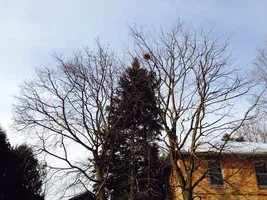
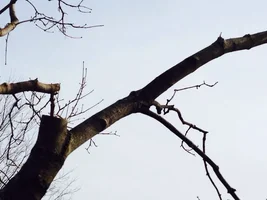
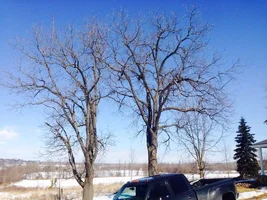
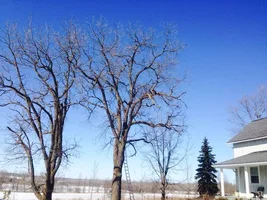
First thing I want to ask anyone is I really would love to know how ginko reacts to reduction. We both have a few big cuts and a few more here on yours perhaps? Again not a bad thing depending on ginko behaviour and suscepatability, but I limited bigger diameter cuts. I think I'll door knock at first opportunity and check wounds and shoot habits. For free because it's to improve on my inexperience of ginko reduction. Hopefully land the job while I'm at it.
Also wanted to correct a term I used. The stems bend and CORKSCREW. This is much different from bend and twist. Shigo also mentions a lot about co doms and how trees grow themselves into problems. And how it takes a long time to get out of those problems.
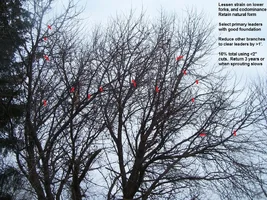
Guy, Yours is a good alternative method, perhaps like drop crotch or reduction via thinning. I did make some cuts at some of those crotches but chose other stems to remain. And it is very difficult to see diameter and stem directions in a 2d photo. That is why I like the red lines as a flexible guide but not as a solid prescription as you mention. There are several differences I want to discuss. And yes my prescription is much closer to a round over on a scale. Again, the top pics show that I followed shape, I didn't dictate it. Anyway, it's all how you look at it.
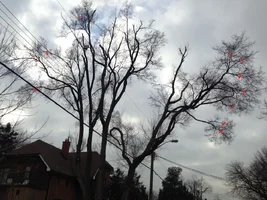
We also made different trade offs. At a few crotches you chose the upright to remain as a trade for creating an elbow. I chose the parallel reaching to remain, avoiding an elbow but risking spread. But to counter that spread somewhat, I reduced the remaining stem with a small nodal reduction cut. I also believe in height control and not just horizontal spread( see elm pic from Toronto ice). I do know that you and others favour the upright cut and I also often choose that. Just not always. I would say we all choose it when retaining the reaching limb would cause an elbow. Not that elbows are that bad. But not ideal combined with 1-1 ratio removal cut.
So I would be completely comfortable calling mine a round over/reduction hybrid. But 'systematic taper improvement app' I like better.
Similarities to reduction:
Cuts are nodal
Cuts are reducing inner branches (inside of dotted round over line)
Some larger uprights were removed far lower than dotted line
Similarity to round over:
1.Heading-LIKE cuts (but not internodal) - reduction cuts
2.Then instead of leaving entire two branches at heading cut retained, they were reduced, creating another stem split, and also a denser leading edge in time. Unnatural looking but trade off to slow extension, Improves taper. Reduces FUTURE and current load and sail. Unnatural looking temporarily, as you can now see new vertical lead off heading cuts. Now reduce, remove and retain shoots-Gilman.
Reasons for heading like cuts: I didn't want to make the four inch crotch cuts to leave a long slender 4" retained and continuing extension. And as you can see, choosing the first available crotch from the leading edge means a three to six inch cut. And further out from that it's either stem trace pruning or heading like. I chose heading like, not that I like it a whole lot. I chose heading-like reduction cuts in order to make an average larger cut around 2 inch instead of 3.5-4.5. Sounds like a small difference but the wound surface area exposed is quadruple with 4"vs2".
Some advantages to your concept by red lines and by your written words:
More natural looking finish
Coarse texture finish
Easier application
Some advantages to my concept:
Slows extension to produce a smaller crown over long term and therefore more tapered in all stems.
Maximizes risk reduction while minimizing injury to the tree
Significantly reduces size and sail instantly and long term (changes habit). but with medium cuts and only a few large cuts (3"-4")
Both apps require a revisit, yes mine sooner because I'm aiming to slow the crowns leading edge more than the natural app
I also want to share some Shigo's quotes. I finally started 'A New Tree Biology
Under 'trade offs' in the back dictionary:
'The benefits of the treatments...must be weighed against the injury caused by the treatment'
'A single treatment can not suddenly correct a problem'
He also mentions frequent applications to slowly fix problems but I can't find it again.
And in the topping chapter
'If you start early, you can train most trees...to regulate size by periodic pruning...Then, even some small topping cuts do not cause serious injury'
He is referring to bonsai and training young trees but I'm scaling this to large trees in a sense that I am starting early on a very long term plan to avoid large failure. In this specimen ginko ideally applications should be made five years apart for a while then spread further over time. But constantly improving taper and with lighter weighted apps every time. Creating a structure that is not natural but not unnatural either. A structure that will be capable of handling the heavier storms and changes in surrounding. The soil is limited and likely will be reduced. so limiting the crown to suit is a good way to balance resources.
The ginko will outlive the spruce row on the side of the prevailing wind.
'Be on the alert for edge trees. Trees that had competition taken away. Trees that have new space.'-Shigo.
So my ideal 150 year plan is to maintain this tree at a slower than natural growth rate, by altering but not ruining its nature. Vitality also goes up when growth goes down. This has been shown with growth inhibitors, which were suggested to me by a few as a way to compliment reduction pruning. It's a great question. Can growth inhibitors assist with crown reduction?
In this ginko tree (not the elm below) an ideal goal imo is to increase the structural strength as much as possible. Forget about guessing. Too much for an average storm but hopefully enough to put risk of failure very close to zero in the eyes of a 150 year outlook. If large failure and woundage is avoided then the tree will live longer by avoiding removal due to risk or perceived risk. Without reduction failure is a question of time not a question of how risky it is right now. It might be fine right now but in time that will change. Nature changes it in terms of growth and reproduction for success. We can change it in terms of careful progressive control and longevity for success.
Shear madness. I have to admit that's hilarious.
'
Sent from my iPad using Tapatalk
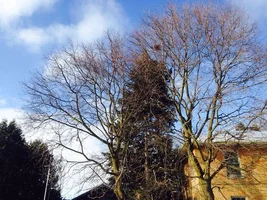
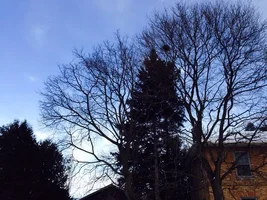
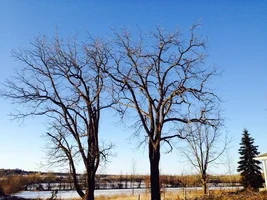
Pretty good Mother Nature reduction. Considering