Reducing trees is unnatural?

Really I think you are afraid to make the cut.
I know the industry.
  1. remove the lower crown
  2. remove the tree
  3. remove large leads/limbs
  4. lions tail the shit out of everything
  5. reduce root zone
  6. reduce soil health
  7. bla bla bla
  8. :sleep:
I see very little value in light reduction at short intervals.
It only suggests directing growth. To get longer and more susceptible to storm damage.
Better off not pruning at all. and let mother nature do it for free.
not at the owners expense.
I am Not saying there is no relevance to what you practice. the largest trees in our area a bold prune in anticipation of ice loads
is absolutely necessary. Dwarfing effect is required not a stimulation/tickle.
Otherwise people remove the tree as the only option.
Differing experiences.
Pruning, crown clean, thin will stimulate growth. that is good stuff unless the tree reads item 1-8.
Just conversation:birra:
 
So what maximum reduction lengths would you suggest to remove from a 3 stem soft maple? Assuming the middle stem is 16" and the outer leaners are 20". The width is 75' and the height is 65'.


Sent from my iPhone using Tapatalk
 
So what maximum reduction lengths would you suggest to remove from a 3 stem soft maple? Assuming the middle stem is 16" and the outer leaners are 20". The width is 75' and the height is 65'.


Sent from my iPhone using Tapatalk
 
anywhere from 25 to 35% short answer
have to walk you through it?
South side mb more North side mb less
what is there to prune back to
curvature of limb, doglegs, deficiencies in wood
near vertical mb less, near horizontal mb more
targets? dollars involved? point of attachment, limb settling on the push and pull/is there buffering from neighbouring trees, branches, buildings etc or is it out in tdhe open
so many variables and observations to consider
anything you can add for education of others,
 
Last edited:
25 to 35 percent of what? The height or the total foliage? Walk me through it. Look at the recent before pic to use as an example in terms of form. No major deficiencies or decay. The odd narrow crotch but not combined with decay. Almost equally ready to break in all parts of the tree. Most likely in the 4-8" stem diameters. Slightly higher chances at narrow crotches.


Sent from my iPhone using Tapatalk
 
foliage is one of many things to consider, small branches and most limb wood have much photosynthetic potential, so prune away
height? really? rarely dangerous as in vertical sail or vertical weight?
stop pussy footing and prune the tree see how it responds and judge for your self .
I had to reduce a silver last year approximately 95% still better than whole tree failure or whole tree removal
you got to put some weight or sway in the limb and say I break it there or prune it here and find something comfortable that meets the demands of some potentially extreme weather
 
Paragraphs!

"This post refers to trees that are passed establishment and into the period of growth, often established and or neglected into their 'problems'. For the basic idea skip to the last five or six sentences. You got it JD3000, Maples can have plenty of codominant stems, especially the now popular and wonderful 'freemanii'. And that is why I often reduce the reduction cut diameter, cutting 6-8 feet off at times instead of 12-15. (Or appropriately smaller lengths in a smaller tree).

Reduction cuts remove the larger stem, so they never have collars. And thinning cuts aren't always enough on their own. (But enough in a sugar maple) Often, a maple crotch with a 3" and 2" inch stem has no collar on either side, as you mentioned. To mitigate between reduction and thinning, you can make a reduction cut at a node or two above one of these points leaving the option (necessary or not) of cutting at the lower crotch once the ratio improves. (The reduced side will gain diameter slower than the stem left to dominate). A good prescription involves progression.

It also depends on the reason for reduction. Major decay requires those bigger, uglier, more damaging reduction cuts. (Damaging cut traded for reducing the likelihood of even bigger storm damage, or equally sized but uncontrolled 'hit the car' storm damage) Narrow crotches, codominant stems and minor decay only require small and medium reduction cuts. And I think the amount of wind load reduction achieved with the removal of small cuts (lengths up to 8 feet, diameters up to 1.5 inches) is majorly underestimated. Actually freemanii is a great species to debunk the common practice and ideology around codominant stems, narrow crotches, and stem ratio correction. The first problem is correction. The term ignores progression. To try to correct a tree instantly may ruin it. To improve a tree progressively may in time correct it.

When a freemanii has so many stems, a progressive approach is really the only approach I see working out. The other approach is only a disaster for the tree. You can't significantly reduce or remove all the codominant stems when a tree is mostly codominant stems, and mostly narrow crotches. You also can't have any immediate goals of correcting a one to one to one to one to one ratio. He goal should be to slowly move away from even ratios, among for at least some difference, not major difference.

Part of what I'm trying to say is that we think in terms of cutting at crotches instead of in terms of nodes more often. We do need both. Further to that once the cut diameter falls below 1.5 inches, the diameter of the remaining stem does not matter much. A 1 inch cut leaving just a bud or leaving a 1/8 inch stem is fine. It looks funny and breaks the one third rule, but a year or two later, that bud will be a 1/2 inch stem at a 1" cut. All sapwood too.

So the one third rule is partly or largely useless as well, certainly in cuts under 1 inch. In tightly branched, narrowly crotched trees like maples, look at the terminal of a codominant and come down several nodes. This other habit we arborists have of coming down to a major crotch is archaic and often impossible given the texture of maples. And maples, particularly soft maples, are becoming more important every day. Not that we should plant many of them but we should take care of them, including norways and Manitobas."
 
Oh I forgot. 'Topping is bad'. Yes height. Really. Yes height is very much a factor. I see you are from Ontario. I'm from Ontario too. Did you visit Toronto after the 2013 ice storm? The observation was consistent that uprights failed more often or at least as often as laterals. To clarify, at the same time, leaning trees failed more than upright trees. For the trees that didn't fail, they failed the highest uprights, in particular. That's just for ice. Wind also fails upper limbs in silvers and others. The lower limbs experience less wind and build strength by adding reaction wood due to the force of gravity which is there more often than the wind. I'm not saying not to reduce width. Reduce horizontal limbs, vertical limbs, and please don't forget the limbs at 45 degrees. In a Manitoba you might not worry about height and laterals become job one. So you get a point for that. But it's only the case half the time. Some Manitobas do need height reduction. Silvers and Norways, (the ones that make probably around half of Torontos canopy) and freemanii most often require height reduction. In many cases more reduction is required on the laterals so you get another point there. Just don't forget the grey area. If We're applying reduction to a maple, I think we should balance the application and make variable levels of reduction in almost all limbs of the crown, including and importantly, reduction of the inner limbs. I know people say not to remove them but norways and silvers can be observed to have long, snaking inner branches, so reduce them.


Sent from my iPhone using Tapatalk
 
Last edited:
Completely relavent. Yes the green ash got hit hard. But do you know the Siberian Elm were hit maybe as hard, maybe harder at around 75 percent significantly damaged. Nice to see they just stubbed them where the broke or just below. Most will shoot. Good prescription or no time I don't know. The silvers had significant damage on every other tree. That's relevant. The elms again had most damage in the uprights. Relavent again. The ash failed on the sides and uprights. That wasn't their fault for not training them. Maybe partly but the trees never had a light storm before a heavy one so the 30 year old ash were in there prime for failure. They should have used more white ash. Structurally superior. like crimson king is structurally superior to emerald queen.


Sent from my iPhone using Tapatalk
 
YEAH!!!

Great thread.

Old green ash around here(yeah there's still some left) are notorious for those long over-extended limbs that always seem to be lion tailed. Shocking right?

Same maple stuff here and everywhere.
When you guys talk about the ice storm in the past in Toronto, could you describe where branch and stem failure was occuring?

Keep up the talk folks.
 
Trees pruned, crown cleaned, thinned and lion tailed, lower crown removed failed more than trees not pruned/forest/seedling/volunteer trees except for the nursery grown trees that received no young tree training landscape tree/boulevard failed hard.
Light reduction was enough to prevent failure but not fracturing. I see them, hear them and expect many tree/limb is cracked to some extent.
 
Not in my 16 years of experience. I reduce soft maples on a weekly basis. I commonly remove 200-800 lbs from a tree. Not really pussy footing when the entire tree gets taper improvement. Slowly improving taper is progressive and effective. Cuts over 3" in maples can be just as damaging as the free job done by Mother Nature. So yes if you apply heavy application, the only advantage is controlling the falling limb, and making a clean cut. So not a total loss. But likely not increases lifespan either. And a four inch cut leaving a two inch stem can ever really be 'clean'. Regular reduction (every 5-10 years) will improve taper WITHOUT significant damage. Compounding on the reduction of the possibility of large storm failure with every application. Having said that I'd still rather apply medium and thorough once than heavy and sporadic once. Improve taper in all parts of the tree, while disrupting the auxin system in a balanced manner. The closer you get to the crown edge, the more terminals you should remove.


Sent from my iPhone using Tapatalk
 
3-4" is good for a limb or lead like a South growing leaner, nearing vertical. But deficient limbs need more material removed
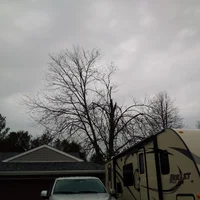
Looked at this today damage from 2013 but showed fracturing from previous yrs.owner refuses to maintain .
 

Attachments

  • IMG_20170415_110109.webp
    IMG_20170415_110109.webp
    500.9 KB · Views: 23
16 yrs experience north of TO? Your in the snow belt. That might explain some of the differing experience. more similar to north waterloo region. fair bit different than Cambridge and Hamilton, lake ontario
 
Nice pic. sometimes it's a matter of defining what is vertical and what is reaching. And often those codominant limbs at 10-20 degrees to the vertical are the high risk. Especially in norways when they surpass the central leader. Definitely agree that damaged limbs need more work. And I guess the client from that pic is waiting for the free Mother Nature reduction. Just won't be free if he's parked underneath. Sometimes it's not a horrible risk to wait for stuff to break though. At least it looks like a lighter medium sized tree. Minor roof damage or eves trough rip off maybe.


Sent from my iPhone using Tapatalk
 

New threads New posts

Back
Top Bottom