Reducing trees is unnatural?

Thanks Ryan, "The tree is about 40 feet tall. Uprights about 2-4 inch diameter." Yup that's why I specced cuts 1-4", thinking that one or two of those codoms could come all the way off, but most would be reduced aka subordinated. Bluntly, I cannot understand postponing that scaffold work for a minute.

So much info on this at Gilman's site, for young trees, paid for by fed grants. I'm putting my tax $ to work by devouring it right now, again. I might spend 20 hours prepping for this 2 hour talk but it's time well spent. This chat is a big part of that prep; thanks to all!
For big trees, Gilman's approach does not work well ime. It's based on extrapolation of his work with little trees. Ryan and dozens of others I've met have a better handle on big old trees, based on experience.

Viewed by me as Goldilocks, Ed G is Pappa Bear, speccing really big, often horizontal, cuts (on live oaks in zone 9, advising cities that want long cycles).
Ryan is Baby Bear, clip clip (on rampant trees in zone 4, short cycles cuz he's in the hood all the time). Maybe extrapolating your big tree work on little trees a tad too much?? And maybe stickershocking clients into thinking about removing good assets? Or is your charisma such that they want you back every year just to bask in your good vibrations?
I'm hoppin into Momma Bear's bed (the middle ground in zone 7), drawing from both extremes.

Who's right? Who can say? Everybody is somewhat, but no one is for every case. "Rules are too Absolute for Mother Nature" quoth the Godfather. Got yer ears on, Dan'l?

"how do you manage site visits to everything you've done? Do you prioritize on a scale of 1-5 when you're done?" Excellent questions. No sane, self-respecting businessperson schedules free site visits, let's stay real about it. When I spec a cycle, I note in my calendar for 1 year later or 1.5 or 3 or whatever it is. Take pics so you can get longterm before and after studies. the calendar prompts me to call; ain't technology wunnerful? If I was good I'd use Jigger or some software to get the client's agreement recorded like a signed commitment, so they can't blow me off and tell me about their leaky roof when the tree's time is up.

Carry on! :)
Guy I do like this post as I know that on average I cut smaller diameters. And I preach smaller cuts. I need to start preaching medium cuts. Remember that 2" is 6-12' long. But I'm not at 1/2 inch as a top end as some people (not Guy) misinterpret my work. And it is not a baby dose. I've taken Over 1000 lbs at a time and in my cheesy youtube video I took over 800 lbs. from a 22" maple. But it's a question of texture. The soft maples often have 6-20 stems. All of which meet the crown edge. Improving ALL stems taper is required on first app. Perhaps favouring some stems but not leaving ANY slender and poorly crotched stems to continue extending further.
I did that 200cm oak in Toronto papa bear style or retrenchment. But because it had decay. 20-25 foot lengths. 8" cuts. And not densely stemmed. I've also taken an 8" top off a sugar. Ouch. Hurt less than removal. And needs monitoring. When I'm at the neighbours I might do a free 5 minute visual. So I'm not against the papa bear cut. I just think it can be used out of context especially if the tree is not decayed yet. I do agree that oaks can take big cuts a little better though and work well with a long cycle. and as Ive said I agree the ten year cycle is better than no cycle. Now consider this suspicion I have.
Does the long cycle require a heavier app? Or could a medium weight app still be applied? The thing is that these big cuts won't be a problem in 10 years but might be a problem in 20 years especially on stressed street trees. 980 lbs came out of the backyard maple. When the same diameter front maple gets done it will only require less than 300 lbs. the vitality is way lower. So that 980 lbs app would go better over 30 years on a ten year cycle than a heavier app on the same cycle. Also the stressed front tree can't be corrected with ten year cycle. Improved, but less improvement than the five year cycle. An attempt to correct a neglected tree in one dose will likely do more damage than good. Especially in stressed Norway or locust or sugar. More replies later and thanks again Guy for your honest opinion. It really helps me see how I'm seen
Cheers and carry on
 
Last edited:
KevinS. So I still want to answer questions regarding site visits. I am sorry to say that I don't schedule visits at all. When I leave I might tell clients that I should be back in two years if it's high risk or softer wood. I might tell them I should be back in 5-7 years if the tree is slower growing or lower risk. I tell them what to look for (growth or vitality signals). And then I leave it to them to call. I don't preach this and I know it's not the best way. I should mention that with high risk trees that I deal with maybe twice a year, I highly suggest annual assessment. But I have taken a few minutes of my day just once a month or less to visually inspect a tree that I know might become higher risk. Really I only work on the odd tree (less than once a month) that even requires site visits at all. If a tree was reduced it is better if I reapply reduction and restoration as a second app. But if I don't get there at all the tree will almost always be better for having one app of reduction. So for the most part I work by demand. Many clients are return clients but many move out. This is where door knocking should go back in my toolbox. I've gone through old daytimers. I have every one. And I keep an eye on a few trees. But what trees am I missing that I wouldn't have if I did what Guy suggests? Probably a few? If they fall is it my fault? No. I only ever said that I reduced the risk. I don't remove risk by reduction. After three apps though I consider them almost indestructible. Especially if decay is not present and i never inflicted injury over 3" in soft woods. We can create trees that are seamless, hole free and civilized with medium weight application along with 2-8 year cycle. And the cycle doesn't have to repeat. It might become longer and longer. Especially in hard hardwoods.


Sent from my iPhone using Tapatalk
 
Ok third reply in a row. Sorry but i realize I have another great question from Guys post. 'Maybe extrapolating your big tree work on small trees a tad too much? Not at all. I rarely have the luxury of correcting a 4" tree. Clients focus on their larger trees and I need to do better to point out the young ones. Sometimes i do them for free in five extra minutes though.
But quite often I'm faced with the challenge of improving a medium tree. 14" but neglected and when one or two cycles are missed, then THREE may be required over time if correction is the goal. Often the reality is one app is going to make a long lasting improvement, but not correction in a ten to twenty year neglected tree.
I really want to reiterate that 'correct' is another problem word in arboriculture. How is structure judged? In my eyes it is by one thing plus another curve ball. By its ability to stand up. The curve ball is the presence of decay. Coder reiterated that what's amazing about trees is not just how they fail, but how they stand up. We've all seen some of the worst ratios and worst included crotches and badly decayed trees go through storms. And not fail. Take these inclusions and ratios and decay issues and improve them. Correction is no longer even in the cards. And doesn't need to be either. Yes the correct tree is superior but not always attainable after neglect. I don't even like calling it neglect.
I need a correction facility more than any tree. I'm falling over all the time. Storms come and I fail. I can't correct myself. I'm imperfect. I can improve. And I will.
Why introduce wounds over three inches to a structure that has no decay. Here's a suspicion
Why not improve the tree by cutting into wood with no more than 4 -8 growth rings? I don't know just trying to find a one size fits all answer again. Here's Another thought. Leave the basic structure alone. Affect the future structure. ime this works and with limited damage.
Also want to reiterate that these ideas and others I blab about might be applicable further south but on a different scale.


Sent from my iPhone using Tapatalk
 
Last edited:
Ryan yes the growth-ring criterion is a good one; mentioned by Gilman and Dujesieffken et al. But that does not explain the practice of clipping tips while ignoring codoms.

But I gotta say it seems like you (and most arborists) waaaay overreact to, and fear, decay. Many hollow trees are stronger than 'normal' trees of the same species and size.
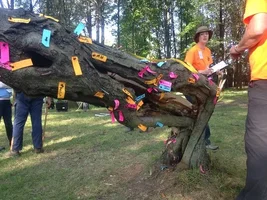
This red maple at Biomechanics Week bent over only after 1100 pounds of pull. (you really should have come down with us!) Most of the researchers guessed it would fail at the hollowest point, but it failed first above the hollow, and second at a tension root with mower blight. The wood around the hollow bent, but NEVER BROKE. We pushed it back up to vertical after cutting the brush off, and there it stands today.

wager tree.webp .
 
Daniel what do you see that is "dated"? The world awaits your updates from Planet Murph! Remember we are talking about YOUNG trees at this point--I could fill a book with commentary on his mature tree approach. Do you have his 2013 Structural Pruning book?

NO... I'd like to get it...

the dated slides of that PP presentation are the 3 step pruning cut slide #31

and slide 34 the reduction cut bisecting the angle between branch bark ridge and a perpendicular line across stem.
 
"the dated slides of that PP presentation are ...slide 34 the reduction cut bisecting the angle between branch bark ridge and a perpendicular line across stem."

Yes, good eye on that. His own 2007 research w Grabosky contradicts that obsolete notion, and correctly stresses that wound size, and as Ryan points out the amount of heartwood exposed, matters more than angle. Even if his grad student did most of the heavy lifting on that ppt project (as on many others), if his name's on it, he should not let that stuff be perpetuated into 2015, imo.

I'll leave it to you to send word on that. As with Greg Moore's obsolete statements on pruning,
( DM: "his argument against "thinning" is at around 29ish minutes. He just casually mentions at the end of the list "significant wounding", very little emphasis...His take on reduction is that it should only be done when there is no other option. 31:00") your comments may be more diplomatic, less incisive, and better received than anything coming from me!

"... I'd like to get (the 2014 book on Structural Pruning)..." I'm not recommending it, for the mature trees that you work on. You would see some major problems that make it quite misleading. The above problem, and the continuation of the confused dogma about 'heading cuts', for instance. The 2007 research is briefly acknowledged in an appendix on page 77, but the failure to integrate this study and many other subsequent research results into the book itself creates a major defect.

Also, he sadly ignores tree architecture, the genetic structural and physiological variability between species, as a factor. I'll cop to my own failure to meaningfully integrate this factor, which is well known internationally, into mature tree care. Considering the corporate dominance and other limitations of the A300 process, the US standard is also unlikely to clarify guidance on pruning mature trees any time soon.
 
Last edited:
Guy
Yes I do wish I saw biomechanics week. Here's the thing.
If you had a choice between trees with large wounds and more decay or trees with medium wounds and no decay. And both held up. What would you choose? I don't worry about decay that much but yes at times it causes failure. Not in hollow trees but especially in trees where the decay is exposed or into sapwood and cambium.
The silvers in Toronto would have lasted longer had they sustained smaller wounds (natural or chainsaw) And yes some were removed prematurely due to fear of decay. And for some with progressive decay that was likely a good thing. I took one down. caused by the neighbours complaint to city then city says cut it. It was borderline. But after failure, I couldn't argue and not much left to reduce.
Those silvers and Norways for that matter which cover a good portion of the city are mostly failing or feared because of large woundage IN COMBINATION WITH stress on a boulevard. Backyard trees handle wounds much better.
And like I said I favour certain stems and reduce co dons and often aim for correctness. But not always
 
Ryan yes the growth-ring criterion is a good one; mentioned by Gilman and Dujesieffken et al. But that does not explain the practice of clipping tips while ignoring codoms.

But I gotta say it seems like you (and most arborists) waaaay overreact to, and fear, decay. Many hollow trees are stronger than 'normal' trees of the same species and size.
This red maple at Biomechanics Week bent over only after 1100 pounds of pull. (you really should have come down with us!) Most of the researchers guessed it would fail at the hollowest point, but it failed first above the hollow, and second at a tension root with mower blight. The wood around the hollow bent, but NEVER BROKE. We pushed it back up to vertical after cutting the brush off, and there it stands today.

View attachment 30685 .

Guy I'm glad you shared this pic. 'The wood around the hollow bent, but NEVER BROKE.'

Do you think they break at solid points instead of hollows because the wood around the hollows is thinner with no restriction(a hollow) therefore making it more flexible? Or at least letting the woods flexibility go to it's max. It doesn't increase flexibility rather it just makes room for it to do its thing.

Same idea kind of as barber chair when there's extra mention 'through the wood' that where it breaks because there's no where else to go.
 
Guy
Yes I do wish I saw biomechanics week. Here's the thing.
If you had a choice between trees with large wounds and more decay or trees with medium wounds and no decay. And both held up. What would you choose? I don't worry about decay that much but yes at times it causes failure. Not in hollow trees but especially in trees where the decay is exposed or into sapwood and cambium.
The silvers in Toronto would have lasted longer had they sustained smaller wounds (natural or chainsaw) And yes some were removed prematurely due to fear of decay. And for some with progressive decay that was likely a good thing. I took one down. caused by the neighbours complaint to city then city says cut it. It was borderline. But after failure, I couldn't argue and not much left to reduce.
Those silvers and Norways for that matter which cover a good portion of the city are mostly failing or feared because of large woundage IN COMBINATION WITH stress on a boulevard. Backyard trees handle wounds much better.
And like I said I favour certain stems and reduce co dons and often aim for correctness. But not always

I don't want to derail this so I'll open another thread. Good stuff here

If you don't mind looking at 'hazard tree evaluation' in general discussion it'd be great
 
Last edited:
( DM: "his argument against "thinning" is at around 29ish minutes. He just casually mentions at the end of the list "significant wounding", very little emphasis...His take on reduction is that it should only be done when there is no other option. 31:00") your comments may be more diplomatic, less incisive, and better received than anything coming from me!

That's hard to believe, (that I would be more diplomatic than you) .. and I suppose stranger things have happened..

quite a thread we got us here ladies and gentlemen
 
For every tree you can show that survived such large percentage of decay I can remember many that went down in storms. The science around what type of decay , species, structure, weight , lean , spread, height, disposition etc will or will not cause failure is pretty darn inexact as practiced by the average to above average arborist these days. I wouldn't go around touting the benefits of hollow trees in order to justify improper pruning techniques. Common sense prevails here Guy...
 
Reducing an otherwise structurally sound tree for the tree's sake is tantamount to playing God. Reduction should be applied to trees with defects or abnormalities with quantifiable evidence (this can be as simple as a codom/inclusion or as complicated as you want to make it) that supports the connection between the defect and failure. The prescription and execution are (relatively) simple if you are armed with the knowledge and experience to identify potential problems. Just my two cents as a 24 year hands-on observer. In other words, common sense combined with knowledge and experience is how these decisions should be made.

Tom
 
that all depends on what you mean by structurally sound... We had an ice storm on 2/5/14 that trashed a whole lot of trees. There were plenty that would have been considered "structurally sound" in that visible defects were absent. I've seen hurricane's take out big hardwoods, super solid looking with no apparent defects, until grinding the stump and come to find 5-10% decay in the root crown.

Guy has been trying for years to get the ANSI pencil pushers to recognize "over extended limbs" as a structural defect. They're not hard to spot for those that have been there. I see them in suburban setting s ALL THE TIME.. So does Guy ... so does anyone that's paying attention and knows "what's up"....

I couldn't tell you when the last time I made a live cut over 4" on a main stem or trunk. Whereas I will from time to time make a 4"+ reduction cuts. 95-98% of all reduction cuts being 3" or less. 4"+ is only under special circumstances and usually at most only one or two cuts of that diameter on any tree. Still make a 4" reduction cut 25:1 compared to 4" cuts on the main trunk or large stem....
 
To be honest, Daniel, I find structural defects on most landscape trees. I was commenting on reduction as a general treatment. Preparing every tree for an ice storm would be impossible!

Tom
 
"...I find structural defects on most landscape trees."
Yes we all can I agree this points out the issue with the vagueness of the concept of defect As well as our lack of understanding of Tree construction considering hollow Ness of that maple and the fact that the hollow part of the tree never failed
" I was commenting on reduction as a general treatment. Preparing every tree for an ice storm would be impossible!"

If we are assigned to prepare treest for ice storms I think we can do it
Like any other service we can't provide a guarantee but I think we can indicate that we're going to improve the situation
We can quantify the extent of overextension say if a Limb extendse 4 feet outside the crown outline so a specification as written to reduce that limb 6 feet or 8 feet or whatever
Quantification however can be overrated and overused
Consider the drill and kill assessments that are being done with formula is the use of which ignores the crown and what can be done to mitigate risk in the crown unfortunately these assessments are still very commonly practiced by very high-profile companies

We should be honest about our ignorance when It comes to what makes a tree structurally sound

I'd much rather cable a tree than do an overall crown reduction to avoid a major failure at and obviously compromised fork
 
Last edited:
To be honest, Daniel, I find structural defects on most landscape trees. I was commenting on reduction as a general treatment. Preparing every tree for an ice storm would be impossible!

Tom
Every tree doesn't need it... and even most trees don't need "crown reduction".. just specific limb reductions on large over-reaching horizontal and near horizontal limbs... When you get into mature hardwoods in suburban environments, that's a lot of trees...

That ice storm on 2/14 was complete confirmation for me that my system of reducing long heavy over reaching limbs works REALLY well! My trees did awesome. All of them except a row of plums that I had to beg the client to prune in the first place. (he didn't like making cuts on his beloved trees). SO I went a little lighter on them than I might have otherwise. Those plums needed a heavier dose of pruning (lesson learned). I have seen A LOT of trees that did really well with a much lighter touch (lesson learned). Even very light reduction of 1/2"-3/4" branches, done in 2008, giving protection 6 years later. I tell clients we don't need to take too much off, we're just taking away "the straw that breaks the camel's back"
 
Last edited:
I'd much rather cable a tree than do an overall crown reduction to avoid a major failure at and obviously compromised fork
I AM a big believer in cables, especially for included unions. HOWEVER I have become a bigger believer in reduction on most mature hardwoods. Offers protection of more than just one branch union.. trees do really well. Still put plenty of cables in. If 1 in 10 big trees needs a cable, then 1 in 2 needs some type of reduction.. (just guesstimating)

Also having a 75' bucket truck which can easily get to most of the reduction work needed makes a huge difference in approach.
 
I agree with Guy in cabling a fork as in linden with its triangular And upright and isolated issue. And I agree with Dan when the structure is more twisted and complex. As for what tomthetreeman said about playing God. Yes I agree For trees away from targets. But apparently sound silvers fail over structures. So I play 'civilize it'. Reduce before Mother Nature does. And further to that, I strongly believe that reduction over builds a tree. So if we reduced not all (Tom, yes this is not practical) but a percentage of the silvers in Toronto (which we did) the more will stand and less damage is made. Which is what happened. Also a diversity among one species in their overbuiltness us a benefit. After the storm we still have some unscathed and in a position to live a longer life. Not having to deal with decay and holes. Probsbly ideal. I dunno maybe hollow and holes is better? :)
 
Last edited:
So if we prune too take the whip out of the limb do we know what effect it has on reaction wood growth. How does it change if it does
I've heard there was an article about that in TCIA mag a few years back... I'd bet $ the author is a scientist, not a sawdust in his pockets type...
Anyone have a link tom the article? Flies in the face of my "research" LOL....
 

New threads New posts

Back
Top Bottom