Reducing trees is unnatural?

Guys guys easy now. I like both your ideas. This is the exact terminology issue I'm talking about. I haven't read this all yet but please. The idea is progress not prosecution. I might be miscommunicating or using words wrong here so please criticize just don't get mad. It's hard when your passionate I know trust me. So thanks for the show of passion.
And more on reducing uprights later. I agree less after the ice. Again a location barrier. But if we define and understand the barriers we can get past them and utilize our distance and differences effectively.
 
Hulk, if you're talking about Ryan's post #12, i can't judge from that 2D angle whether it needs more off or not. The fact that it held up to ice indicates that Ryan's judgment was right. ;)

Dan, we agree, let's leave messiahs out of this, or fuhrers will be close behind! It's another Canadian I was talking about.

Ryan, as far as lit reviews go, I just got a couple links from TCI's archives via editor Don Staruk. Find Henry Davis' work in these 2 issues:
http://tcia.org/sites/tcia.org/files/tci-magazine/05-2003-TCI-Mag.pdf and http://tcia.org/sites/tcia.org/files/tci-magazine/09-2002-TCI-Mag.pdf and study it closely.
Arborists around Boston knows of this legend and his work. Props to Boston's Tree Warden Greg Mosman for showing me some of those trees; I learned so much from both these guys!

I cite Henry's work in a piece I just finished for Australia's Arbor Age magazine, a writeup of my 2013 Expo talk. TCIA would not print it :( boo hoo so it went overseas. I'll ask Mark to post it here too.
 
Just an aside thought. In earlier pictures you showed how you take small cuts but many of them and high frequency. You did 3 prunes in 4 years one post said. With continually taking bits of foliage off do you ever see it is slow to 'heal'?
Reading about your dosage prescription and insect attacks on trees they have similarities. Not that your pruning girdles cambium but crown die back, flagging, etc. has some similarity.

You show work on willows, silver and trees that would likely not die if you drilled a 1" hole in the trunk and pack it with salt. How does it fair on sugars, oaks, hickories..... When mature these trees naturally do what you're talking about so does doing it early help?

Do some species need a minimum of 3-5 years between cycles or do you think that doesn't matter?
 
Another thing I've been seeing lately is people say trees in winter form(no foliage) are ugly and trees only look pretty in the summer.
Why do people care about no leaves they still look like trees, and if you prune for structure they usually look fine. It's how they look 6 months of the year it's just how they are.
 
Kevin I'll reply to 3 good points you raised, and let Ryan speak to the rest.

"How does it fair on sugars, oaks, hickories..... When mature these trees naturally do what you're talking about so does doing it early help?"
Yes, definitely, on red and white oaks ime. Crown regeneration aka 'growing downward' can be triggered by tip reduction; see post #13

"Do some species need a minimum of 3-5 years between cycles or do you think that doesn't matter?"

ime it does not matter, IF the dose is light, but still I have not tried to sell clients on such a short pruning cycle. I'm in zone 7 compared to Ryan's zone 4, but don't work much with Populus or Acer negundo or willow. But I've worked on mature hollow willows in zone 4(3?) in Sweden that are on a 3-ish year cycle.
The Q robur there, like most Q phellos here in NC, can wait 5 years or more, but then again some very hollow Q falcata and alba here have gotten a 9% reduction every 2 years. It's a specimen- more than a species dependent question imo. One mature ice-damaged Q phellos here got reduced back to the first good node in 2002; viewed this year I saw no *need* to sell a restoration visit.

"Another thing I've been seeing lately is people say trees in winter form(no foliage) are ugly...if you prune for structure they usually look fine."

Yes that's the whole idea of making small cuts; the natural growth habit can be maintained. :)
 
I like the challenge, and the farther you are away from the cut the better the chance of a bad cut ,,,, compartmentalization is your friend

What pole pruners do you guys use? Doing that much they must be better than mine I find it to be more tiresome than climbing the entire tree
 
Daniel. Great points about temporary cuts. And I've done what your saying but never thought of it exactly like that. Just like that Willow I showed. The nodal cuts that are left can shoot then when you remove it the stem remaining will likely have grown more. This also improves cut to remainder ratio. I also refer to shortening lower limbs as 'tucking' with clients. It is a great compliment to raising as you shed light on living space and garden below.
On the leaving uprights I agree to a certain extent. I'm assuming your not referring to the willow. In most harder trees I agree. If I'm doing a reduction I might just thin the central upright. In a heavily decurrent (spreading) tree I would likely treat it in balance with the rest and reduce it. In a very tall tree with a target I would likely go quite hard on the leader especially if any decay or structure issue. Furthermore it is interesting that the ice here broke more uprights than laterals. Silvers, birches and Siberian elms, all softer species, broke uprights more. The uprights had to bend 180 degrees to meet gravity while the reaching laterals only had to bend 45. What about Limbs that are at 60 degrees to the horizon and are in between, these are high up where wind is strong and leaning slightly.
Guy, thanks for the references to check out.
Kevin, I think the cuts will heal faster if anything. Less area to cover. I do check and haven't seen slowness. Hard to measure or get a feel for though. And yes I do the odd oak, sugars don't generally need reduction but did one sugar reduction/retrenchment, black cherries, lots of locust. All good usually for at least five years. Watch reaction annually where possible. Any way the softer hardwoods. So yes these trees are tough and don't die easily but they do die. And death isn't the point. If you make 1-3 inch cuts to avoid 6-16 inch failure then you save the trees aesthetics and structure. The failure leads to decay and structural vulnerability. Then the risk tree is removed. Toronto silver maples are coming down frequently. Actually after the ice some of the topped and reduced silvers stood up best. Not that topping is good, but it worked in this case until topping issues catch up.
Top five reasons for loss of softer woods
Poor nursery growth, up and roots
Poor pruning and late raising leading to decay.
Lack of thinning or reduction pruning
Storm failure due to the previous three points leading to decay then removal of risk tree
Spent today observing reactions to about 100 I did two seasons ago. Locusts, freemanii, norways and apples. Looking good over all after ice and although my app was thought to be too light, a good percentage sent shoots. The point is if they all sent shoots then too hard. If none sent shoots then too light. I could have gone heavier here and lighter there. But harder overall would have looked ugly and been worse in the long run. Many I just accepted could not be corrected in one app or in a ten year cycle. But they can be IMPROVED enough at a ten year cycle to avoid damaging failure that might also lead to removal. We really can only guess the dose weight. It's great to have a few handfuls of samples of 100 to look back at though. They are going ten years to next dose which is long but out of a hundred likely only a few will suffer in a storm before ten is up. Again, storm depending. Can't make trees bullet proof with ten year cycle and don't need to.
For some species do we need to go every 3-5?
We don't need to go at all. But if we want to feel safER under a Willow or soft maple we can. So assuming a target then I'd say 3 is ideal for an average Willow or Manitoba. Maybe 4 for average silver. But these numbers aren't for a tree way at the back fence. Add 2-3 for that. These numbers are for trees over the roof. Then throw in decay and minus 1-2 years. Or throw in multi stem Norway maple madness. If you want to improve this do it with a heavy app to start and light follow up apps every two or three.
As for pruners I used to use Marvin bull but too heavy. Now I go from reg Marvin to pole saw. Sure I make a lot of handsaw cuts too, but impossible to finish a thorough reduction that is complex due to structure and or decay. With those we are not looking for natural looking we are looking for structural improvements and accepting the trade off of unnatural LOOKING shoots. That's the whole point to this thread . obviously a retrenchment is unnatural looking but a reduction may have to also look odd but more restorable than retrenchment.
It is necessary in trees with higher risks with more target value. And necessary to get pole tools out to reach the ends that remain after you've made the bigger (1.5-2.5 inch) cuts.

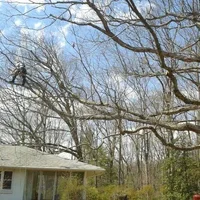
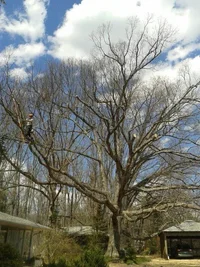
Hulk thanks for mentioning diameters. We need to talk about the bigger cuts with diameters because it's hard to see it. Did you leave those two big stubs to shoot and keep them away from the remaining limbs that will take over. I know those storm cuts can be a brain teaser. Especially when your forced to do something big. And I don't think you needed to take more. Time is on your side. Watch reaction and get more next time as you manage reactive shoots as well. Looks like you made a few small (1-2") cuts on that upright as well. I'd also reduce an upright like that. It can still dominate, especially if it's still there after a storm. Now it's more likely to be there enter a storm.

397885c80daf25070291434ba4452b11.jpg
c9ee641ce29fa91ad4863ddf587a9eba.jpg

Daniel. Here's tucking in a very black and white sense. Structural improvement through shaping. Much more of a shear than I would normally apply. I used pruner and 12 foot ladder. Not shears. More detailed structural next time
bc8ac1a1d7d263210b3091de50323e88.jpg
652230869ab1a6ecce8b969fb632e4b1.jpg

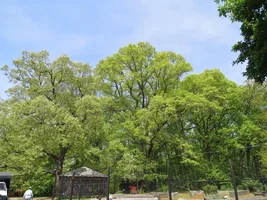
Just wanted to show I also do natural looking apps. Still high volume reduced. This will go 4-6 years. No house. Good tree. Willows not only can take heavy app. They laugh at it. Pruners required. Even if your 145 lbs.


Sent from my iPad using Tapatalk

 
Thanks ryan; I'm stealing those pics for a Structural Pruning of Young Street Trees for Tree Stewards Zone 7 class I'm doing next week.
Hulk yes compartmentalization is good but on 1-2" cuts it's gonna happen if the angle of the cut is not perfect.
Better a 'bad' 2" cut that a 'good' 4" cut. When cuts are too big, the natural form is lost.
What is a 'natural cut'??
On the 2 big stubs in the white oak, how much farther out were the breaks?
 
I also refer to shortening lower limbs as 'tucking' with clients. It is a great compliment to raising as you shed light on living space and garden below.
Though I appreciate your work and the passion it takes to share it, we don't agree on everything. That's expected and good. Means we might be able to learn something new from each other. I strongly discourage the practice of raising or elevating trees, except for clearance from vehicles and foot traffic etc. If a client insists they want to grow grass under a tree, which is rare to me, I might do some reduction cuts on the lower limbs, sometimes severe reduction. And I try to avoid it. The lower limbs seem to do so much for a tree... Just look at how healthy the trees are that still have these limbs.. Its an eye opener, if you just ope your eyes and see what is often right in front of you..

Daniel
 
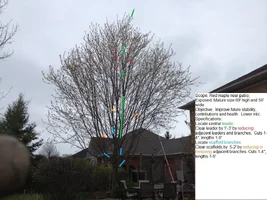
rr maple patio.webp Ryan that first tree by the patio--maple? Norway? Red?
I'm asking because species is part of the Scope of Work, which should be clear before planning work.
With young trees we Build structure; with mature trees we Maintain structure. We'll get nowhere here by saying what we always do or don't do.

Also, we must ESTABLISH THE OBJECTIVE before we sell the work or touch the saw. If we are not real clear on the expected outcome, our work is NOT compliant with standards, A300 or any other.

If your objective is good structure in the future, locating and promoting the leader(s) seems like Job #1. Yet the patio tree looks like it still has a lot of codominance going on. I'm not as fanatical about central leaders as the ppt below, but it has good points about building structure.

Your willow above looks like you had that in mind and selected leader and scaffolds, but the maple(?) still looks bushy, with longterm problems unresolved.
It looks like you applied old tree specs to a young tree, and kinda did a roundover. Look 10-50 years down the road--what do you see? The pic tries to show a standard-compliant approach, applying some of Ed's principles. It's not exact of course but I hope it illustrates some of what he's saying.

http://hort.ifas.ufl.edu/woody/powerpoints/pruning_young.ppt
 
Daniel. Great points about temporary cuts. And I've done what your saying but never thought of it exactly like that. Just like that Willow I showed. The nodal cuts that are left can shoot then when you remove it the stem remaining will likely have grown more. This also improves cut to remainder ratio. I also refer to shortening lower limbs as 'tucking' with clients. It is a great compliment to raising as you shed light on living space and garden below.
On the leaving uprights I agree to a certain extent. I'm assuming your not referring to the willow. In most harder trees I agree. If I'm doing a reduction I might just thin the central upright. In a heavily decurrent (spreading) tree I would likely treat it in balance with the rest and reduce it. In a very tall tree with a target I would likely go quite hard on the leader especially if any decay or structure issue. Furthermore it is interesting that the ice here broke more uprights than laterals. Silvers, birches and Siberian elms, all softer species, broke uprights more. The uprights had to bend 180 degrees to meet gravity while the reaching laterals only had to bend 45. What about Limbs that are at 60 degrees to the horizon and are in between, these are high up where wind is strong and leaning slightly.
Guy, thanks for the references to check out.
Kevin, I think the cuts will heal faster if anything. Less area to cover. I do check and haven't seen slowness. Hard to measure or get a feel for though. And yes I do the odd oak, sugars don't generally need reduction but did one sugar reduction/retrenchment, black cherries, lots of locust. All good usually for at least five years. Watch reaction annually where possible. Any way the softer hardwoods. So yes these trees are tough and don't die easily but they do die. And death isn't the point. If you make 1-3 inch cuts to avoid 6-16 inch failure then you save the trees aesthetics and structure. The failure leads to decay and structural vulnerability. Then the risk tree is removed. Toronto silver maples are coming down frequently. Actually after the ice some of the topped and reduced silvers stood up best. Not that topping is good, but it worked in this case until topping issues catch up.
Top five reasons for loss of softer woods
Poor nursery growth, up and roots
Poor pruning and late raising leading to decay.
Lack of thinning or reduction pruning
Storm failure due to the previous three points leading to decay then removal of risk tree
Spent today observing reactions to about 100 I did two seasons ago. Locusts, freemanii, norways and apples. Looking good over all after ice and although my app was thought to be too light, a good percentage sent shoots. The point is if they all sent shoots then too hard. If none sent shoots then too light. I could have gone heavier here and lighter there. But harder overall would have looked ugly and been worse in the long run. Many I just accepted could not be corrected in one app or in a ten year cycle. But they can be IMPROVED enough at a ten year cycle to avoid damaging failure that might also lead to removal. We really can only guess the dose weight. It's great to have a few handfuls of samples of 100 to look back at though. They are going ten years to next dose which is long but out of a hundred likely only a few will suffer in a storm before ten is up. Again, storm depending. Can't make trees bullet proof with ten year cycle and don't need to.
For some species do we need to go every 3-5?
We don't need to go at all. But if we want to feel safER under a Willow or soft maple we can. So assuming a target then I'd say 3 is ideal for an average Willow or Manitoba. Maybe 4 for average silver. But these numbers aren't for a tree way at the back fence. Add 2-3 for that. These numbers are for trees over the roof. Then throw in decay and minus 1-2 years. Or throw in multi stem Norway maple madness. If you want to improve this do it with a heavy app to start and light follow up apps every two or three.
As for pruners I used to use Marvin bull but too heavy. Now I go from reg Marvin to pole saw. Sure I make a lot of handsaw cuts too, but impossible to finish a thorough reduction that is complex due to structure and or decay. With those we are not looking for natural looking we are looking for structural improvements and accepting the trade off of unnatural LOOKING shoots. That's the whole point to this thread . obviously a retrenchment is unnatural looking but a reduction may have to also look odd but more restorable than retrenchment.
It is necessary in trees with higher risks with more target value. And necessary to get pole tools out to reach the ends that remain after you've made the bigger (1.5-2.5 inch) cuts.

Hulk thanks for mentioning diameters. We need to talk about the bigger cuts with diameters because it's hard to see it. Did you leave those two big stubs to shoot and keep them away from the remaining limbs that will take over. I know those storm cuts can be a brain teaser. Especially when your forced to do something big. And I don't think you needed to take more. Time is on your side. Watch reaction and get more next time as you manage reactive shoots as well. Looks like you made a few small (1-2") cuts on that upright as well. I'd also reduce an upright like that. It can still dominate, especially if it's still there after a storm. Now it's more likely to be there enter a storm.

397885c80daf25070291434ba4452b11.jpg
c9ee641ce29fa91ad4863ddf587a9eba.jpg

Daniel. Here's tucking in a very black and white sense. Structural improvement through shaping. Much more of a shear than I would normally apply. I used pruner and 12 foot ladder. Not shears. More detailed structural next time
bc8ac1a1d7d263210b3091de50323e88.jpg
652230869ab1a6ecce8b969fb632e4b1.jpg

Just wanted to show I also do natural looking apps. Still high volume reduced. This will go 4-6 years. No house. Good tree. Willows not only can take heavy app. They laugh at it. Pruners required. Even if your 145 lbs.


Sent from my iPad using Tapatalk
How big is your service area and how many trees do you do a year? Unless it's regular steady client that has told us to just take care of it they have to call us. We have 6 trucks out doing different things to routinely monitor everything sounds nuts.
 
Guy, that maple is a red silver. Probably autumn blaze. And I know it still needs careful structural work. I went easy because of time of year (bud break) but achieved objective.
Dan, yes I once heard criticism from an environmentalist towards arborists for raising trees. I agree very much about it being best for the tree. In the pines in my area and North it is very evident that vigor is better with crown down dark shade, moist soil. Unfortunately trees are changed mostly for people. I also dislike big stem cuts. I raise and tuck to achieve goals without the REQUESTED stem cuts. Raising will always be a common and necessary objective for trees and people to live together.
 
"Guy, that maple is a red silver. Probably autumn blaze. And I know it still needs careful structural work. I went easy because of time of year (bud break) but achieved objective. "

OK so it's a freemanii; thanks. Hugely overplanted exotic in your area; an alternate host for bad pests on natives--attached.

Why do you think budbreak is a bad time to prune? That makes no sense biologically, especially on a rampant growing species. Myth #78 is that dormant season is the best time, and to avoid pruning "when leaves are forming or falling". I probably said that 1000 times in the past millennium, and was wrong 900.
Leave Shigo behind on that one--he was overcautious based on guessing not experience. Read Dujesieffken, Gilman et al.

What objective did you achieve?

I hear what Kevin's saying with short pruning cycles, but I do not agree that arborists should wait for the call rather than scheduling future visits. We're not firemen are we?
 

Attachments

Guy, I think bud break is a bad time to prune if for no other reason than the cambium
is actively growing - "slipping", and therefore more susceptible to damage from climbing activities. A more suitable time for grafting than pruning...
 

New threads New posts

Back
Top Bottom