
Navigation
Install the app
How to install the app on iOS
Follow along with the video below to see how to install our site as a web app on your home screen.
Note: This feature may not be available in some browsers.
More options
You are using an out of date browser. It may not display this or other websites correctly.
You should upgrade or use an alternative browser.
You should upgrade or use an alternative browser.
New Base Tie-In-Point
- Thread starter Marden
- Start date


I said its below zero, and we got it all tuned up. Im gonna go answer the accountants 25 questions (poor guy) then go fire up the JD270D and start mucking out all the bull [pick a different word] where the new pond is going. That beast has a good heater and a radio.

Reg
Branched out member
- Location
- Victoria, BC
[ QUOTE ]
Some folks dont think having the option of being lowered from the ground is worth it, or practical. During a mishap in tree work this is one of the few useful things a trained ground worker can do. The way we use it the access line stays in the tree for the duration of the job. After being used by the climber for access, it becomes an access line for a rescuer if needed later in the job.
[/ QUOTE ]
I think its a great option Big guy....with the added bonus of being able to remove a slowa$$ climber out of a tree against his will. With any luck he be too busy over thinking his third tie-in to even notice.
Some folks dont think having the option of being lowered from the ground is worth it, or practical. During a mishap in tree work this is one of the few useful things a trained ground worker can do. The way we use it the access line stays in the tree for the duration of the job. After being used by the climber for access, it becomes an access line for a rescuer if needed later in the job.
[/ QUOTE ]
I think its a great option Big guy....with the added bonus of being able to remove a slowa$$ climber out of a tree against his will. With any luck he be too busy over thinking his third tie-in to even notice.
Reg
Branched out member
- Location
- Victoria, BC
[ QUOTE ]
Reg is my hero. That vid with Angus is hilarious, he is obviously a beast.
I think tying a running bowline makes the most sense if you are climbing on a base tie. Its quick safe and secure. Tying two butterfly knots above that, whether you even have a dedicated kit or not is not a huge extra ordeal. It does however provide an instant, safe method of lowering a climber...that doesn't require prusiks, backups etc.
I really believe, that in almost all instances of a climber not being able to rescue themselves that the climber is either pinned, or unconscious with a lanyard. For the most part base ties rescue systems, in my opinion, are unnecessary. BUT tying two extra knots is no big deal and it doesn't take anything else that I don't already have (climbing line, munter hitch, snap, figure 8, porty etc...).
[/ QUOTE ]
Very diplomatic Nick, always knew you had it in you. I wont ask how the new role is working out because evidently you're kiiling it (doing a great job, that is).
I do hope they are going to send you to the APF in November.
Reg is my hero. That vid with Angus is hilarious, he is obviously a beast.
I think tying a running bowline makes the most sense if you are climbing on a base tie. Its quick safe and secure. Tying two butterfly knots above that, whether you even have a dedicated kit or not is not a huge extra ordeal. It does however provide an instant, safe method of lowering a climber...that doesn't require prusiks, backups etc.
I really believe, that in almost all instances of a climber not being able to rescue themselves that the climber is either pinned, or unconscious with a lanyard. For the most part base ties rescue systems, in my opinion, are unnecessary. BUT tying two extra knots is no big deal and it doesn't take anything else that I don't already have (climbing line, munter hitch, snap, figure 8, porty etc...).
[/ QUOTE ]
Very diplomatic Nick, always knew you had it in you. I wont ask how the new role is working out because evidently you're kiiling it (doing a great job, that is).
I do hope they are going to send you to the APF in November.

Frax
Participating member
Just two wraps around the tree and a running bowline.
And add in a butterfly just so I can say it's potentially lowerable. No hardware at all. It's clean and as simple as it gets.
I think the chances of a lowerable rescue are minuscule. But the porty is probably there already for rigging. Whoever is using that on the ground can use it to rescue in the rare case where that might be possible. Or even better, the GRCS. That's the $2500 device I'd use if it was already strapped to the tree.

And add in a butterfly just so I can say it's potentially lowerable. No hardware at all. It's clean and as simple as it gets.
I think the chances of a lowerable rescue are minuscule. But the porty is probably there already for rigging. Whoever is using that on the ground can use it to rescue in the rare case where that might be possible. Or even better, the GRCS. That's the $2500 device I'd use if it was already strapped to the tree.

Crazy_Jimmy
Participating member
- Location
- Texas
Just curious if anyone has ever actually done an actual rescue using a basil rescue system ?

treebing
Been here much more than a while
- Location
- Detroit, Mi.
Mark Chisholm I believe has
treebing
Been here much more than a while
- Location
- Detroit, Mi.
I very much enjoy being a low production company that allows me to tinker. Sometimes I think it takes complicating things to find the simplest solution.
Gosh I wish I could operate spurs like that guy in the video. I am way to reliant on my rope. That's impressive.
Gosh I wish I could operate spurs like that guy in the video. I am way to reliant on my rope. That's impressive.

- Location
- Green Mts.
[ QUOTE ]
Just curious if anyone has ever actually done an actual rescue using a basil rescue system ?
[/ QUOTE ]
I'm glad someone has finally asked this question. What are the chances that an injured climber, who was up there working is going to have a straight shot to be lowered to the ground?
Just like lowering brush, if you don't let 'em run a little he's get hung up!
A lot of this just doesn't make much sense to me in a real world situation.
Just curious if anyone has ever actually done an actual rescue using a basil rescue system ?
[/ QUOTE ]
I'm glad someone has finally asked this question. What are the chances that an injured climber, who was up there working is going to have a straight shot to be lowered to the ground?
Just like lowering brush, if you don't let 'em run a little he's get hung up!
A lot of this just doesn't make much sense to me in a real world situation.
treebing
Been here much more than a while
- Location
- Detroit, Mi.
I think lower able systems are much more important for rescue when using one way ascenders which i think are dangerous and should be avoided in the first place. I really think a good lowerable system can be useful for other reasons. It allows the grounder to easily add or subtract line from the system. Like, for the first tree I want just enough tail to reach the ground. But then I swing over to the neighboring tree, go through some redirects and I still just want just enough tail to reach the ground not any more. With a easy set up base tie. My groundie can take care of that without actually untying me. One thing that I find very annoying is when there is 20-30 feet of rope cooled up on the ground getting tangled. Ideally there will only be 3 or feet of my tail touching the ground. Lowerable systems have more of a purpose than just rescue.

macswan
Been here a while
- Location
- Champlain Valley, VT
Well said.
Reg
Branched out member
- Location
- Victoria, BC
[ QUOTE ]
Well said.
[/ QUOTE ]
Yeah it is a very good and relative point....being able to adjust the length. I personally just wouldn't waste my money on the extra hardware shown in the earlier photos just to achieve it. You are are employing a bunch of parts to a system (all Dependant on each other to work
) for what could otherwise be achieved with just one line. Call me old fashioned.
Well said.
[/ QUOTE ]
Yeah it is a very good and relative point....being able to adjust the length. I personally just wouldn't waste my money on the extra hardware shown in the earlier photos just to achieve it. You are are employing a bunch of parts to a system (all Dependant on each other to work
) for what could otherwise be achieved with just one line. Call me old fashioned.

bonner1040
Branched out member
- Location
- Boston
Mark,
I am going to have to disagree. With the setup i demonstrate, if you truly believe that a base rescue is going to be required than feel free to set up the lowering components ahead of time.
In my mind, 99% of all DRT climbing is not done with a lower able anchor point. Knowing that, I question the necessity for an INSTANT system. I also question the trade off of shaving a few seconds vs, carrying and setting up some overly complicated anchor point. Additionally I find fault with using heavy hardware that drags the base tie down as well as placing my hardware (RIG, IDS etc.) in a position where it can be snapped against the trunk of tree.
I wager that even with the kit I use on the ground in the bag that I could rescue a dummy as fast as than any of these twice and thrice backed up systems.
I practiced our setup with all the people I worked with. I cut more than a few lines and the response from the guys I worked with was that it was more than adequate and they were all comfortable with its use.
The wonderful thing about tree work is we only have to listen to each other tell us how its done best here, then when we get in the real world we decide for ourselves. I think everyone should make up their own minds, but to me some of this base tie stuff is ridiculous.
I am going to have to disagree. With the setup i demonstrate, if you truly believe that a base rescue is going to be required than feel free to set up the lowering components ahead of time.
In my mind, 99% of all DRT climbing is not done with a lower able anchor point. Knowing that, I question the necessity for an INSTANT system. I also question the trade off of shaving a few seconds vs, carrying and setting up some overly complicated anchor point. Additionally I find fault with using heavy hardware that drags the base tie down as well as placing my hardware (RIG, IDS etc.) in a position where it can be snapped against the trunk of tree.
I wager that even with the kit I use on the ground in the bag that I could rescue a dummy as fast as than any of these twice and thrice backed up systems.
I practiced our setup with all the people I worked with. I cut more than a few lines and the response from the guys I worked with was that it was more than adequate and they were all comfortable with its use.
The wonderful thing about tree work is we only have to listen to each other tell us how its done best here, then when we get in the real world we decide for ourselves. I think everyone should make up their own minds, but to me some of this base tie stuff is ridiculous.
bonner1040
Branched out member
- Location
- Boston
I will add, if you watch the video, that een at demonstration pace, with the kit sealed at the trunk the load had been transferred and the climber was starting to lower within 30 seconds. With pauses and text! How much faster does it need to be?
www.youtube.com/embed/byhVP7f6CwI
www.youtube.com/embed/byhVP7f6CwI

SRTsteve860
New member
- Location
- North West Connecticut
But if someone is going to get hurt, most-likely some form of cut type injury or a crushing injury from a slip fall or being hit by a rigged piece, it seems those would be the times any climber who is "in the know" enough to want to set up this system, they also will be lanyarded into their work position, and unless its a smooth pole where they can be lowered with the lanyard around the trunk, it would need the injured climber to either release themselves, or someone to enter the tree to free them anyways, and in conjunction with this, if the climber is sound enough to free themselves from the lanyard, there is the good chance they also would be able to operate a friction hitch to get themselves to the ground.
If its some long reaching limb walk or something that they cant simply descend straight down, then they wouldnt be able to be lowered from that spot either.
just my .02
-Steven
If its some long reaching limb walk or something that they cant simply descend straight down, then they wouldnt be able to be lowered from that spot either.
just my .02
-Steven

- Location
- Retired in Minneapolis
Here's another way that a basal anchor can be used in a rescue.
Climber is injured and a rescue climber goes up.
Rescuer has to lower themselves and tend to victim.
A groundie can assist in belaying the victim freeing up the rescuer to attend to the victim and NOT have to lower in addition to care.
Giving a basal anchor a huge vote just because it 'could' be used for a rescue isn't the right way to look at it. Its just one of many things that set it apart from a choked anchor.
Apart not above.
Climber is injured and a rescue climber goes up.
Rescuer has to lower themselves and tend to victim.
A groundie can assist in belaying the victim freeing up the rescuer to attend to the victim and NOT have to lower in addition to care.
Giving a basal anchor a huge vote just because it 'could' be used for a rescue isn't the right way to look at it. Its just one of many things that set it apart from a choked anchor.
Apart not above.

Tony
Carpal tunnel level member
- Location
- Lancaster, PA
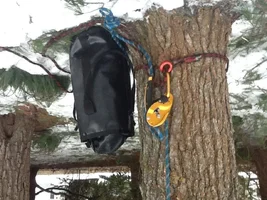
Hers is a deceivingly simple/complex system. I have been using for 2 years. Primarily for ascent. Some SRT-WP.

Like stated above, I am not so concerned with rescue as with the ability to attach midline and add line to the system easily.
Hooks up fast, unhooks just as quick. Other benefits in shock load dissipation as well.
Tony
Like stated above, I am not so concerned with rescue as with the ability to attach midline and add line to the system easily.
Hooks up fast, unhooks just as quick. Other benefits in shock load dissipation as well.
Tony
Attachments
SRTsteve860
New member
- Location
- North West Connecticut
Is that how trees grow in the southern hemisphere?
- Location
- Retired in Minneapolis
That's the descent mode heheheeeh
New threads New posts
-
test
-
 Alternatives to standard asphalt around roots
- Started by southsoundtree
- Replies: 5
-
-

-

-
 For Sale: 2018 Vermeer BC1000XL Chipper | 918 Run Hours | Deutz Diesel
- Started by Blue Ribbon Tree
- Replies: 2
-

