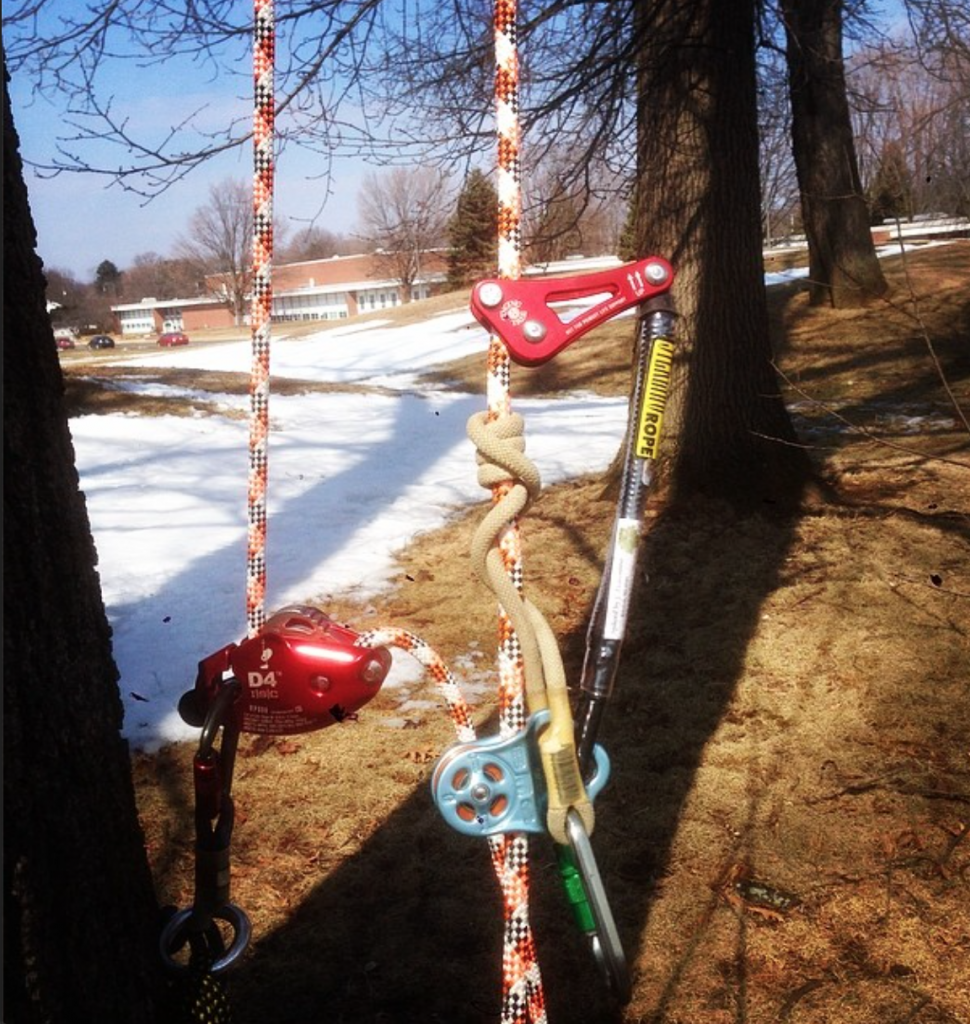
New Base Tie-In-Point

I hope the new buzz board allows swearing,
How is a guy supposed to make a point without colorful descriptors. This pick a different work bull [pick a different word] is [pick a different word] stupid.
 
I can't explain why, but pictures of base ties that have all kinds (actually, any kind) of gear just irritate me. Especially if people call them 'simple'.
I'm not trying to antagonize anyone by saying this. Like I say, I don't know why it should irritate me. People should use what they want if it's rated.
But everyone climbs differently and as we have seen, region makes a big difference.
Moving to the American south from the Canadian prairies is a big eye opener. I discovered that I really knew sh1t and it's still that way. It probably always will be.
 
ScreenShot2014-04-07at13147PM_zpsde6cf7e9.png

Here is what I switched to using to using (very simple). It shows my climbing system more than the base anchor (sorry for that). But it is simply an old section of climbing rope (rope boss) with a large arborist ring, a foot lock prussic to cinch it tight, and a ISC D4 to clean up all the congestion. I have a youtube video of how its all setup.
 
[ QUOTE ]
In thinking of the scenario. Yes a 230 foot line is something we should carry. I tie ropes together a lot but that is impractical. But I would only consider a 230 foot line if I had a very efficient way of managing it. Taking wraps is cumbersome and it eats up a lot of line. A good managing system easily allows you to climb the 40 footer with your base tie system. Jeremy is showing me how it works. We will see.

[/ QUOTE ]

Carry on thinking about it if you want Kevin, because I wont be. I have a 230 ft length because many times I have to bigshot past a hundred feet. I could join ropes together too but like the idea of just one. Primarily, its just an access line, I take a second, much shorter line up with me.

Its all relative to your personal situation. Like, how many times does Jer's scenario unfold like that. And there's your justification. I get a lot of use out of that 230, so there's mine. Cant think of a single significant situation where i needed someone to adjust the length of my line either. I personally dont want a bunch of gay looking stuff at the bottom of my tree - No offense to anyone, its just how I see it.

I would assume also that Jer or yourself would have seen that situation coming, as his line would've been hanging at 10ft throughout his whole time working in that tree ?

So plenty time and opportunity to make adjustments without having his full weight on the line beforehand. In the case of either a termination knot or cinching type device, I would think pretty comfortable to deal with regardless.

If you are only using it for an access line you might consider setting up your basal anchor as a full circle system (continuous loop). That way you can do a rescue with 230' of rope if your TIP is not much over 100' up. You just use a good bend to tie the two ends of the rope together and then attach the rope to your anchor with the bend just above your anchor. Then, when you need to do a rescue you just release the anchor and lower away. As the knot goes up the climber comes down. This system does have some risks (e.g., the knot could get caught in a crotch), but it definitely works well most of the time. I have used it many times in training, and never had a problem. My advice would be to use a conventional rescue if you have lots of rope, but if you only have one rope and it is just barely long enough to rig the tree, then you should consider the full circle as a viable alternative.
 
I always feel funny about putting something like the boss or the ID as the friction or lock off device at the base of the tree. If I wasn't raining debris down during the climb that would be ok. I would just hate to blast it with a good chunk of wood and blow it apart. That's why I decided to use an 8
 
Thanks! That's what I thought for a long time too, but how many groundies are trained in aerial rescue? Yeah a port-a-wrap is awesome and wont break but that takes awhile to setup and can be confusing to a groundsman to be a rigging line setup. I was surprised because I thought the handle on the D4 was completely plastic but it is metal with a thin plastic coating, therefore it is very difficult to blast apart. The way I set it up, I have everything back up incase the device somehow was broken.
 

New threads New posts

Back
Top Bottom