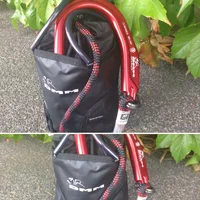
I was going to slightly retract what I said about the hook being a danger to hitting you; it is only under certain circumstances that this is the case. It is as you imagine, just common sense - the closer, and more vertical your target - the higher your chances are that it might come back at you - just like a steel biner/throw weight/anything would.
Most often in the tree - you'd probably not be throwing at angles that are too vertical (though sometimes will). Most of the time you'll probably be throwing it between 45 degrees, 90 (horizontal), or beneath. Just like throwing anything - you'll realise that the better your vantage point (ie, higher) over the target - the easier it is - then you can always descend to put your weight in it.
I was testing to see how far and high I could throw it - therefore my angles were at 45 degrees or higher (I was just seeing what it could do). If it gets stuck in any way (when your trying to free it) - of course you want to get closer to it (to try and manipulate it easier), and of course the closer you are to it, the greater the chance that it could hit you when you finally free it (of course, the more vertical - the worse). I was just testing to see what it could do. Like any product, it has it's limitations.
I'm still keen to hear from anyone who can try out a Petzl Connect Adjust in SRT from full weight all the way down to half-weight and less. My boss has a Petzl Reverso (the closest thing to a Connect Adjust I may be able to test) - though he's so busy - he's neglected to tell me where it is.
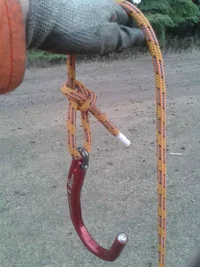
Below is a photo of what I have tested (though yet to use at work); it is simply a Bowline - though I have deliberately made the loop about a biner length, and I have also tied it so that the bight of the knot would come over the branch in the way that you see in this photo, as if my hand were the branch (if the knot/bight were facing the other way it would be harder to pull over the limb). The reason I want to try out this configuration is because of course I found that if you have a small knot at the end of a single line - it can be hard to pull it through a branch union (depending on how tight it it) without it getting caught/having to flick the line a little in order to loosen it slightly to get it to almost 'jump' through; when you do this it is possible to inadvertently orient the hook wrongly or even accidentally flick the hook out completely. With the Bowline I am distancing the knot slightly further from the hook - so hopefully there will be less chance the hook may flick out from the union (unless I want it to). Also the 2 sides of the Bowline loop should stabilise the orientation of the hook more after the knot has passed through the union. We'll see...
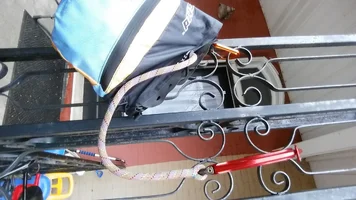
Below are just another couple of photos of the nose.
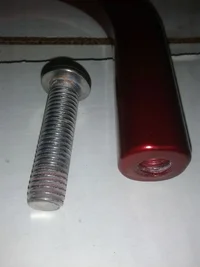
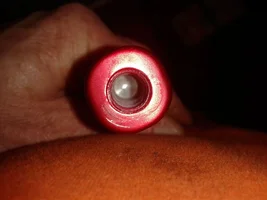



 ). Actually if I really do not want to "push" the limits of the hook in a 2 in 1 configuration, I can put a biner through the hook clevis I suppose. and just leave the hook dangle at the D.