Descending

Its not the cost per se, climbers get what they need when they need it. With that being said we are alwyas looking for something bigger, better, fatser, SAFER. and if possible cheaper to maintain/purchase overall. If we purchase say 4 new cords per week, times 4 weeks, we are well over $500. How much would a lockjack or unicender cost? How lonmg would it last before a cam/clutch/bar needs replacing? Is it a better investment with our money?

TM pretty much summed up my response.
 
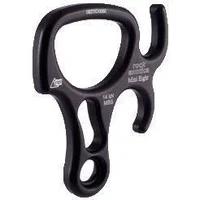
Blinky brings us a device that has potential, a horned 8;

234954-F1.jpg


Now, I'm thinking of it's use, but not using is as a conventional 8. Take a look at the center slot, the oblong oval right in the middle of the piece. Gimme a second, I've gotta go retrieve a supporting picture and then describe how I can see it applied.
 

Attachments

  • 234954-F1.webp
    234954-F1.webp
    6.2 KB · Views: 35
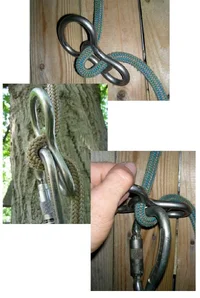
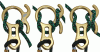
Here is an SRT version of a non-conventional use of an 8. The DdRT version would simply have the anchor end of the rope anchored to the climber.
These images show both 11 mm (Velocity) and 13 mm (Hi-Vee) being used in the piece.

234957-8-slot.jpg


This particular 8 had a 'let go, lock off' intrinsic. To release for descent, you had to pull the wide end of the 8 downward, like in the third image. Otherwise, you stayed stationary until you applied action, just like you would a hitch.


A horned 8 is nothing new, there are a lot of them out there. A horned 8 with the rope slot, those are more of a rare breed, but I've got a picture of one of those somewhere here in house......
 

Attachments

  • 234957-8-slot.webp
    234957-8-slot.webp
    90.2 KB · Views: 30
[ QUOTE ]
How much would a lockjack or unicender cost? How lonmg would it last before a cam/clutch/bar needs replacing? Is it a better investment with our money?


[/ QUOTE ]

Not even an option for what you are trying to achieve. Great tools for what they were designed for, which is control and use of friction. You would see noticeable wear in one day of using them in the manner you described.

Dave
 
A rack is the simplest, cheapest, most durable tool for an application like this. Cavers came up with the tool in the early 60's and they've been very refined now.

Stainless would be the most durable but a bit more slippery than aluminum. Using enough bars is important. Adding an autoblock underneath is pretty much SOP for other vertical users of racks.

I'd want a hyper bar on mine in this application.

http://www.rocknrescue.com/acatalog/Rappel-Racks-and-Rack-Parts.html
 
[ QUOTE ]
Wouldn't a Cinch work alright for this sort of thing?

[/ QUOTE ]

A Cinch would work, just as would a Grigri, a Rig or any others in that class of self-locking belay devices. A couple things to note, though.

These are meant to be used in slow motion. By that I mean, belaying another climber, you are paying out line slowly. That part is OK. We as climbers would do exactly that in the tree using it as a self-belay device, we would just want one-handed, near frictionless out-feed, 1:1 in SRT, but 2:1 DdRT where it is replacing the friction hitch. This has very little to do with Bull's application.

Second, Boston's climbers want to come out of the tree rippin' fast. The advantage of these devices is their fine sensitivity. The disadvantage of these devices is their fine sensitivity. They're really designed and meant to catch a falling climber on belay. You can open that baby up and fly down the rope, no problem, no question. Coming to a smooth, controlled and graded STOP from terminal descent speed is another matter. The position between slow-down and stop is a very, very tight tolerance. Now, this is good if the device is going used as designed and intended (slow motion, instant stop of a falling climber). The application we're talking about is a different animal. If you're rippin down a rope and you pass the 'sweet spot' of controlled descent, you are immediately in STOP mode, and you will stop, very instantly.

A very instant stop is what these devices were designed and intended for; to catch a falling climber. They were designed opposite to traditional belay devices where increased hand pressure on rope slows the falling climber. With these devices, decreased hand pressure on the device slows the falling (or descending) climber. Hands off the device, complete stop. It can be a jerky ride.

 
A note on the physics. We're using these devices to overcome the forces of gravity-- correction, we're using these devices to overcome the forces of motion, an accelerating mass. You go from a stop, and accelerate to some velocity. Friction is the opposing force to an object in motion. There is energy at work here, kinetic energy, or the energy of motion. This energy, in the process of being resisted through friction (decelerated) is converted to another form of energy, heat.

This heat gets passed to our device, or friction hitch (and to a lesser extent, the rope), and contribute to the wear on devices and ropes. Descending slowly gives time for that heat to dissipate outward, into the device. That heat then dissipates out of the device, and into the air. This takes some time. With Boston's scenario, all the action happens in a very concentrated period of time. Heat production spikes in rapid deceleration. The point here is.... maybe I didn't have a point. I guess, just be aware of this.
 
Neither the Rig nor the I'D were designed for belaying or catching a fall. They were designed for work positioning and descending. The Rig is rated at 150kg (331 lbs) for 200 meters (656 feet).

In looking at some of the ideas in this thread, I see a lot of rope running through/on aluminum. It won't take many rappels until you start to see black aluminum on your rope. That's aluminum oxide, one of the most abrasive materials around - embedded in your rope.

With a rack, I use a dual hyper bar, or the Rig (and Grigri and Cinch for that matter) the rope runs on a steel bollard and a steel pinch pin. That will hold up much better to lots of rope run than aluminum devices, such as al F8s, al biners, etc.

An I'D might be even better for this application. It has a larger steel cam, if it gets threaded backward it locks off with an internal cam, and it can be locked off with the handle.

http://www.youtube.com/watch?v=1UlGlFUbFY8

The latest model has a button in the handle to keep the handle in position. The one in the above video was not the latest version.

The small I'D (shown in the video) does not have to be disconnected from the saddle to be installed on the rope or taken off the rope. The Rig doesn't have to be disconnected either, but the Rig doesn't have the backward thread safety.

I would think it'd be hard to beat a small I'D for this application. Of course there's no way to be sure until it's been down the rope a bunch of times.
 
[ QUOTE ]
Neither the Rig nor the I'D were designed for belaying or catching a fall. They were designed for work positioning and descending.

[/ QUOTE ]

I stand corrected.

In catching a fall, what's meant is safely holding a climber's weight static by the belayer, hands-free if the belayer is being a putz and not paying attention.

In self-belay, same thing. The device doesn't know whether you're belaying a climber, or you ARE the climber, belaying yourself.

I have never used an I'D or Rig in doing speed descents, so I can't comment.
 
Regarding the Rig, this is a very safe tool by design. Even though it doesn't have the anti-panic cam, loading it is straight forward and easy and, once learned, would be less likely to do improperly than the tying of a knot. The descent lever flips out of the way when not in use in a position where if something falls on the unit from above, there will be no slippage, it will go into lock mode. Even a friction hitch will slide down the rope if something falls and catches on it from above.

But what BB might like about it, is that it has two modes of descent. In one mode for small adjustments, the handle is used to modulate the speed. Even on single rope, this is very easily accomplished. But for rapid descents, which can approach freefall speed, the lever is pulled all the way down, fully releasing the cam and speed is then controlled with the gloved, belay hand.

I believe this is the type of ability that BB is looking for. However, I am still reticent to fully endorse it in a doubled rope system because I simply do not have enough time in that mode with it to do so.

Dave
 
Thanks Dave, I forgot about the anti-panic. The I'D has a panic position. Pull the lever too far and it locks off. That's good and bad: it's good for the 'panic' situation, but it may limit how fast you can rappel.

As Dave pointed out, the Rig does not have the anti-panic mode - which again is good and bad: if a rappeler panics, he may fall. OTOH, you can pull the lever 'all the way' to get maximum speed.

And again, as Dave pointed out, there's no real way to know for sure until somebody has been through lots of feet of rope and spent time using the Rig in this application.
 
hey cory you also factor in the cost of new rope and rope bags every few weeks...

i've been following this thread alittle bit and maybe try to post with something coherent.

the answer is finding the right 10mm beeline or its likeness.

i have gone through 4 different 200ft bulk orders of the stuff and each 200ft has had a different color core. yellow, blue, green and orange. so far the orange core has held up the best. and surprisingly its held up to the heat with a gloved hand doing the rap'n. (i just started to wear gloves at work)

also very impotent would be your hitch selection. the martin/mexican hitch although good for rope climbing around has 1 very nasty pinch point that will melt through with a quickness.

the distal is what i am using now but even that wears real nice like in a couple spots.

i think i am going to go to the vt because of all them colls and wraps but at the cost of a few more inches everytime i make a new prussic so that might lead to cost increase in more hitch cord but maybe it'll save on rope and maybe add some time to the knot.

theoretically the perfect set up for this would be the taughtline on a closed system. or maybe taughtline on a splittail. but the key is rapid descent.

bullie. tell these guys who the best crane removal crew in the northeast is.
 
Yeah, tell us, enquiring treebuzzers want to know.

Pog, why not descend just a bit slower? You said, I think, that your cord is done after one day, like 50 descents. Well, most hitch cord I'm guessing must last for a few hundred raps, so what about slowing down, is it an option. Just a lil.
 
Hell I'm using the same piece of Ocean I bought at TCIA in what... November? Hitch cords last me a long time. I don't do 50 descents in a day though. If I was doing that many trees in a day they'd need to pay me a LOT of money.
 

New threads New posts

Back
Top Bottom