Descending

Interesting on the Harken pulleys, but as Tom says, a device such as this has been created for the arborist. C'mon Tom, find us a link.

There seems to be consensus toward a bollard, or a one-way, ratcheting pulley at the crane point. Having watched the videos, anything other than a single-tree pick requires that you detach from the crane and reattached to the tree. You would have to detach from the crane while it does pick #1.

Waiting for the crane to return, the climber sets a second lifting sling. Crane returns, hook him up, swap slings and bail to cut site #2 from a tie-in site on the tree. At this point there is no reason to be attached to the crane. You're just doing a short drop and would set yourself for that while the crane was lowering its load.

Once you drop down to the point of cutting you would flipline in, pull rope and reset rope below the cut (ANSI requirement, TITS). Make the cut. Set the final sling and prepare your climbing line for your final bailout.

Now, at this point you can pre-set yourself to bail out off the tree, or wait, hook up the lifting sling to the crane, un-set your climb line from the tree, connect yourself up to the crane, then bail out.
Am I correct in this?

If I am, the only real advantage in rappelling off the crane is in a single-pick operation where you never detach from the crane in the first place.

Personally, on multi-pic ops, on the final hookup, I would pre-ready my climbing line right where I'm at, wait for the crane ball to return, hook up the lifting sling and bail immediately, 1:1 twin line. I would be to the ground and detached, pulling rope by the time a climber up top would get his climb line un-done from the tree, and hooked back up to the crane shackle/bollard/ratcheting pulley.

I've been in this spot many, many times and have never considered bailing off the crane hook. It would mean additional steps. I need to get to the ground, get my rope out and get cutting that final cut. Cranes cost me intense dollars and I need to pay him his tip and send him home.
 
Here's a (click-->) crane job time-lapse, contract climb the company owner shot for me.
It was a tricky one, big, limby sycamore, over top of a garage, a tight landing zone and wires everywhere,

The owner said he'd pay me an extra hundred bucks if I had the balls to do the dismantle without spikes AND finish within the planned timeline. I made the extra hundred and saved him even more, coming out an hour and a half under.

I'd do these all day if I could. I really envy you guys with cranes.
 
If you have someone placing straps and someone cutting, the guy setting straps bails to the ground after every strap set. the guy cutting stays in the tree the whole time. I can see the sling setter burning through a lot of hitches.
 
I have used the Harken ratchet blocks for what they were designed for on sail boats. Like everything else Harken, they are top notch but would not work for this application.
If they intend to stay with a standard 2:1 system, the solution to their problems can best be visualized by examining a lowering system.
When a log or limb is cut if you are heavy enough you can lower it with just your gloved hands. If you let the piece run your gloves will get hot, real hot. Now take one turn around a smooth bollard and you can lower the same piece at a fast rate of speed with little heat build up.
You have just distributed the work load between your hands and the bollard. The bollard itself needs to be smooth and of large enough diameter to have a favorable bend ratio for the rope.
Now the problem with a standard bollard is the turn- around friction created will work in both directions, pretty much binding up the system and not allowing the climber to move. However, allow the bollard to run in one direction on a smooth-bearing surface would allow the climber upward movement with, theoretically, as much ease as run through a pulley. But on the descent the sharing of the load on the drum would significantly reduce the load on the hitch.
I would not be comfortable with using the currently available bollards in this application. Not only will their non-rotating drums bind up the system as mentioned, their rope-capturing mechanisms are not adequate for safe operation in this application.
Thus my thoughts of a swing cheek block that would fully capture the rope that has a turn around a smooth-barrelled, ratcheting, bearinged bollard.

Dave
 
Dave,
You're way over my head but, when I read 'one-way pulley/bollard', I thought of the Petzl Pro Traxion. This is an efficient one-way pulley (ball bearing) that can be unlocked for use as a normal pulley.

It has a WLL (one-way holding mode) of about 560lbs and a breaking strength (again, one-way holding mode) of about 900 lbs. It is intended for life support, and some rescue applications but not for heavy rigging.

I have no idea if this would work in this application, but I thought I'd mention it and let you guys decide.
 
Ron, I can't elaborate more right now, am running out the door, but the Pro Traxion, as is the Harken ratchet block are designed for progress capturing. They do this very well. But this feature falls short of what I am talking about.

Dave
 
[ QUOTE ]
Dave, I thought of the Petzl Pro Traxion.

I have no idea if this would work in this application, but I thought I'd mention it and let you guys decide.

[/ QUOTE ]

The ProTraxion would not work. I have one and use it regularly, but it is not a ratcheting pulley. It is a cammed pulley, a one-way rope jamming pulley. If you search it on the web you may find it described as a ratcheting pulley, but it is not.

A ratcheting pulley turns one way, freely, but stops in the opposite direction. This does not mean the rope stops when pulled in the opposite direction, just the pulley itself. This means when the rope goes the opposite direction, it encounters the friction from passing over a stationary steel wheel, a 180 degree turn.

The bollard concept takes the rope 540 degrees; up, around the stationary drum a full turn and then back down. This offers a much greater amount of friction and would in essence make your hitch last a lot longer as the larger part of the friction would be administered up top, a couple problems, though.

#1, the friction is controlling you in large part from the bollard, and has a great influence on the speed of descent. And you are still in a 2:1 system, your friction coming from two independent sites. You have no active control over the upper friction in a conventional bollard.
#2 Unless the rope has a dedicated guide channel over the bollard, it can bind. This is caused by the rope crossing over itself. Sometimes it will, sometimes it won't, but it always can. if it does, you're stuck.

There are some new rescue pulleys that function both as a pulley going one way and a friction handler going the other. This cmc rescue pulley allows you to set the amount of friction going the opposite direction.

Here's another frictional pulley called the 540 traverse.

I have not used either of these, I just found them doing searches. This is the sort of one-way frictional pulley type devices that we're talking about, but they're not bollards, just bollard-like in the way they offer friction (rope rotating around a stationary drum).

Call me a skeptic, I just see something like this complicating a system that should be remarkably simple.
 
good find on that 540. that looks more like what we are talking about. expensive though. I bet you would barely even need a wrap on your friction hitch.
 
This discussion has seemed to have gotten way overcomplicated. Rope techs have been descending quickly for decades using F8s and racks. If arbos can't figure out how to use systems that have been in place and proven for years they might be better off not going aloft. There have been many good suggestions in this thread already that are simple and safe. Use a friction device instead of a hitch, there are plenty on the market. They only cost a few mulitiples of what a friction hitch costs but last years.

The 540 and similar bollards work well but make a descent system more complicated. KISS.
 
these are fun! I definitly dont have a problem with burning out hitches. I have more of a problem throwing away ones that I feel have been in service too long. They accumilate and I dont quite like them for climbing cause they get a little nappy and a little crunchy but perfectly strong. I like the 8 mm beeline with splices. I cant relate to the line of work that would burn up hitches like that. A lot of interesting concepts have come out of this thread. I wish they had these tools more readily accessible to see and play with. its hard to know what they are really like from a picture. I am happy to know about the 540s existence regardless, as well as the scarab, this thread has been quite interesting.
 
one option might be a ropes course reduction block. My dad uses these when belaying people on the ropes course. It is a block of aluminum instead of a pulley and add friction up top. This size wouldn't work with a spliced rope but other sizes are probably available. Just a thought.
 

Attachments

  • 235741-plum019.webp
    235741-plum019.webp
    177.1 KB · Views: 117
[ QUOTE ]

Call me a skeptic, I just see something like this complicating a system that should be remarkably simple.

[/ QUOTE ] [ QUOTE ]

This discussion has seemed to have gotten way overcomplicated. Rope techs have been descending quickly for decades using F8s and racks. If arbos can't figure out how to use systems that have been in place and proven for years they might be better off not going aloft

[/ QUOTE ]
I've got it figured out, I'm just hanging with the conversation because it's interesting.

If a figure 8 or a rack worked really well, all-around, I'd be using them. As mentioned, an 8 twists the rope, rack is slow on and off and can be cumbersome. BOTH blow chunks as far as slack tending. However, both could work in a descent-only scenario, I would just go stainless.


The bollard up top is an interesting concept, but when you throw a friction variable into the mix, an unknown factor that you have no active control over, it's like asking for limitations.


What about having the bollard right in front of you? Consider this. Rope would come down, do around and back down; 360 degrees, not 180 or 540.
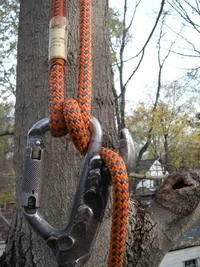
In 2:1 you would have a 180 lace over top and a 360 wrap in front of you, shared friction, but not anything up top that would factor heavily into your descent . Primarily, the length of line passing through friction control would be your biggest factor. Now JUST FOR FUN, I am going to post a boiled-down, 'least common denominator' version of a 2:1, bollard in front of you. Remember, this is not being suggested as a means of descent, but rather posted as a mock-up, a grossly oversimplified look at what I'm talking about. No flaming required, there are many reasons you would not want to use this particular setup. It can help you imagine what a more ideal setup might look like.
235772-military2-1.jpg
 

Attachments

  • 235772-military2-1.webp
    235772-military2-1.webp
    95.5 KB · Views: 55
.....huh..... what???? A hyperhorn on a steel triple lock CARIBINER?? WTF is up with that?


Clearly, in that picture, you would have wear on your splice, not OK, and the bend radius is less than ideal, but this configuration does not twist the rope. This is as quick-on/ quick off as anything you'll ever see. And it does not even require a friction device.

So, given those two advantages alone ( as well, the setup could go DdRT, DbRT or SRT and is not made of aluminum), how could we visualize something like this as a more formal and workable model?

Ideally, the caribiner itself would have a channelled 'guide' patterned into the larger diameter top 'tube', it would need a second hyperhorn facing either down, or out (or both) and a wiregate trap for the top lockoff horn. And a swivel below where the picture stops.

This doesn't exist, I'm just thinking out loud.
 
Many years ago I bought one of these bollards:

http://www.bmsrescue.com/blayspl.html

I use it with half inch rope as an aerial rigging point. We found that all we needed to do was have one full wrap, we used the outside tracks so that the rope had a longer helix. My crew and I worked out a really smooth rhythm to alternate ends of the rope so no hockles developed. After working with it I asked my crew to figure out how much of a time/labor saving we gained by not having the LD at the base of the tree. Without going into all of the details of our procedure it was agreed that we gained at least a half a person, maybe more, by using it.

Look at the specs and read the attached article, he knows his stuff!
 
With tree machine's idea you could tie in how you normaly do, but use the horned karabiner where you put your friction hitch. once you start descending, take a wrap, just like on the unicender.
 
[ QUOTE ]
[ QUOTE ]

235772-military2-1.jpg


[/ QUOTE ]


Why mot a muenter hitch on a biner under your fr hitch. break the hitch and rap on the muenter. If something happens you are still secure and heat is off the knot.

I use this method for srt when using my monkeyteail on spars. quick and simple.
 

New threads New posts

Back
Top Bottom