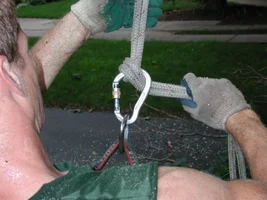
Descending

I hope I was clear in that I don't use this setup for climbing, just that in simplifying a descent setup the point where things become no simpler, the biner becomes the bollard, but a lockoff is still required for hands-off work.

The setup above places a lockoff on the biner itself. What this means is ANY device you use, in conjunction with this horned biner, becomes a device that has a lockoff. That opens up new worlds. [ QUOTE ]
Why mot a muenter hitch on a biner under your fr hitch. break the hitch and rap on the muenter.

[/ QUOTE ] With a convenient and secure lockoff for the munter, it would be a one-handed, not a two handed operation as with a munter/friction hitch setup. Plus a munter twists the rope, not acceptable if you're doing sizzling ground approaches.

[ QUOTE ]
I bet that configuration WOULD twist the rope - I'm thinking worse than a F8 would because of the full coil around the biner.


[/ QUOTE ] Bet all you want, it doesn't. DOn't ask me why, I can't explain it, I just know from experiencing 8's, munters and this thing. This wrap is kind of a kindred brother to the munter; but the munter twists rope, and this one doesn't.

Does this wrap even have a name? Someone told me Military wrap once, but I question this.

Below, here the wrap is shown on twin line. AGAIN, not recommended. Note, the climber is on the ground, no PPE, twist gate biner instead of a triple lock. This is a posed shot, not involving tree work. It is just to show the wrap in twin line 1:1 configuration.

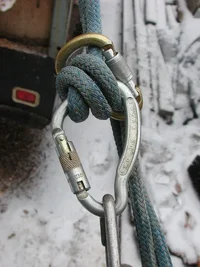
237598-Rappell.jpg
 

Attachments

  • 237598-Rappell.webp
    237598-Rappell.webp
    51.1 KB · Views: 46
I have made a rack that can be used for descending (and ascending). the big rack I call the Hog Dog OAR (for Offset Ascending Rack). The rack pins are size 80 ansi chain links mounted through offset aluminum arms, with an aluminum spine. It acts as a one way cinch that grips the rope when weigh is hung on it, and does not release until the handle is pulled. Here is a video of this large OAR (sorry for the squealing pulley, and sideways ascent).

http://www.extremerockclimbing.net/ascending-rope-rack.html

The OAR pictured has been dissembled to make other OAR's, but I could make you another about 8" overall, and about 2 lbs. and send it to you if you would like to try it out.

I have other videos on youtube of a compact OAR, with static and shock load drop tests.
 
The effort you've made is appreciated, but you've made a unicender, sir. At 8" you've made something half the length of a saw. At two pounds, you've made a boat anchor.

Does it perform using all three rope techniques? Does it masterfully manage 1:1, both single and twin? Does it tend slack, friction free like lubricated silk?

I don't mean to be harsh, but the unicender people (rock exotica at this point) may take issue with you. As well, theirs is smaller, lighter and (please note...) patented.

Using a single device to both ascend and descend is simply replacing a friction hitch with a mechanical device in a 2:1 DdRT system. 2:1 DdRT is a very inefficient system to begin with, but climbers tolerate it because you don't have to change over to abseil. But when a changeover only takes 5 seconds, and both devices are highly optimized for what they do, a one-device-does-it-all has much less of an appeal.

Before you go re-mortgaging your house on this thing, some due diligence may be in order. I'm just trying to be practical in offering advice, not dogging you. I can appreciate better than most the inventive spirit, but you're 15 years too late on this particular device. It's already been done.

Try inventing a dual ascender with dual-sided friction handling capabilities. This hasn't been done.
 
The Hog Dog OAR is heavy at 2 lbs., but for crane work this may not be such a issue, and having the friction through high grade steel pins would seem to be an advantage for long descents. The Unicender is a great design, which is itself nearly 7" in length.

The OAR is being tested, and has been found acceptable by one arborist in CA to date. I am no threat to Rock Exotica.

I have actually already made a dual-sided ascender (which has also since been dissembled since this picture was taken) This unit could be made compact, just as I have made a compact OAR.


http://s36.photobucket.com/albums/e33/gdsandkes/?action=view&current=100_1030.jpg


http://s36.photobucket.com/albums/e33/gdsandkes/?action=view&current=100_1094.jpg
 
[ QUOTE ]
I don't mean to be harsh, but the unicender people (rock exotica at this point) may take issue with you. As well, theirs is smaller, lighter and (please note...) patented.

[/ QUOTE ]

Interesting, the small version of the OAR (in the Photobucket image) looks good. I'm noticing that design is significantly different from the Unicender in regard to the friction parts of the OAR that contact the rope, the steel pins, different design altogether. It really is a miniaturized rack. Not sure the Uni can claim to own the rack design concept. Anyway that's for lawyers to decide. Always good to see innovation.
-moss
 
Boston.
I don't know if this would work for what your looking for, but i was thinking that you could use the Kong Hydrobot and place a friction hitch below it. Just like Kevin Bingham and I do for single lining but instead it would be a doubled line with both ends running through the hydrobot and then a hitch tied around both like a prussic or kliemhest is used when footlocking. Your still using cordage, but in my experience when using a kong robot and srt climbing my hitch rarely ever sees the heat and i use tenex so it could be real inexpensive to replace when the time comes.

Not sure if it would work but might be worth a shot.
 
I know this post is getting a little long winded but I thought I might suggest the Petzl Stop. If only one strand of line is passing through the device it's an awesome descender. Wouldn't be able to use it on a doubled rope though. If you're coming down a doubled line though, you could always tie a butterfly in one end just below the TIP and then put a screw link or carabiner in it and around the other end to choke it off and just come down one line. The Stop is super fast on and off the rope and stops and locks well on 11mm line.

-Monkey
 
I tested out the OAR DdRT ascender/descender created by Surveyor. It works very well. More friendly to the rope than the Uni, it has multiple round "axle" (the pins) contact points to the rope as opposed to the rounded off thin edge contact points on the Uni. As I thought it's like a miniaturized rack. And it behaved like a rack, when I started descending from 75' I had to feed the rope up just a bit to get going because the rope weight below was slowing it down. It has two descent modes, one lever is a fairly moderate to slow speed, with two levers pulled down it opens up and you can move as quick as you'd like. The fast mode was more to my liking but the slow mode would be good for limbwalking etc. It seems to dissipate heat very well, I was able to move as fast as I wanted on descent. Again, I only descended from 75', don't know what the heat performance is from bigger height.

For ascent it's very smooth. I really enjoyed that there is zero sitback (loss of height) when you stop climbing. I like to pull from above the hitch (or device) when I'm ascending DdRT so I configured it a little different than Surveyor does, he pulls from below the OAR, kind of like body thrust technique. I put a mini-carabiner from the top attachment point of the OAR to just above the carabiner/knot anchoring the other leg of the rope to my harness (as opposed to anchoring the static leg on the top of the OAR). The device self tended perfectly well in this mode.

Overall I'm very impressed. It's a prototype and could use some additional "fit and finish". Based on the crane climbing requirements stated by Boston Bull I believe the OAR fits the bill. It's a heavier of a chunk of gear compared to the Uni but I don't think that matters for crane or work use in general.

As far as patent infringement goes it is a very different design than the UNI, any similarity is superficial IMHO.

I'm going to try and shoot some video on Friday showing how I configure and climb on it.
-moss
 
My brother has climbed on the OAR unit and he has some reservations. I'll talk with him and get something posted.

I'm concerned with how the pins are used to support the rope. This isn't the way the pins in the chainlinks were made to be used. They are made to have both ends of the pins supported. Adding the rope leverage could bend them open causing a fall.

When my hand heals I'll be on the OAR for a personal test.
 
Thanks Moss and Tom for your comments. I look forward to the video.

the unit I sent Tom is a three arm OAR which I did a shock load drop test with of an earlier model which used the regular size 60 ansi chain links pressed through 1/4"x 1" aluminum arms to form the rack arms. The inner pins are in fact supported on both ends of the pin with the steel roller link side plates, while the outer pins are bolstered by the aluminum arm to which they are attached. I dropped 200 lbs from a height of 24'. Here is that video.

http://www.youtube.com/watch?v=pD3EqluCKDg

There was no bending or breakage at all with this drop test. The unit I sent Tom uses the heavy series size 60 roller chain links which are even stronger.


I sent Moss a four arm OAR which uses the heavy series size 60 links also, which has the advantage of holding the max limit of my static weight test on both 11mm and 13 mm rope shown here (with a previous test on a three arm OAR).

http://www.youtube.com/watch?v=j4HE0t1fQT0&feature=related

The four arm OAR is also better in that it has automatic braking with two descent options as Moss has indicated, depending on the weight attached, I have descended with it on a single line and it works fine with my 150 lb, frame, being easier to modulate the descent speed by pulling the lower "slow" descent arm and modulating the upper descent arm with an index fingertip.
 
[ QUOTE ]
My brother has climbed on the OAR unit and he has some reservations. I'll talk with him and get something posted.

I'm concerned with how the pins are used to support the rope. This isn't the way the pins in the chainlinks were made to be used. They are made to have both ends of the pins supported. Adding the rope leverage could bend them open causing a fall.

When my hand heals I'll be on the OAR for a personal test.

[/ QUOTE ]

Tom, the load is distributed across many pins, not all pins are anchored one side only. What you're saying makes sense on paper but climbing it didn't seem possible for the rope to escape, too many parts would have to fail at once. Maybe Surveyor will post a link to his load tests, the device is super robust in shock load scenarios.

Main flaw if you can call it that is that if you slack the rope getting onto a branch you have to tighten it up before reloading or it will drop a few inches before grabbing. Then again that needs to be done with a hitch.

It needs a slack tender pulley added on the bottom to redirect when you're coming back from a limbwalk.
-moss
 
Just went out to the car and grabbed the device for a close look. 4 pins are anchored on one side only (4 other pins are supported both sides). The "one-sided" pins are approx. 7/32" diameter x 1 and 1/4" long steel round stock through a very heavy chain link (link plate is 1/8") which is flush flat against 1/4" aluminum stock. The pin is through the 1/4" stock, 3/4" of the pin is on the other side (rope contact area). Don't think there is going to be any bending happening. The OAR is overbuilt if anything. You could wail on it with a hammer and bend something but the way the rope flows through it and forces distributed don't think so.
-moss
 
I agree with Moss
blush.gif
I have actually made an OAR with the next size smaller chainlink (size 50) and it seems quite strong. I have not drop tested this tiny OAR. I have also made a four arm HOG DOG OAR with size 80 links.
 
If Boston Bull is interested and Surveyor agrees I can hand the unit over to him to test for DdRT climbing off a crane (Bull and I are in the same area).

The small OAR sounds very interesting.
-moss
 
Thanks for the video demonstration Moss. I have a four arm OAR being tested which does not employ the rollers, and the two middle arms are stubbier than the one you used. By pulling down on the bottom middle arm you can modulate the speed of descent with one finger on the top middle arm (the top rack arm then acts as a brake assist). I will have to think about your suggestion for slack tending as you had it rigged. I am working on an OAR for BostonBull.
 
This is very interesting. I would like to see it SRT. And also, can you start a whole new thread about the OAR? I dont think it should be buried 9 pages in under the vauge title of descending.
 

New threads New posts

Back
Top Bottom