Descending

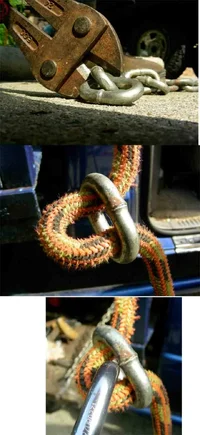
Here ya go. This series of images is pretty self-explanatory. Again, only in a pinch, DdRT or SRT only.

It's worth carrying on your saddle because it takes up next to no space, weighs next to nothing, works rather well and can serve another important occasional advantage in the shotline/line tracing arena.

234747-rappel-link.jpg
 

Attachments

  • 234747-rappel-link.webp
    234747-rappel-link.webp
    102.8 KB · Views: 43
These are crude, basic forms of descent devices, but can be remarkably effective if upgraded, which they have been.

Upgrade #1, two chain links welded side by side allows DdRT, DbRT and SRT. Remarkable, such a simple piece can be used for all three rope techniques.
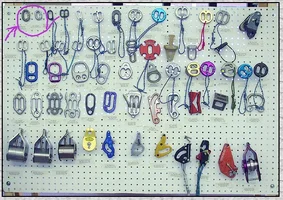
This describes the entire class of belay devices like a number of those shown below.
234749-display-chain-link.jpg


Upgrade #2 install a cable loop to parallel the rope bight. This keeps the piece from 'riding up' the rope during descent and allows you hang it on that little brass snap on your saddle. This describes every ATC, or ATC-like device ever invented, by any manufacturer, a class known as tube devices. Cheap and effective, they <u>all</u> lack one major upgrade.

Upgrade #3, intrinsic lockoff. As far as I know, no manufacturer has advanced a dual-sided tube device to incorporate a lockoff as part of the device.

The ATC group (the XP and the Guide) by Black Diamond have done a great service to this category by 'cleating', or adding friction ribs to the rope channels, giving most excellent control. Trango's Pyramid, too. And Petzl's Verso. All very similar top-end tube devices for about $25.

One thing to consider, however; let go of the rope and you drop like a rock.

This is why I think these compact, lightweight, simple, inexpensive and effective devices need upgrade #3. I vote Rock Exotica to take that step. They're stuff has just gotten more and more awesome over the years.

 

Attachments

  • 234749-display-chain-link.webp
    234749-display-chain-link.webp
    148.4 KB · Views: 33
[ QUOTE ]
These are crude, basic forms of descent devices, but can be remarkably effective if upgraded, which they have been.


Upgrade #3, intrinsic lockoff. As far as I know, no manufacturer has advanced a dual-sided tube device to incorporate a lockoff as part of the device.


One thing to consider, however; let go of the rope and you drop like a rock.

This is why I think these compact, lightweight, simple, inexpensive and effective devices need upgrade #3. I vote Rock Exotica to take that step. They're stuff has just gotten more and more awesome over the years.

[/ QUOTE ]

The common rappel back-ups were either an autoblock below the device that holds enough friction to keep the belay device locked off if the autoblock is released, or a prussic/ friction hitch above the rappel device.


Installing the belay device below the friction hitch, pulling out any slack possible, and then releasing the friction hitch, should allow the climber to rappel with any of these tuber style devices, with a safety lock-off.
 
Simpler and quicker is to have a caribiner below the tube device and run the standing end through a locking biner as it comes out of the friction device. All the biner does is act as a fairlead, keeping the rope in tight to you and guaranteeing that the rope maintains a tight configuration passing through the the device and down.

What this does is assure tension over the final friction zone, a sort of soft lock in SRT and a pretty assured soft lock using twin line (DbRT). You adjust by feathering the rope upward while weighted. To tend slack, you take the rope in hand between the device and the biner and raise upward.

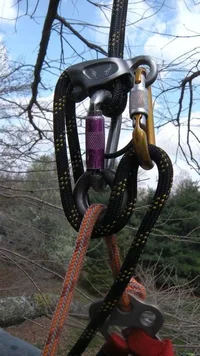
This keeps everything one-handed. The picture below shows more of a hard lock. To do what has been described above, you would attach the fairlead biner off the ring itself and drop the rope through it. Soft lock.


As the picture below shows, this is a 'sort of' hard lock. I mean, you can weight it fully and work hands-free, but if you lift the standing end while weighted you can position downward. Because of this, it is more a definition of soft-lock.

234772-threeparts.jpg


Hardware is a Black Diamond ATC Guide, connected by an ISC quad-lock and backed by a Petzl Attache screw-lock running 11 mm KMIII. Three hardware producers working in harmony.

This violates my suggestion earlier of shying away from Aluminum devices that take all the friction. the main connector caribiner takes almost all the wear. SRT would eat through that aluminum biner, twin line, ~half as fast. The device (the ATC) is more a keeper, not the main friction component. It just holds the rope in the proper configuration and adds the final amount of friction as it passes over top. The connecter biner should be a steel triple lock.
 

Attachments

  • 234772-threeparts.webp
    234772-threeparts.webp
    64.1 KB · Views: 56
TM-
That's an interesting use of that "eye" on the belay device.
For those unfamiliar with this device, the eye is used in rock climbing for belaying the second climber from above with an autolocking benefit, when rigged differently than in this belay/ rappel configuration.

Concern about excess wear on the bridge in this configuration???

A good thing about this type of belay device is that it can have the "brake hand" side of the rope/ running end coming out of the belay device over either side, giving some adjustability.

I would think that it would be simpler to maintain the (release-able under load, contrast prussic hitch) friction hitch above the belay device, probably with an extension, allowing the climber to descent, re-ascend if need be, and be backed up in case of a panic situation (at least as much as we ever have in a panic back-up with a single friction hitch on our climbing system. As long as the climber lets go of the hitch , it will lock-up if the brake hand is released.)

One problem with the tubers is that as they wear down, you can start to get a less than rounded edge forming. Part of normal gear inspection.
 
[ QUOTE ]

What about instead of putting your climbing through the ring like normal you add a wrap and use the ring kind of like a bollard?

[/ QUOTE ]

What? Use the ring like a bollard? As written, that's not possible. Do you mean use the ring in a standard manner and then do a wrap around the caribiner, using the caribiner like a bollard?

[/ QUOTE ]

I meant the ring you tie into on the crane. I was trying to think of a way to do it without any descending device at all. After reading my post I get the confusion. Sorry about that.
 
I guess the device i want doesnt exist. I want to completely eliminate, if possible, friction hitches altogether. Something quick on, quick off. f8's hockle the line, and all others dont offer the "I let go I stop feature" us Arborists are used to.

Guess its back to hitch cord.
 
[ QUOTE ]

I guess the device i want doesnt exist. I want to completely eliminate, if possible, friction hitches altogether. Something quick on, quick off. f8's hockle the line, and all others dont offer the "I let go I stop feature" us Arborists are used to.

Guess its back to hitch cord.

[/ QUOTE ]

[ QUOTE ]
or the lockjack sport

[/ QUOTE ]

I was going to say the samething.

I wont go with the Uni, cuase, Tom pushes it too much. I think he gets comp money for everyone sold.
avid.gif


really, I've used both, I myself like the lockjacks. Either one you choose you'll like it way more than a hitch cord.
 
Your concern about the climber not being able to handle the change in routine doesnt seem warranted to me in this case. If one were using the scarab tool for example. I dont believe that they would forget that they were using it and treat it like a hitch. its a diferent motion but its also a different tool, i don't believe ones mind would be confused. Id give it a shot.
 
I've really gotta agree with treebing. Your descent speed ultimately depends on the rate of the line going through your hands. You are belaying yourself. Is the climber on the way down going to all of a sudden let go of the rope? Rather doubtful.

We're talking about a pure descent, no work positioning, nothing really technical. Keep two hands on the rope. One is backup to the other. Leave the hitches in the truck.
 
I recently traded some stuff for a Lockjack sport and have been loving it. Here in the Portland area we have some really big trees and so long descents are not uncommon. I have been very pleasantly suprised at how well the Lockjack has worked for me. It gets pretty warm at times but I haven't notices any line glazing.

My new boss has a friend who does CNC milling. I am going to see if he can mill up a batch of stainless clutches that will dissapate heat well and hold up better than the aluminum ones do. I'll let you guys know if I have some made and how they perform.
 
[ QUOTE ]
I've really gotta agree with treebing. Your descent speed ultimately depends on the rate of the line going through your hands. You are belaying yourself. Is the climber on the way down going to all of a sudden let go of the rope? Rather doubtful.

We're talking about a pure descent, no work positioning, nothing really technical. Keep two hands on the rope. One is backup to the other. Leave the hitches in the truck.

[/ QUOTE ]

pure descent to where the cut is being made, thats the key. Then work positioning via a lanyard and lifeline choked to stem.
 
Pog Mo Thoin, taking out say 20- 40 trees everyday, and hitch cord cost is a concern?? That's just plain hard to believe.

What are you doing about the high paced wear on your chipper anvils, are they being replaced once a month instead of every 2 years??

An extra 10 bucks a day when the company is grossing, let's guess, 6 to 10 grand a day per crane?

I don't get it, but then again we don't run 3 AT's, so I'm not saying you are wrong, I just don't get it.
 
And if hitch cord expense is a concern with that kind of production, I'm probably not much of an accountant, either.

And btw, with mind boggling production that eats up one hitch cord per day, I think we should salute the Mayer sales team as well as whomever schedules all that work. Actually doing the work is probably the easy part. It's sounds like quite a pace.

Lastly, if hitch cord is being toasted at a heretofor unimaginably fast rate, I would say use crappier, cheaper cord: why use beeline which is some of the best, when it only lasts a day. Use old climbing line made into eye/eye cords. Same principle as not using high quality motor oil in a vehicle that burns a ton of it.
 
I can see Cory's point, but looked at it a couple other ways; let's say you buy eye-eye tress cords at 30 bucks each, 10 at a time, and every two weeks you have to order them again. And again. And again. I don't care how much money you're making, repeitive expenses need to be capped wherever they can. This is not a matter of someone being a cheapass. Throwing money down a rat hole is just plain bad business.

Then there's safety. Bossman looks at a used hitch cord and says "Bin this thing. Use a new one." And again. And again. This is a responsible bossman. If the cord is not tossed, how long before that cord wears through? I see a clear commitment to his climbers' safety; doing the right thing and wanting to do it better.

So what we have in this thread is a responsible bossman simply trying to find a better, safer, more economical and efficient way, reaching out to his professional community to find answers. This is not only heroic, but just plain brilliant.
 

New threads New posts

Back
Top Bottom