
Avant/branch manager rotation troubleshooting

ATH

Been here much more than a while
Location
Findlay, Ohio
Just bought a Branch Manager T1010 last week.

The wiring harness to switch from grapple to rotation was not attached... Pretty sure this was the first time the technicians have seen that harness for an Avant... It took a minute to figure out how it was supposed to go. It did not rotate at first. Then we realized the plug was turned. All was working well when I left.

I hooked it up today to practice a little bit at the shop before bringing it on to a job site. Rotation is not working. Regardless of which position the switch is in, it just opens and closes a grapple.

I confirmed continuity between all the wires, and everything seems connected. What am I missing?

I know there are different joysticks on different models of Avant, here is mine. (2024 model 528)
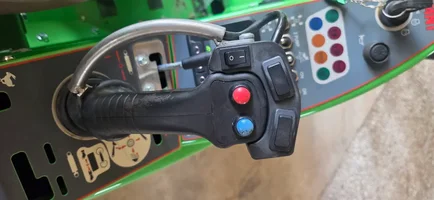
20260423_151801.webp
 
See if you actually feel the solenoid / magnet switch with your hand to rule out a hydraulic issue before you get too far down the electrical gremlin path. It’s on the left side of the boom.

I assume you’re on the right path with the wiring harness but you never know on a new machine now days; I’ve tightened so many bolts and plugged in so many connectors on brand new machines…
 
  • Like
Reactions: ATH
See if you actually feel the solenoid / magnet switch with your hand to rule out a hydraulic issue before you get too far down the electrical gremlin path. It’s on the left side of the boom.
...
Thanks...so if I have my hand on the solenoid while someone toggles the switch I should feel it?
 
Is it new or used? Used, machine or attachment, internal wire fatigue breaks right at a connector can cause intermittent operation. Had such a wire on a car door power window motor. Manipulations during debug always seemed ok continuity but on reinstall the wire hung just right to trigger the intermittent behaviour. Took forever to conceive and find that gremlin.

Like trailer lights, test for volts at the expected wires, then volts while delivering specced load current ie maybe a lightbulb draws the same as the solenoid, (while flexing wires) . Then independent source like jumpers off a battery power the solenoid connector pins listen for click (flexing), finally check for sucky pins - corrosion, bent etc. Deoxit, straighten/tighten, sandpaper, dielectric grease.

Beyond that is fried componentry. :(
 
  • Like
Reactions: ATH
I didn't pay attention...but I wonder if I had the switch to "rotation" when I plugged it in. Pretty sure the machine was running when I plugged it in...I'd have picked up the attachment, and not likely turned it off to plug it in. That wouldn't be unreasonable to pop a fuse if it tried to feed power at hookup.
 
An electrical load is an electrical load, wherever you make/break the cct. Running/not running changes from battery terminal voltage to charge voltage so that can make about 10% difference in current load.

Best to figure out why the fuse popped. Melted wires and switches are bad news and the fuse is your safety valve. Fuses are usually quite a bit higher (sometimes 2x) than normal load so something had to be substantial to make it pop.

As a teenager I melted the light switch in my dash by fuse fixing bad trailer lights on the side of the highway at night. I most remember the smell. Mmmm plastic smoke.
 
A 30 amp fuse at that is a pretty big draw on a 12v dc circuit.
Something is probably off, but it also might not? Maybe see what else is running off that fuse and if it’s isolated or not.
I’d just replace it and test it out, I’ve blown many fuses and sometimes they just let go. Other times it’s a legit issue but trial and error…
 
Mine popped 2 or 3 times after I had the rotator apparatus fitted.
Then, it didn’t.
I’d advise against too much stripping out until you’re sure it really is an issue.
 
  • Like
Reactions: ATH
I'm pretty sure that diagram is supposed to be the joystick showing that switch. If so, there is nothing else on it.

Fuese are cheap...maybe I'll try hooking up on/off and switch open/closed to see if that is the cause.
 
For fun if you've got a good multimeter a) capable of 30 or 40A current readings b) with peak detection, take a blown fuse and hotrod it into a pair of current leads to plug into your meter. Then sub it for the fuse and just read what load or spikes are occurring. Such a probe could pay back big as the years go on. Also then you're no longer just guessing and hoping. (pic looked like those little two blade style fuses)

edit - for a 30A cct you probably want 60 capability on the meter - and stick an inline fuse on your probe wire (to save the meter - they usually only have an internal fuse for their lower scales and a simple shunt for hi scale)
 
Last edited:
  • Like
Reactions: ATH
Yes, they are standard automotive fuses.

I don't have a peak detection multimeter...but I'll keep that in mind if I should decide to do more troubleshooting. It's a good idea.

Thanks!
 
Thinking back on n automotive vid chasing a draining battery the current probe could also serve for finding parasitic loads that stay on when you turn the key off and mysteriously drain your battery. Sometimes in a modern car it's a case of a failing module. $$$ at a mechanic
 
  • Like
Reactions: ATH
I'd like to add a revision. Most DVM ammeter scales top out at 20A rms/dc and getting a higher capacity is a bit of a $$ unicorn in comparison. Enter the current shunt which is a low value resistor put in series with the current (just like the one inside a multimeter) but you can easily get a 50A or 100A model and just measure the mV across it (just like a DVM on Amps setting does internally) using a relatively ordinary dvm. V = IxR to calc/scale. Some years back I put in a current sensing shunt system on my uncle's RV so he could know if he was abusing his battery bank.

For up to 20A the 2-wires-dead-fuse probe could be directly read into AMPS on the DVM.

Fuses don't blow at their rated ampacity. They blow by self heating where the heat up is too fast for the ambient heat dissipation and it could be a smaller overage for a longer time or a bigger overage for a shorter time. Less sensitivity so as to absorb short spikes is called slo blow. Some electronics spec fast blo fuses. Automotive is probably slo blo.

A dose of trivia. :)
 

New threads New posts

Back
Top Bottom