Re: drop a 75\' tree in a 50\' LZ
[ QUOTE ]
One point on the above post.. when you are dealing with HUGE trees, you can't count on the same principles that work reliably in smaller trees..
And that is good.. Let them be a warning to climbers not to try it, if they don't understand or are not able to execute... For example... are you comfortable and confident in making a plunge cut while standing in hooks?
One notable exception is when dealing with huge trees. The forces that get generated in dropping huge trees can overwhelm even the best made hinge, or any defects in the trunk or roots, especially given the leverage involved.. When there is no escape route, and those kinds of forces involved, you can't trust your life to it.
So 190' tree is much different than dealing with a 75' tree..
[/ QUOTE ]
Link to GB's huge redwood topping at 150'.
http://www.baileysonline.com/itemdetail.asp?item=18910
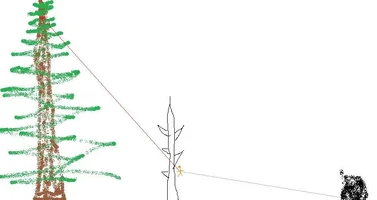
If people have seen this series of pictures, its possible to see how much reaction force is generated from the top falling forward, creating and equal and opposite counter-force opposite the lay. Looks like the top moves the trunk almost enough to smash GB, or at least his springboard platform against the neighboring tree. Looks like it moves it at least 5', if not 7', 8' or more.
This massive force that this healthy looking redwood withstood from a large top, which pushed the top of the remaining trunk back Many feet, is demonstrative of the force.
This issue is not only proper reading of the tree, and proper placement of felling cuts, but whether or not the tree, overall, can withstand the massive forces of a huge top drop.
Taking Huge tops in compromised/ dead/ poorly-rooted trees is going to be hugely difference that in live, healthy, strongly-rooted trees.
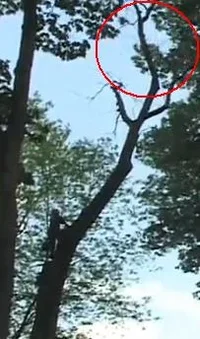
If a large top-drop is done on a tree that is on a sub-surface rock shelf or hardpan soil layer, the root system may have been enough to grow and withstand the blowing of the wind in the grove, snow loading of winters, etc, but not the huge reactive force of a top drop. It may have died from the stress of insufficient resources due to some unknown factors such as a sub-par root system, (possibly from a secondary disease/ insect, I'm Guessing that EAB will affect stressed trees much more than healthy trees. Was there some presumed cause of death on this dead ash, Daniel?).
I'm going to say that I'm not sure if the forces/ variables of large tree versus small tree are a lot different, or if its just a matter of proportions (overall), whereas large top versus small top, we can see reactive forces are not the same. There will be more issues of side lean in relation to bar pinching and such, as I think that .404 chain is all bigger that this variable, and resulting kerf, gets. The chain/ kerf doesn't grow proportionally to the size of tree.