DIY lanyard for recreational tree climbing --- static or dynamic rope?

I’m no fan of rock gyms but the ones in my area will not let you climb on a tree harness, unfamiliar gear to them therefore unacceptable, for insurance reasons (at the very least), there is a relatively narrow range of acceptable gear in most rock gyms.
-AJ
No I get that, I know they have a limited understanding of things. And they make money providing the right gear to those that want to do more than boulder the cave!
 
Hey there

A few thoughts
- put your Prusik and micro pulley on the same biner makes your system more streamlined

- is that a 3-strand Prusik?
Does it bite, is it rated, why do you need it so big???

-double 8 is a solid knot totally safe however I prefer a fisherman there, I find it gets caught in less crotches, twigs, etc. And the open eye in the double 8 can let biner move, side load, etc. (Just one more thing to watch out for) if you like the double 8 consider using a captive eye safety snap also that amount of knot tail may get annoying
(Ps double 8 = figure 8 on a bight, just so no one yells at me)

-is there a solid stopper in the end we can’t see don’t want it to pull through and you fall away

-are the biners screw gates? If so that’s a no go, has to be triple action biners(minimum) for primary life support. ( when u take your rope off)

-make sure your ropes are rated to a minimum of 5000 lbs and biners are rated (22kn? Help me out here guys)

Just a few things I noticed. Good luck don’t fall
Screw locks are fine, just check them periodically. In a way, things that need to be checked guard against complacency. But you can minimize trouble with screw gates, screw down so you don’t screw up, and in horizontal use or when rattled check em regularly. The triple action are good though. Sometimes I find screw gates a bit easier to manipulate.
 
Screw locks are fine, just check them periodically. In a way, things that need to be checked guard against complacency. But you can minimize trouble with screw gates, screw down so you don’t screw up, and in horizontal use or when rattled check em regularly. The triple action are good though. Sometimes I find screw gates a bit easier to manipulate.
A lanyard on and off 100 times you’ll get annoyed with the screw gate and stop using it because hey I’ll be careful. Also triple action gates are a requirement but I forget where from possibly the arbor safe work practice act. Which is Canadian.

But all that being said forestry snaps are still on just about every flip line
 
A lanyard on and off 100 times you’ll get annoyed with the screw gate and stop using it because hey I’ll be careful. Also triple action gates are a requirement but I forget where from possibly the arbor safe work practice act. Which is Canadian.

But all that being said forestry snaps are still on just about every flip line

Rec climber will not likely be using a lanyard as a flip line, more as a second short rope so a carabiner makes the most sense as opposed to a forestry snap for the most versatility. Flip line and snap is more about running saws in trees. Hanging off D's is no fun, when a rec climber (or any climber) is advancing their main rope and they're not standing on something in the tree the lanyard needs to attach to their harness bridge or whatever their central attachment point is, traditional flip line not so good for that.

The double lock/triple action gate is a work climber requirement so it doesn't apply to rec climbers, however I think they're advisable for any tree climber. When people are tired they forget to do things, that's why it's a work climber requirement ;-)
-AJ
 
On a derailing side note why are forestry snaps allowed if they call for safety snaps to be triple action?
It started leaning that way years ago, isc tried to corner that market with the newish triple action snap. I think it came down to apples and oranges. @Tom Dunlap or other members on the board might be able to shed light on it
 
Hey folks, thank you all so much for all the comments and support!

I've been reading this thread, as well as continuing to do my own research on the web, and doing some tests at home on my father-in-law's training bar. I'll reply to some of your comments and ask a few follow-up questions :-)


About the hitch and pulley on the same carabiner

@Bob Bob, @Jehinten, @KevinS,
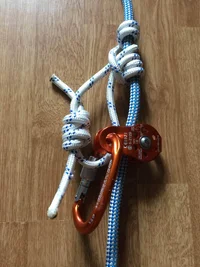
IMG_9100.webp

... is this what you mean? Or would you recommend the hitch clipped on the outside of the pulley, and why?


Top-roping, self-belaying

The harness adaptation for lanyard attachment points suggested by Logan turned out to be very, very uncomfortable! So, i'll i'll wait until i can invest on a designated tree-climbing harness with the appropriate work-positioning hookups :-)

Meanwhile, i combined what i know with some of your ideas and further research, and came up with something like this:
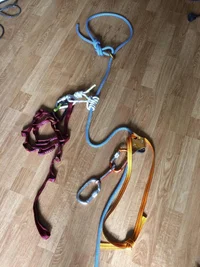
IMG_9101.webp

* The same semi-static Beal 11mm Industrie i've been using (and many of you have told should be fine for my purposes in my other post about rope choice).

* Figure-8-on-a-bight/rappel ring tie in for the base anchor, or directly up on the tree, depending on what makes most sense. (By the way, is it always safer to use a base anchor, or is it mostly for the convenience of being able to retrieve everything from the ground?)

* Petzl Croll to tend the slack. No special reason to choose this guy over other options other than the fact that i already had access it from my father-in-law's gear. I'm using the quick-draw to get it a bit further out, because i didn't otherwise have space to switch to my descending setup. The webbing loop is just to keep it in place. (As some of you have mentioned, i agree it's important to have options to get out of the tree in case "free" climbing where i fell from is not possible.)

* Prusik backup, which i reach with a daisy chain girth-hitched to my harness, and which could also be used to walk the rope if needed, or to assist in releasing the tension from the Croll if i need to switch to my descending system.
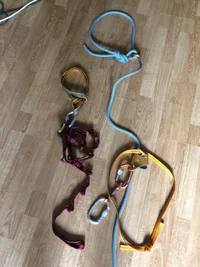
IMG_9107.webp

* An alternative to the Prusik backup that i will use whenever there are enough branches available is to clip the daisy-chain directly to my redirecting slings, girth-hitched to the branches/trunk.


About avoiding dynamic ropes on a tree

@moss Could you clarify why catching falls on a tree with a dynamic rope is a terrible idea? I've been hearing this all over, but i want to learn to think like an arborist --- not just parrot one :-) I'm asking this merely from a safety perspective, not from an efficiency, elegance, or any other dimension.

I understand that one will always (?) have the choice to install (or advance) the rope above them on a tree, so the concern about having factor > 1 falls on a tree should really be a non-concern --- i got that part of the fundamentals, and i understand that a static rope will always serve that purpose --- now i just want to understand why they'll indeed accomplish that better :-)


I'll get back to a few of the other comments and questions later (wife's calling!).

 
Hello Mika, I'm starting a new thread in the "Rec Climbing" forum section to continue the discussion on "Why catching falls with a dynamic rope in tree climbing is a terrible idea". I'll post a link to it here when it's done, thx.
-AJ
 
Picture this, you are walking out on a branch, it gets really small and starts to bend.. maybe break? you have a top rope and can suck up the slack and a lanyard you can wrap under the branch. As you go further out the top rope tightens and effectively pulls the branch up instead of you bending it down. You can see that its's possible to go way out on a limb that way and still be protected in the event it does break!

I presume you're talking about something like this, but with a lanyard around the branch you're walking on in addition to the top rope?


I haven't tried it out in the field yet, but it might be one of the coolest ideas from arborism i've come across so far!
 
Hello Mika, I'm starting a new thread in the "Rec Climbing" forum section to continue the discussion on "Why catching falls with a dynamic rope in tree climbing is a terrible idea". I'll post a link to it here when it's done, thx.
-AJ

Thanks, @moss! Look forward to it :-)

P.S.: i somehow missed the Recreational Climber's forum, and i now understand what might be part of the source of confusion for some you. If anybody here with admin privileges could move this thread to that forum i think that would be helpful to everybody --- and perhaps you could move my thread on rope choice as well (this is the one). Thanks!
 
I'm a former rock climber and current professional and rec tree climber. In your situation I would try rock climbing lines with the highest elongation for fall arrest, and thickest diameter for ease of handling in the hand. You may benefit from a motion- style lanyard. You should have a plan for what to do if you fall to a place where there are no foot holds or hand holds, and possibly just empty space because a tree climber does not necessarily "fall into the wall." Also, think about how you would deal with falling past a very large branch and then climbing back over it with the rope pressed very hard against the branch. Lastly, just going to concur with previous statements that your anchors for dynamic falls need to be of larger diameter than they would be for non-dynamic falls.

Thanks for the input! Just to clarify --- by the 'anchors' here, do you mean the branches i'd be tying in to, or the ropes/slings involved in their installation --- or both?

And what exactly do you mean by a 'static fall' --- is it a fall factor > 0 fall on a static line, or do you mean just hanging from an already (nearly) stretched static line?

Your last sentence made me a bit confused, because it seems like the forces involved on a static fall would be smaller than those on a "dynamic fall" if you meant the former. So, i'm guessing you meant the former --- i.e., the scenario to be avoided?

Thanks once again!
 
What new guys don’t get is that when we Let it Run we are artificially making the rope more dynamic, effectively simulated stretch without the rebound. My kingdom for a groundie that understands this basic concept!

Stephen, i think i understand the underlying concept of what you're talking about here, but how would the rope run if it's static and all the slack is between the climber and the anchor?
 
I've mentored and taught a fair number of rec climbers who came to me from a wall or rock climbing perspective. It's tough for them to shift their orientation from the gear and technique they know. If a tree climber thinks there's a possibility they might fall (2'or 10') on the next move they need to reconsider, there's no need to make a move that way. I came to tree climbing (who didn't?) as a free climber and like many rope and harness climbers make a lot of moves that do not depend on rope tension, and do so safely. It's lack of in-tree experience and/or technique that would lead a new climber to think they need a rock paradigm in a tree. Tree climbing is not about gear it's about knowing how to be in a tree, any great tree climber can do it all with a 3-strand rope and a leather belt if they have to. Looking at it that way, trying to to find a way to use dynamic rope is focusing too much on gear and not on climbing the tree efficiently and safely.
-AJ

This is exactly my concern! And i'm hoping you could clarify some of what you said here --- you mention you do lots of moves that do not depend on rope tension, and do so safely --- how? Are you talking merely about principles such as, keeping 3 points of contact, or top-roping with some self-belay device along the lines of what i shared in this reply?

I want to clarify that i am not 'trying' to use a dynamic rope --- i don't even have one! I'm just trying to find safer ways to arrest a fall of factor > 0 --- or else prevent them from happening without taking the "free" climbing element out of the picture --- to me that's a key component of the fun of tree climbing.
 
Thanks for the input! Just to clarify --- by the 'anchors' here, do you mean the branches i'd be tying in to, or the ropes/slings involved in their installation --- or both?

And what exactly do you mean by a 'static fall' --- is it a fall factor > 0 fall on a static line, or do you mean just hanging from an already (nearly) stretched static line?

Your last sentence made me a bit confused, because it seems like the forces involved on a static fall would be smaller than those on a "dynamic fall" if you meant the former. So, i'm guessing you meant the former --- i.e., the scenario to be avoided?

Thanks once again!
Haven’t had a chance to pour through everything yet, but anchors should be the main stem not branches. What ever systems you choose tying in around the main stem should be your anchors basal or crown
 
Another way to put is, if a rock climber asks a tree climber how to climb a tree does the tree climber try to figure out a way for the rock climber to climb using their current gear and rock technique? A rock climber can figure that out on their own. The tree climber can offer advice based on the reality of what tree climbing is. Try bringing tree gear to a rock wall/gym. Laugh riot ;-)
-AJ

I don't mean to distract you from the post you're writing about arresting falls with a dynamic rope, but i would like to give you some feedback on this one :-)

1) I think a rock climber wouldn't expect you to show them how to do it with their gear and technique. But i'm sure they would appreciate it if you took that into account (to the extent that you're aware of it), and at the very least taught them the reality of what tree-climbing is in contrast with rock-climbing, and not just like, "forget everything you know about climbing." (Not that this is what you said, but it could be uncharitably interpreted like that.)

2) I'm not a rock climber, but i have more exposure and access to rock climbers than tree climbers, so my intuitions are indeed biased in that direction --- i think this might be the case for more people coming to you regardless of their knowledge of vertical techniques.

3) I've been asking rock climbers how they would climb trees, and the vast majority of them answer that they wouldn't climb trees --- i then counter, "whatever, but how would you do it if you were to climb a tree?," to which they once again reply, "i wouldn't climb trees."

Perhaps rock climbers are just bad at hypothetical reasoning, but the fact of the matter is that i haven't got a good idea of how rock climbers would expect their equipment and technique to work on a tree from the ones i know.

I hope this helps your approach to teaching recreational tree-climbing to people coming from rock-climbing!
 
Hey there

A few thoughts
- put your Prusik and micro pulley on the same biner makes your system more streamlined

- is that a 3-strand Prusik?
Does it bite, is it rated, why do you need it so big???

-double 8 is a solid knot totally safe however I prefer a fisherman there, I find it gets caught in less crotches, twigs, etc. And the open eye in the double 8 can let biner move, side load, etc. (Just one more thing to watch out for) if you like the double 8 consider using a captive eye safety snap also that amount of knot tail may get annoying
(Ps double 8 = figure 8 on a bight, just so no one yells at me)

-is there a solid stopper in the end we can’t see don’t want it to pull through and you fall away

-are the biners screw gates? If so that’s a no go, has to be triple action biners(minimum) for primary life support. ( when u take your rope off)

-make sure your ropes are rated to a minimum of 5000 lbs and biners are rated (22kn? Help me out here guys)

Just a few things I noticed. Good luck don’t fall

Last post today --- thanks for the inputs, @KevinS!

In answer to your questions:

The Prusik cords and other gear ratings

I make my Prusik loops from accessory cord. In the very first post, you see a 6mm Tendon graded for 10kN. It's that long because i used it with the rope doubled, and it worked fine for that. It's indeed too long and won't work at all on the single rope unless i extent the pulley --- i posted that picture just to illustrate the setup i was looking into.

My accessory cords were getting old and shabby, so i've recently replaced them with 7mm and 8mm ones rated a bit higher at around 15kN (also Tendon, which is the easiest one for me to get to besides local Ukrainian brands). I will experiment with them and see what develops. (I have two ropes of 11mm and 10.8mm diameter, respectively.)

Any comments on this? I've heard people say here (and also read in Jepson's books) that all things tree-work need to be rated at least 22kN, but i couldn't find anything like that except online. I took some self-rescue courses when i was home in Brazil last year, and my instructor was using 6mm accessory cords as well --- he even bought the extra length i had from me! (it came in 5m packages.)

Everything else is rated > 22kN, except for my daisy-chain, which i use as a tether, and it's 16kN.


Knots

Yes, i always use stopper knows (fisherman's). It just doesn't show in the picture --- that's in fact not my lanyard, but my climbing line, which i used to illustrate the design i had in mind.

I appreciate you (and the other folks) pointing out to the termination knot --- i've also started using fisherman's in this context, and i understand that, on a tree, the less cumbersome the knot the better!


Thank you very much once again for your thoughtful reply, and i hope you'll have a couple of minutes to go over this one as well ;-)
 
Back
Top Bottom