DIY lanyard for recreational tree climbing --- static or dynamic rope?

I've mentored and taught a fair number of rec climbers who came to me from a wall or rock climbing perspective. It's tough for them to shift their orientation from the gear and technique they know. If a tree climber thinks there's a possibility they might fall (2'or 10') on the next move they need to reconsider, there's no need to make a move that way. I came to tree climbing (who didn't?) as a free climber and like many rope and harness climbers make a lot of moves that do not depend on rope tension, and do so safely. It's lack of in-tree experience and/or technique that would lead a new climber to think they need a rock paradigm in a tree. Tree climbing is not about gear it's about knowing how to be in a tree, any great tree climber can do it all with a 3-strand rope and a leather belt if they have to. Looking at it that way, trying to to find a way to use dynamic rope is focusing too much on gear and not on climbing the tree efficiently and safely.
-AJ
 
I've mentored and taught a fair number of rec climbers who came to me from a wall or rock climbing perspective. It's tough for them to shift their orientation from the gear and technique they know. If a tree climber thinks there's a possibility they might fall (2'or 10') on the next move they need to reconsider, there's no need to make a move that way. I came to tree climbing (who didn't?) as a free climber and like many rope and harness climbers make a lot of moves that do not depend on rope tension, and do so safely. It's lack of in-tree experience and/or technique that would lead a new climber to think they need a rock paradigm in a tree. Tree climbing is not about gear it's about knowing how to be in a tree, any great tree climber can do it all with a 3-strand rope and a leather belt if they have to. Looking at it that way, trying to to find a way to use dynamic rope is focusing too much on gear and not on climbing the tree efficiently and safely.
-AJ
I agree! Completely! When I move in a tree there is no point in time where I risk falling, I am always connected! And effectively short leashed. Therefore, it almost matters not what kind of rope I use except for ascending. I don’t want a bouncy assed rope there.
 
My point is that all ropes stretch, there is a cut off point where the rope stretch is catagorized as either static or dynamic, and at that point it’s a grey area.

I think the original poster was talking about "dynamic rope" in a doubled lanyard configuration, enough stretch to cushion a fall would be negated in a doubled config. The other part is what a pain in the ass to tie termination knots with a dynamic line. Rock climbers won't be anticipating that moment when you try and pull your lanyard through a tight union, that F8 follow-through termination is going to really clog up the works, will get hung on everything. It seems like a lose/lose scenario. Pain is a good teacher though ;-)
-AJ
 
No climbing above my anchor point, and rarely at a fall factor 1 situation, more like always on top rope. With all the easily accessible anchors that the tree has, it is safest to take advantage of them.
 
Some ropes are pretty bouncy though! I would avoid them for in the tree work for sure.

In a lanyard setup, especially in a doubled configuration, stretch is so close to non-existant that I consider it negligible...I wouldn't even consider it as an issue for a lanyard.

Even in a choked, single lanyard my 20' lanyard has negligible stretch.

My considerations are:

Knotability
Durabiity
Diameter
Color...to keep track of it. Always a unique color that isn't a climbing rope.
What do I have on hand

Usually I like a stiffer lanyard rope which is more likely found in a static rope.
I tie double fisherman for eyes and then whip, stitch or seize the tailcr swivel eye 2.webp
 
In a lanyard setup, especially in a doubled configuration, stretch is so close to non-existant that I consider it negligible...I wouldn't even consider it as an issue for a lanyard.

Even in a choked, single lanyard my 20' lanyard has negligible stretch.

My considerations are:

Knotability
Durabiity
Diameter
Color...to keep track of it. Always a unique color that isn't a climbing rope.
What do I have on hand

Usually I like a stiffer lanyard rope which is more likely found in a static rope.
I tie double fisherman for eyes and then whip, stitch or seize the tailView attachment 53037

Ba-bam, that's it. My comment on doubled dynamic lines is based on Tom's comments years ago on the same issue. Thx for chiming in Tom.
-AJ
 
Similarily, i have used very dynamic mountain rescue in rigging off of flimsy tops back to their own members to reduce as much impact as possible thru the system , specifically the support, then allowing slip to not inherit 2xLoading as much as possible.
.
Run doesn't drag on support only impact of slowing, so drop fast enough it can be slowed by other branches, but still have enough play to roll off and just guide descent with low support loading.
.
Limited elastic dampening from 4' drop on doubled lanyard bodyweight, especially if line 7k+ etc.compared to other rigging expectations.
.
Total play, stretch, slip, support flex,any frictions that convert loadForce to heat etc. are forgiveness in system,potentially absorbing dynamics. Each point is like a steam release valve in a pressure system, set to bleed off so much pressure at such and such a tension/impact. Kinda like backwards of playing wack-a-mole under the hood and replacing 1 radiator hose at a time, gradually increasing the pressure in system allowing the next weakest hose to fail. Pressure in a system and pressure releases; all lengths and forces are finite and can be exhausted.
.
edit: here is pic i took whenst they were still concerned about Y2K...
i believe posted here, originally w/original notes of historical comradre to the build. As i remember Mark Chisholm and i were sequentially blaming each other(and Tom i think?) for the hitch on D-idea; later traced both hitch anchors back to D original seating, then Half Hitch each to D length, to then serve to Friction Hitch
>>Now pulling at original design angles on D;
>>maintained the self tending thru the cord itself as best friction hitch comb/tender; in best position; all w/minimal hardware.
cord on strand quite favorable characteristics, prefer cord 50-75% of rope diameter and also stiffer than host preferred.
.
Lanyard%20Setup%20for%20KC.jpg
 
Last edited:
For sure a 15’ lanyard isn’t going to stretch enough to matter. Hand, wear and diameter and stiffness is what matters.
3/4” feels real nice- 1” even better!
 
This is pretty far off the rails, train’s in the gulley! Catching a fall in a tree with a dynamic rope is a terrible idea. Everyone on this forum who uses dynamic rope climbing trees please raise your hand. Hmm, thought so.
-AJ

The OP is engaged in recreational lead climbing, which does not translate to professional climbing. Can has rails!? :)
 
The OP is engaged in recreational lead climbing, which does not translate to professional climbing. Can has rails!? :)

No difference in the fundamentals between pro and rec climber. You wouldn’t say a non-professional should handle a hand gun differently than a trained law enforcement or military person, the fundamentals apply to the non-professional.
-AJ
 
Last edited:
Another way to put is, if a rock climber asks a tree climber how to climb a tree does the tree climber try to figure out a way for the rock climber to climb using their current gear and rock technique? A rock climber can figure that out on their own. The tree climber can offer advice based on the reality of what tree climbing is. Try bringing tree gear to a rock wall/gym. Laugh riot ;-)
-AJ
 
Last edited:
The OP is engaged in recreational lead climbing, which does not translate to professional climbing. Can has rails!? :)

Interesting though that you mention lead climbing. Anytime i’m recreationally going for it on a tall conifer whether it’s a big white pine in the east or a giant sequoia or coast redwood in the west, if I’m first one up i’m lead climbing. No rock technique involved but i’m lead climbing the way a tree climber does.
-AJ
 
In a lanyard setup, especially in a doubled configuration, stretch is so close to non-existant that I consider it negligible...I wouldn't even consider it as an issue for a lanyard.

Even in a choked, single lanyard my 20' lanyard has negligible stretch.

My considerations are:

Knotability
Durabiity
Diameter
Color...to keep track of it. Always a unique color that isn't a climbing rope.
What do I have on hand

Usually I like a stiffer lanyard rope which is more likely found in a static rope.
I tie double fisherman for eyes and then whip, stitch or seize the tailView attachment 53037
Exactly! Even with a stretchy rock rope 10-20’ in positioning lanyard isn’t going to matter. Useing a dynamic rope as a climbing line is BS. It could be done as a belay, I just don’t understand why.
 
Is that the beginning of our DEDA?
.
WOW!
As far as i can remember DEDA was all you, i maid 2 from a post you did, thanx!
.
i think that was a very fertile time, lots of ideas floating until these rose above the rest ; but can't remember what/who/when was first etc. fairly.
It only triggered my memory when saw note about Mark in own pic, i'd think Dan is TreeCo etc., then stirred in JP's contribution of the length.
.
What i presented some didn't like not switchable/modular w/o untying cord to D;but as far as minimal hardware(and co$t), connection chain, immediate tending etc. served me very well in this 1 sided lanyard!
.
The DEDA's i maid screw linked to D's, so more portable/modular build; rather than so 'dedicated' to 1 saddle.
.
i once again agree on the bodyweight load halved by dual support legs of lanyard, on such short runs, at such high tensile, with other slips in system isn't going to get tons of elasticity from the line.
Perhaps longer line with load that encroached more on the rope tensile to extrude out the elastic response;but here have minimized impact against the line tensile at low elastic length. Side loading forces would wash out quickly, as tension pulls sideloading forces into line to lower them(man on rope) as opposed to side loading of compression forces that push each other further out of line (tree falling,but tension in the mix is where we get ballasting to center even then pulling inline,while the compression forces are trying to push out of line to higher loading.)
 
Last edited:
Another way to put is, if a rock climber asks a tree climber how to climb a tree does the tree climber try to figure out a way for the rocker climber to climb using their current gear and rock technique? A rock climber can figure that out on their own. The tree climber can offer advice based on the reality of what tree climbing is. Try bringing tree gear to a rock wall/gym. Laugh riot ;-)
-AJ
I would use tree gear in a rock gym, the only thing I would change would be the rope. Sure a Rock saddle is less weight and generally more comfy to wear, But a tree saddle would work. Biners translate fairly well too. Even the helmet would work. In a rock gym I would prefer bent gate sport biners- there is no pro to place so that's easy. Frankly, I never liked rock climbing gyms... maybe in the winter for shits and giggles.
 
I would use tree gear in a rock gym, the only thing I would change would be the rope. Sure a Rock saddle is less weight and generally more comfy to wear, But a tree saddle would work. Biners translate fairly well too. Even the helmet would work. In a rock gym I would prefer bent gate sport biners- there is no pro to place so that's easy. Frankly, I never liked rock climbing gyms... maybe in the winter for shits and giggles.

I’m no fan of rock gyms but the ones in my area will not let you climb on a tree harness, unfamiliar gear to them therefore unacceptable, for insurance reasons (at the very least), there is a relatively narrow range of acceptable gear in most rock gyms.
-AJ
 
Hello there!

I'm a beginner recreational tree-climber, and i have a question about putting together my own lanyard. What are your thoughts on dynamic vs. static rope?

A little more info.

0) I searched the forum for 'diy lanyard,' 'lanyard dynamic,' etc, and couldn't find anything about this --- my apologies if this has already been discussed --- i'd be grateful if someone pointed me to that ;-)

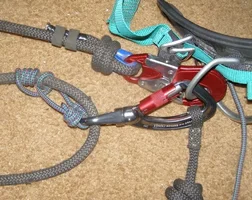
1) I climb with a rock climbing harness, and i'm considering an adaptation for tree-climbing lanyards such as TREEfool's. This is the lanyard design:

View attachment 52862

3) I like to "free climb" as much as i can, using tethers to secure myself to the tree while i otherwise proceed "as if i were climbing without any safety system" --- in practice the tethers are stretched as much as possible, and also help me keep my balance, etc --- but hopefully you get what i mean? (By the way, i use a daisy chain and a CT multi-chain clipped to girth-hitched slings, and with their lengths adjusted as often as i can.)

... so, what happens if i fall? I've been browsing the web about static falls, reading articles such as this one, and watching videos such as this one, and they got me a bit worried about the potencial impact force on my guts. I thought a dynamic rope lanyard might mitigate the risk.

On the other hand, impact force calculators such as this one suggest that the impact force on a factor 1 fall on a dynamic rope might be pretty close to the rope specification (~ 6kN on 7--8kN ropes), and the fact that i'd be using it with knots, friction hitches, and the fact that the rope would be rubbing against a tree doesn't make me feel objectively more comfortable with the solution.

What would you suggest?


Thanks in advance!
Mika
Hey there

A few thoughts
- put your Prusik and micro pulley on the same biner makes your system more streamlined

- is that a 3-strand Prusik?
Does it bite, is it rated, why do you need it so big???

-double 8 is a solid knot totally safe however I prefer a fisherman there, I find it gets caught in less crotches, twigs, etc. And the open eye in the double 8 can let biner move, side load, etc. (Just one more thing to watch out for) if you like the double 8 consider using a captive eye safety snap also that amount of knot tail may get annoying
(Ps double 8 = figure 8 on a bight, just so no one yells at me)

-is there a solid stopper in the end we can’t see don’t want it to pull through and you fall away

-are the biners screw gates? If so that’s a no go, has to be triple action biners(minimum) for primary life support. ( when u take your rope off)

-make sure your ropes are rated to a minimum of 5000 lbs and biners are rated (22kn? Help me out here guys)

Just a few things I noticed. Good luck don’t fall
 

New threads New posts

Back
Top Bottom