
Treetopflyer
Been here much more than a while
- Location
- Coastal N.J
One Classy son of a bitch right thurhey I made a meme just for your bad ass selfsee the dude in the hats smile now thats classy.

Follow along with the video below to see how to install our site as a web app on your home screen.
Note: This feature may not be available in some browsers.
One Classy son of a bitch right thurhey I made a meme just for your bad ass self


No..Its a tool ...for a ...job ..Bwahhhaaahhaaaahahahaaaaaaaachristmas in july?



No ,I don't. I have always rigged on multiple ring setups. At least two ar a time. Other than redirects at pretty wide angles, occasionally.I think it's also about the friction of multiple rings more so. Have you tried to rig decent weights on a single ring? Very jerky. Friction of three (or two) stabilizes this

I think this has to do with the outside of the rope, when bending a radius, has to stretch while the inside (pulley or ring side ) has to travel less distance than the outside of the rope so it wants to bunch up. This creates internal friction in the rope. On a single ring (say 1 inch diameter) the outside of the rope had to stretch enough to make a 180 degree bend. With 3 rings, this now allows 3 inches for the outside of the rope to stretch for making the 180 degree bend (creating less internal friction internally in the rope.) This is how it has been explained to me. I'm just passing along info I obtained and would like to see if this makes sense to everyone else. Hope it helpsThis is a post from the rigging whoopie thread I found that pushes for some good conversation in my opinion on the three ring theory something I've been pondering though it was better than one or two and feel like this helps me believe myself
From 10 /12
I don't know how bring the post over here all fancy like. So I copy pasted it.
morayMember
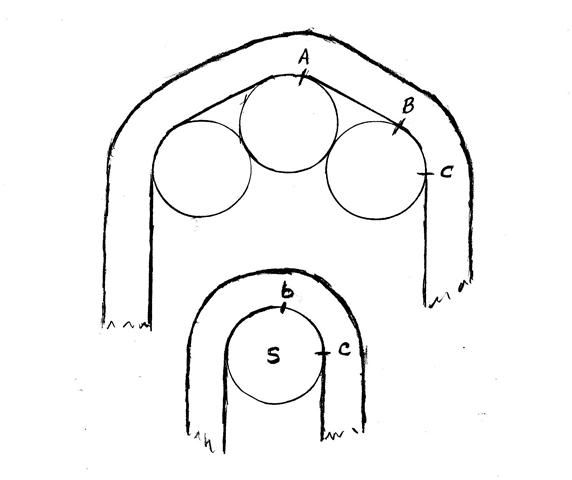
I'm wondering if this is true. In the drawing below. the 3 rings with a taut rope are shown above, and a single ring, S, with taut rope is shown below.
Wherever a rope is in contact with a ring it follows the surface of the ring and therefore has a bend radius equal to the section radius of the ring. These curved sections of rope are exactly the same for the 3-ring configuration and for the single ring. So the arc from B to C in the upper diagram is exactly the same as the arc from b to c in the lower diagram, and one would expect the weakening effect on the rope to be the same in both cases.
Now in the upper diagram the rope from A to B is perfectly straight because it is not contacting any ring. There is no bend radius and no weakening of the rope. To believe that the 3 rings are somehow better than one, one has to argue that the straight section A to B and the other one to the left are somehow helping to cancel or reduce the weakening that occurs in the arcs, such as B to C. If so, why not move the rings much further apart, say a foot between each ring, and get an "effective pulley radius" of two feet? I doubt if anyone believes that works. If lengthening the straight sections doesn't help, then reducing them shouldn't hurt, and we can reduce them to 0, ending up with the single ring, S. The rope, in other words, doesn't know the difference between 3 rings and one.
If ropes were perfect mathematical objects, this would seem like a pretty solid argument. But they aren't. Maybe there is some benefit to the rope in having a 180-degree bend subdivided into 3 bite-size chunks rather than a single uninterrupted arc, as in the lower diagram. Does anyone have any actual evidence, or a good argument, that this is true?
that sounds like it makes senseI think this has to do with the outside of the rope, when bending a radius, has to stretch while the inside (pulley or ring side ) has to travel less distance than the outside of the rope so it wants to bunch up. This creates internal friction in the rope. On a single ring (say 1 inch diameter) the outside of the rope had to stretch enough to make a 180 degree bend. With 3 rings, this now allows 3 inches for the outside of the rope to stretch for making the 180 degree bend (creating less internal friction internally in the rope.) This is how it has been explained to me. I'm just passing along info I obtained and would like to see if this makes sense to everyone else. Hope it helps


Hear Hear...I second that post.I love dogs and ropes and don't believe in abusing either of them.

Thanks for revibing this one paul.. Ever get into the rig N rings ? .. I feel it's tool every rigger ought to know. You'll find it indispensable once your setting (retreivable maybe novel in some instances but proves useful when you want it ) rigging points that can hold a shit ton.. Sometimes I'll just go up to make the cut after setting all rigging and Ropes from the ground. Means alot to some ,not much to others .. I get paid for Tree assinations being fast and accurate.. the rigging rings , As well as some other tools that help deploy them quickly and get Trees flying where we want make that money just a bit easier..Here is most of my rigging stuff.


![DSCN0011[1].webp](/forum/data/attachments/35/35168-fdd893368f97cad07a5371f0d45a65a0.jpg?hash=f0eIQ6nXmk)


