New device from ISC

I don’t think you can get much safer, reliable or intuitive than a Zigzag. It just doesn’t require that much thought to make it work. And with all the fear of them bending or breaking how many times have we seen that be an issue?

I have three different versions of the ZigZag, and like 6 in total I think. Never had a single problem with any of them. It's been my go-to for DRT for like a decade now, and along with a chicane, an on-again-off-again SRT device. As mentioned in an earlier post, it just works. It's the Honda Civic of climbing devices both DRT and SRT.
 
I basically only use the grey atlas gloves, I’ve had a few issues using the thinner blue ones, even had a hitch eat them a few times. The grey doesn’t have the same peeling issue.
Hate leather gloves unless I’m only running the rigging on the ground all day
Yep, once you get used to a certain spec latex palm glove (gray Atlas my favorite too) you'll rarely get it hung up in a hitch or multi-cender. Nothing is perfect out-of-the box but when you find the nearest to perfect glove a few ergonomic/mental adjustments and benefits outweigh negatives that disappear anyway.

There is always: "Oh shitte my glove fingertip just got stuck in my (fill in the device)". Don't sit there tugging and swearing, stand up on your rope, unload the device and bada-bing you're free.
-AJ
 
...until it doesn't. There's a reason that every piece of gear that I can remember reading the instructions for included something along the lines of, "...climbing is inherently dangerous. You could die. Use at your own risk." I have tested a freshly tied hitch until I felt good about it, climbed for a few minutes and only then had it start to not grab consistently, even letting me slide continuously if I allowed it.
Everything that works well in climbing has to be tested, learned, and reevaluated again before drawing conclusions. Body and mind have to learn and adjust. We all know this. Assuming a fundamentally well-designed and redundantly safe piece of gear, the instructions and warnings are to be read and understood but... the manufacturer has to cover their liability, regulatory limitations, and weird use-case outliers. The informed climber finds their way and uses the device safely and effectively. Unless they can't find a way to do so.

I'm rope on rope as primary method, I've got it well dialed for my climbing style.

Looking forward to trying a Reflex in a tree when I get a chance to do so.
-AJ
 
So have another question about the Reflex - does anyone out there have any experience with it in a V rig or M rig kind of situation? The ZZ is OK and Hitch Climber is nifty for these. If Reflex is OK with it then it would about complete it for me (not climbing now - still shovelling white stuff . . . . and shovelling . . . . sigh).
 
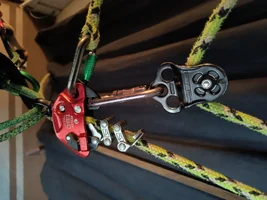
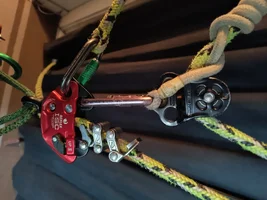
I emailed ISC asking about multiple configurations for the MRS attachment points including a v-rig and or connecting a second system.
The multiple attachments seem perfect for it but as the leverage on the lower arm squeezes the rope in the lower friction point more as the links are pulled off of center, the angles may not allow for it to work right. I didn't see any mention of it in their literature or instructions so I emailed them. They said they had to go over some things with their engineering team and would get back to me with an answer shortly. That was about a week ago now.
 
I emailed ISC asking about multiple configurations for the MRS attachment points including a v-rig and or connecting a second system.
The multiple attachments seem perfect for it but as the leverage on the lower arm squeezes the rope in the lower friction point more as the links are pulled off of center, the angles may not allow for it to work right. I didn't see any mention of it in their literature or instructions so I emailed them. They said they had to go over some things with their engineering team and would get back to me with an answer shortly. That was about a week ago now.
Thanks very much ! Please be so kind as to forward any info you receive from them. Cheers and stay safe.
 
ISC emailed me back

V-rig yes
Attaching secondary system no

Here's the details for anyone curious.

So back on February 25th I emailed ISC the following.

In MRS configuration is the Reflex designed to be able to use a V-rig type configuration where the termination would be in the lower "okay" MRS attachment point and the belly of the rope between two sections of tree would be captured and attached to the "optimal" upper MRS attachment point or does that not work because of the angles and extra leverage on the lower compression point?

Also, would it be okay in MRS configuration to attach another system to the lower "okay" MRS attachment point? For instance, moving a lanyard or other climbing system to the device rather than on the saddle for certain work positioning?

They promptly responded and said that they would pass my question along to their technical team and get back to me as soon as possible.

A few days later I followed up with another email including some pictures to clarify what I was asking.

A few days after that they responded that they passed along the information to the team and would be getting back to me.

A week later I emailed again with the following.

Just wanted to follow up regarding the question of different configurations with the multiple MRS attachment points on the Reflex.

Can the Reflex be used in a V-rig MRS configuration?

Can another system be attached to the lower (okay) attachment point?

If so, would it be okay to attach another system only in MRS configuration or is attaching another system okay in SRS configuration as well?

A few days later they said that they had some information back but had to check with the engineering manager and would get back to me shortly.

Another week later they apologized for the delay and responded with the following.

Regarding the photos of the V-rig.

"The ‘M’ or ‘V’ rigs shown are both good.The karabiner between the pulley and the REFLEX looks like it is steel? Always best to use an aluminium karabiner to keep wear and tear on the aluminium eye to a minimum."

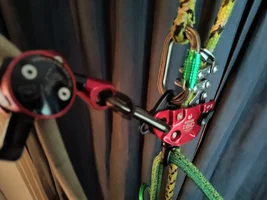
Regarding the photo of a separate climbing system attached to the device.

"We would advise keeping the primary support (REFLEX) separate from the lanyard, for redundancy, so we would advise against this setup. The loads from this setup could force the swivel unit of the REFLEX into the metalwork of the frames OR force the swivel unit to push the rope block against the built in pulley wheel."

The carabiner is a R.E. Rock O, not steel.
Anyway, they say v-rig is okay so time to start experimenting. It's definitely going to change the friction on the lower compression point depending on the angles I think.
 

Attachments

  • IMG_20260223_103442404_HDR.webp
    IMG_20260223_103442404_HDR.webp
    101.6 KB · Views: 13
  • IMG_20260223_103709502_HDR.webp
    IMG_20260223_103709502_HDR.webp
    99.1 KB · Views: 13
  • IMG_20260223_105810819_HDR.webp
    IMG_20260223_105810819_HDR.webp
    71.5 KB · Views: 13
ISC emailed me back

V-rig yes
Attaching secondary system no

Here's the details for anyone curious.

So back on February 25th I emailed ISC the following.

In MRS configuration is the Reflex designed to be able to use a V-rig type configuration where the termination would be in the lower "okay" MRS attachment point and the belly of the rope between two sections of tree would be captured and attached to the "optimal" upper MRS attachment point or does that not work because of the angles and extra leverage on the lower compression point?

Also, would it be okay in MRS configuration to attach another system to the lower "okay" MRS attachment point? For instance, moving a lanyard or other climbing system to the device rather than on the saddle for certain work positioning?

They promptly responded and said that they would pass my question along to their technical team and get back to me as soon as possible.

A few days later I followed up with another email including some pictures to clarify what I was asking.

A few days after that they responded that they passed along the information to the team and would be getting back to me.

A week later I emailed again with the following.

Just wanted to follow up regarding the question of different configurations with the multiple MRS attachment points on the Reflex.

Can the Reflex be used in a V-rig MRS configuration?

Can another system be attached to the lower (okay) attachment point?

If so, would it be okay to attach another system only in MRS configuration or is attaching another system okay in SRS configuration as well?

A few days later they said that they had some information back but had to check with the engineering manager and would get back to me shortly.

Another week later they apologized for the delay and responded with the following.

Regarding the photos of the V-rig.

"The ‘M’ or ‘V’ rigs shown are both good.The karabiner between the pulley and the REFLEX looks like it is steel? Always best to use an aluminium karabiner to keep wear and tear on the aluminium eye to a minimum."

Regarding the photo of a separate climbing system attached to the device.

"We would advise keeping the primary support (REFLEX) separate from the lanyard, for redundancy, so we would advise against this setup. The loads from this setup could force the swivel unit of the REFLEX into the metalwork of the frames OR force the swivel unit to push the rope block against the built in pulley wheel."

The carabiner is a R.E. Rock O, not steel.
Anyway, they say v-rig is okay so time to start experimenting. It's definitely going to change the friction on the lower compression point depending on the angles I think.
Thanks very much for this - good work.
 
3 of us at my company recieved the Reflex yesterday. All of us are impressed by it and will most likely be using it as our go to for most work. I had 2 climbs yesterday, SRT pruning a big bur oak, and a crab MRS with a redirect on a pinto to try out since I got that with the shipment too.

During the bur oak prune on a base anchor I threw my tail through a higher union and tried taking the device off and on in the canopy to see how easy that would be compared to the akimbo which I'm used to. I think it's very easy and quick to take on and off, just needs to have a little slack, same as any other mechanical, slower than the akimbo.

I had abother big bur oak SRT prune today and smaller MRS training prune on an oak in the afternoon and had similar experiences as yesterday, exceptionally smooth. It's got a heavy body that likes to flop around in ways I'm unused to I was also able to get it to self tend in MRS in the optimal position once I figured out hand placement with the close spacing between working and terminating end.

A big question mark I had was how does it work with grippy climb gloves. I don't get it sucked into the device half as much as the akimbo, but it does catch on the underside occasionally, may be a skill issue for now. Not a big deal for me, seems hard to get it really stuck or anything like that. I was trying out all different kinds of hand placements to see if I could get it to catch my glove before it eventually did.

For MRS especially, but in general the Reflex doesn't deal very well with friction coming from below the device while trying to descend/limbwalk. I haven't tried dragging tail through a redirect yet. With all the zigzag users commenting on how its a step down in smoothness from that device, I was a tad worried it would bother me but its very very smooth and has a lot of fine control. It's at least as smooth as a hitch in MRS which I think is amazing. To have a device that does both so well without tuning anything or fiddling is great. I don't mind fiddling and dialing in devices but this is better to recommend to other climbers as a first mechanical because it doesn't come with all the frustrations.

Once I figure out my Akimbo 2 settings I may leave it as more of a MRS or secondary device but time will tell. That may be just so I can tell my wife I still use all of my shiny toys and it wasn't a waste of money.
 
I've had the Reflex for about 3 weeks and did a few climbs. I climb mostly MRS, but wanted to get a good SRS climb before writing a review. Did that today. The other devices I "normally use for comparison:
*Unicender has been my primary device for MRS climbs for about 6+ years.
*Zigzag...I've liked climbing on the ZZ better than Uni, but didn't like fussing with feeding rope through every time, so I used Uni more.
*Hitch cord+wrench has been my preferred SRS system - never really liked the Unicender for that mostly because not a great place to clip into chest harness. Just my preference.

OK, so to some comparisons:
*Slightly less intuitive than the Unicender to hook into the rope...not hard, just took a few times to figure out aligning the friction points correctly. After maybe 10 uses, its just as fast.
*Smoother than Unicender. Maybe not as smooth as the Zigzag, but its close.
*No setback. Others weren't bad, Reflex is better.
*I probably do like descending the the Unicender a touch better - a little more control when you wrap the rope over the top. I like small rope movements while limb walking on the Reflex better.

As of now, I cannot imagine wanting to go back to either Zigzag, Unicender or wrench=hitch cord/climber. Not that I dislike those, just like the Reflex more.

Things I don't like:
*I don't like that the MRS attachment hole has to use a ISC Small Oval. Nothing against the Small Oval, just didn't love having to buy another carabiner for that.
*More than that, I don't like how tight that small oval fits in there. I'm assuming there is a reason it cannot flop around. Maybe it causes the friction points to release when it does? But being in a tough spot in the tree, wanting to reposition the tie in point, it is not enjoyable to fight with that tight fitting carabiner.
*When I get down and want to unhook everything, I need to take out that same tight fitting carabiner to open the gate and get the rope out. It's not a bad thing that it keeps the gate from opening accidentally...but again, It's a little annoying to wiggle that out just to unclip.
(So I guess everything I don't like is the MRS attachment point..maybe I should try climbing from the "OK" hole instead of the "Optimal" hole...didn't really think of that until I put this into words and looked back at the instructions).

View attachment 101165

wondering if anyone has taken a dremmel to that top hole?
 
  • Like
Reactions: ATH
wondering if anyone has taken a dremmel to that top hole?
the plastic liner is supposed to be replaceable, so might not be a bad idea...loosen it up a little bit is all it needs to be easier to feed the biner in and out.

FWIW, I did try a RockO and it does, indeed fit. I guess I didn't need to but the ISC Small Oval since I already had the RockO...I think when I initially tried it I thought it too tight so I bought the Small Oval thinking it'd fit better. Its about the same.
 
the plastic liner is supposed to be replaceable, so might not be a bad idea...loosen it up a little bit is all it needs to be easier to feed the biner in and out.

FWIW, I did try a RockO and it does, indeed fit. I guess I didn't need to but the ISC Small Oval since I already had the RockO...I think when I initially tried it I thought it too tight so I bought the Small Oval thinking it'd fit better. Its about the same.
Oh it’s just a plastic liner? Is it removable?
 
Oh it’s just a plastic liner? Is it removable?
Yes...page 12 of the manual: https://www.iscwales.com/Uploads/Products/UIMs/1-327-5-3012-1-MH285-Mechanical-HitchUIM.pdf (again, with the blasted instructions!)

Of course, I searched for the part KT311A and it doesn't show up, so maybe its only theoretically replaceable. But it is removable.

I just wonder if the carabiner will flop around too much and might hit the top friction plate leading to unplanned descent if that thing were removed entirely.
 
One thing I've noticed in some online videos, and in use, is that the Reflex appears to maybe have a "sidedness".

The ISC manual shows left handed use of the Reflex links. This would be with the Red side of the Swing Frame towards the user.

Part 21 of the device - ISC calls this the Rope Block, shown on page 3 of the manual - appears to work best when the Pisiform landmark of the palmar hand is near the Rope Block (the "meaty" bit by the wrist).

This requires the user to flip the device over to the black side facing when using the right hand to "cradle" the links. In my use, this eliminates any "jerkiness" in descent and gives really good control pretty much on any rope I have tried.

In my use, it then doesn't matter whether gloves are leather as recommended by ISC in the manual or rubber faced, as long as that portion of the palm is adjacent to the Rope Block. Maybe of help to newer users.

I think . . . or it could be the single malt again.

(with apologies to Grays Anatomy and Henry Gray)
 

New threads New posts

Back
Top Bottom