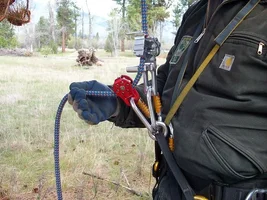
unicender - is it worth it?

The wear is like a burnish. Havent had one 6 months yet though. I am more worried about the effects of water, heat and cold and wood doing what it likes to do which is crack and split. I think it will be possible to have replaceable, or super durable friction points on an aluminum frame.
 
I like the wear on aluminum. It creates more friction when wearing, then other metals such as steel. I like the plastic, because of how easy it would be to make the rope wrench and it would keep the expense down. I think the ultimate would be nylon rope wrench, with an interchangeable clutch, so you can switch it out to aluminum, steel, titanium, wood, or nylon. Whatever the user prefers.
 
A purpose built unicender for smaller diameter rope would probably last longer on say a poison ivy or velocity. A good material for the clutches may be aluminum bronze. The trade off would be more weight.
 
I wonder if a smaller, less intrusive low friction rope wrench could work with the uni in order to reduce wear. something that would just take a little heat off the more expensive uni components.
 
that would be awesome bing, have it attach to the top tie in point on a short tether. if the come out with the slack tender uni, then i will be a uni flyer. there was to much of a style change on one tom let me borrow
 
I think that the slack tending and wear aspect will develop soon enough. I would love to see and you all would love to see a single line tool work as intuitively to grab as a hitch on doubled rope and as free to run as the uni on single line. The uni needs some kinda counter-movement on the straight cam release to add a little friction.
 
I toyed and played with attaching a helical hitch off of the top ring on the uni to share friction and wear. Worked sweet and obviously self tends up but no emergency descents as it is a two hand operation.
On very long descents using the bight I would recommend this, as much more than fifteen metres of rope below will keep the cams open if your hand slips.
 
something that may work with the unicender, is to fold down the top attach point and thread the rope through the hole that the biner uses in DRT before the rope goes through the clutch arms (as long as the hole aligns with the clutches), then in SRT it would act as a small aluminum rope wrench atop the unicender.
 
I got over a year on mine before needing a rebuild and for me, a production climber/owner, it's been invaluable in both speed of climbing and being less sore or tired at the end of the day. Like all things it's not perfect or ideal for every climb, but I do end up using it nearly every time.
 
[ QUOTE ]
Dave,

Would you attach a pic of your pulley slack tender setup?

Morgan made a prototype of a slacktender Uni. I've been climbing on it and some others too. it works nicely...now...to see if it goes into production. Sorry, no pics yet.

[/ QUOTE ]

Here it is, Tom. This is a pretty Mickey Mouse setup compared to what it should be if designed into the unit. It does, however, work well enough to use the Uni in a RADS configuration.

If Morgan is still working on design refinements, I would really like talking with either you or him because I have some strong ideas on what I believe to be simple-to-implement changes that would make vast improvements.

Dave
 

Attachments

  • 253834-Unifairlead.webp
    253834-Unifairlead.webp
    118 KB · Views: 251
[ QUOTE ]
I wonder if a smaller, less intrusive low friction rope wrench could work with the uni in order to reduce wear. something that would just take a little heat off the more expensive uni components.

[/ QUOTE ]

I have no doubt this would work well, Kevin. However, the beauty of the Unicender is that it is truly a stand alone tool. Its use in the tree is very fluid and intuitive because of this.

The wear is an issue, not so much due to the cost factor, but of the fact that it doesn't seem necessary. And should be fixable with some thought.

Dave
 
I agree. Even when the price was $450. It is worth it. But, now it is $280 at Wesspur. ($10 dollars less than Baileys. $20 dollars less than Sherrill).

The concept behind working SRT is worth changing climbing a style for. There were times I wanted to "can" the idea, but when I waited it out and kept using it, the reward is worth it. I'm much more effecient in the tree. I'm not always going to be faster (therefore I'll use what ever method I need that is fastest and most effecient). But, usually, the Uni is the choice...

The rebuild is $80 dollars.

I use a Gri-Gri for a teather.

I had to replace the wearable parts in 6 months. I'm now comming up on 6 months, on my newer plates, and I have no sign of slippage. So, I believe, the aluminum on my replacement parst is hardened.
thinking.gif
 
[ QUOTE ]
[ QUOTE ]

I use a Gri-Gri for a teather.


[/ QUOTE ]

Hey Jamin, can you show a pic or explain more on how you have that set up?

[/ QUOTE ]

That sounds useful for those super long droopy branch walks back in/up if you had a long tether and you belayed off of the uni to go out and set a rads on the tether to come in. I never liked the grigri on my lanyard as it would not always grab when I wanted. Do you have that problem when using as a tether?
 

New threads New posts

Back
Top Bottom