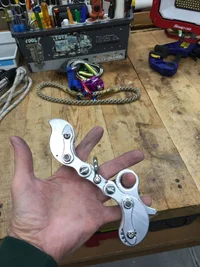
This is the Akimbo

pulling to failure will be done as soon as i have the heart to destroy one of my babies:crying:! drop testing a fall situation will be interesting but not necessarily definitive.

flex, i do still live in santa cruz. pm me.
For sure, no one like to break beautiful.
I suspect, like the other designs it will slip when dropped. Nice to know what it does with a side load, or if it slides down and hits a stopper knot etc.
Thanks
 
Last edited:
it will most certainly slide after a certain point. that point will depend on the rope and friction setting. that makes a destructive test a bit moot i guess, but i still want to know where the weak points are. i think a side load test will be of far more practical value as it represents a more realistic scenario.
 
Cool looking device, I'm intrigued by its function and feel to release, seems to hold friction mostly at the bottom, in a way similar to hitch hiker, I wonder how well the Akimbo can open up, or rather, release friction, for quick movements? Does the top collide into the bottom to hinder a fully open release? The scissored action when opening looks great!
 
Cool looking device, I'm intrigued by its function and feel to release, seems to hold friction mostly at the bottom, in a way similar to hitch hiker, I wonder how well the Akimbo can open up, or rather, release friction, for quick movements? Does the top collide into the bottom to hinder a fully open release? The scissored action when opening looks great!
friction is shared by the top and bottom arms. the top arm is what pulls the bottom arm closed such that pulling the top arm down eases friction on both top and bottom simultaneously. i designed it so that when the top and bottom arms come in contact the rope runs free. cheers
 
friction is shared by the top and bottom arms. the top arm is what pulls the bottom arm closed such that pulling the top arm down eases friction on both top and bottom simultaneously. i designed it so that when the top and bottom arms come in contact the rope runs free. cheers
This will be interesting to see and a deviation from everything else that is out there. Others have ONE controllable friction point while the other is progressive but not controllable although there is some minor transfer of load. Sounds like what you are talking about is beyond just transfer. So for those that think it looks like something already out there...we may be in for a treat.
 
Just to repeat what I posted on FB.

ALL, bigtop multicenders need a spring, PERIOD.
Rich,
Can you explain this I have been following this forum for a while and can't see with the way gravity and rope pull this ascender would need one. Maybe I have missed read this post or caught it out of context.
Thanks
Jared
 
Every device has a spring, with the exception of the BDB, I think. When you think about it even a friction hitch when it properly set, has a spring. When it is properly tied there is a little tension that causes recorded to engage first without operator contact. The unicender, Roadrunner, zigzag, all have springs. It's what causes the device to engage and overcome the weight of the friction device. Without it, you and the devices will freely follow gravity's lead to the ground.
It's one thing in a panic situation to have to let go and let the device to engage as opposed to consciously have to engage it.
 
i have been using various permutations of the Akimbo for about a year with no spring. the spring is needed for two very specific problems, both are only problems when the top arm is set "loose" on the rope. one is the akimbo will slide down the rope when the rope is slack, it will grab as soon as weight is applied, but it is annoying and could be a nasty surprise if you didnt notice. second is when using a foot or knee ascender it will fail to grab unless you sit into it firmly, ie it wont grab on its own without applying weight to it. it will grab every time if you pull fast or hard, kind of like a seatbelt. any production model will need a spring, but more for consistency rather than critical function.
 
Aliens are an example of a single axle design, Camalots are the only double axle design.

Omega pacific's link cam is more unique, but only in the rock climbing application, though the hinged cam lobe is also "sprung".

Might be some interesting spring technologies, or just some idea about what is probably a somewhat common manufacturing process.

DMM, by the way, makes cams.
 
All I'm saying is that climbing on a mechanical without a spring is like climbing in a hitch that won't self engage hands off.
Getting the gap just right is an iffy move. Flat spots that typically develop on a climb line could be interesting.
 
Last edited:
This is only true with 100% frictionless top connections. A hitch does not automatically engage do to spring action but by friction. A mechanical hitch will self engage if an appropriate amount of friction is maintained.
What I'm saying is that a properly tied hitch provides some "spring" action to put some pressure on the line somewhere in the hitch. Without the light "push" there will be NO friction to self engage.
 
All I'm saying is that climbing on a mechanical without a spring is like climbing in a hitch that won't self engage hands off.
Getting the gap just right is an iffy move. Flat spots that typically develop on a climb line could be interesting.

I do agree with you on this, but only to a point. The danger of climbing on a tool that
has a relaxed, frictionless position is extremely dangerous. This has been proven over and over as climbers keep striving for the " holy grail " of self- tending.

I personally find that a small amount of contact friction is more beneficial than not. As this new tool is still in the design stages I would prefer to see this contact incorporated into the works and not rely upon a spring as essential to its function. It would be best if Jamie could relegate the spring to just a performance enhancement as opposed to a critical and life dependent component.
 

New threads New posts

Back
Top Bottom