
Navigation
Install the app
How to install the app on iOS
Follow along with the video below to see how to install our site as a web app on your home screen.
Note: This feature may not be available in some browsers.
More options
You are using an out of date browser. It may not display this or other websites correctly.
You should upgrade or use an alternative browser.
You should upgrade or use an alternative browser.
Tapered Hinge: Diar(y)rhea of a thread gone wrong and left un-moderated
- Thread starter *useless info*
- Start date
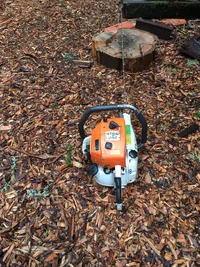
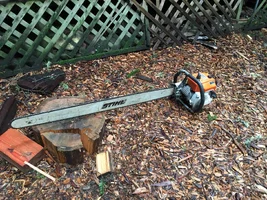
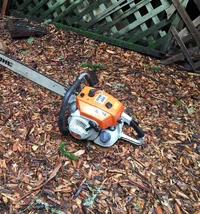

Evo
Been here much more than a while
- Location
- My Island, WA
That is a sexy beast! Fell into your lap? Hope your hips are ok old man! Let me know if it’s too much saw for you and I might consider helping you out by taking it off your lap.

The biggest top I ever took was about 5ft in diameter at around 125-130 ft. Used an 090 for the cut. I was in my 20's, so it was a very long time ago. I'm not sure I could even pull an 090 up that far any longer. I will be using this old hog for big falling cuts, bucking big logs, and light ornamental prunings.
Last edited:

RopeShield
Carpal tunnel level member
- Location
- Ontario, Canada
Keep posting @Daniel .
It is a dangerous job because the industry is run by big corporations and coward associations.
None of this work, cuttting, climbing etc should be done without mentorship and envolvement in certified apprenticeship.
Anyone who blames Daniel for being reckless is completely ignorant to the truth about this industry and how cowardly and corrupt it really is. Specifically the training companies/retailers taking peoples money with the knowledge that they supply gear and insufficient training to young and old men and women and leaving them to fend for themselves and watch them be injuried or killed doing work they should not be doing.
Daniels approach to sharing, is his. I believe we are all better for it.
Stabbing and toxic comments only show ignorance. Sometimes its fun other times it is a distractiion from the truth.
Run with the wolves go down with the pack!
We are in this together.
It is a dangerous job because the industry is run by big corporations and coward associations.
None of this work, cuttting, climbing etc should be done without mentorship and envolvement in certified apprenticeship.
Anyone who blames Daniel for being reckless is completely ignorant to the truth about this industry and how cowardly and corrupt it really is. Specifically the training companies/retailers taking peoples money with the knowledge that they supply gear and insufficient training to young and old men and women and leaving them to fend for themselves and watch them be injuried or killed doing work they should not be doing.
Daniels approach to sharing, is his. I believe we are all better for it.
Stabbing and toxic comments only show ignorance. Sometimes its fun other times it is a distractiion from the truth.
Run with the wolves go down with the pack!
We are in this together.
Evo
Been here much more than a while
- Location
- My Island, WA
I keep wondering where or who I’m suppose to get training from in order to use a 7/16 or less than 1/2 climbing line?Keep posting @Daniel .
It is a dangerous job because the industry is run by big corporations and coward associations.
None of this work, cuttting, climbing etc should be done without mentorship and envolvement in certified apprenticeship.
Anyone who blames Daniel for being reckless is completely ignorant to the truth about this industry and how cowardly and corrupt it really is. Specifically the training companies/retailers taking peoples money with the knowledge that they supply gear and insufficient training to young and old men and women and leaving them to fend for themselves and watch them be injuried or killed doing work they should not be doing.
Daniels approach to sharing, is his. I believe we are all better for it.
Stabbing and toxic comments only show ignorance. Sometimes its fun other times it is a distractiion from the truth.
Run with the wolves go down with the pack!
We are in this together.
RopeShield
Carpal tunnel level member
- Location
- Ontario, Canada


Jem4417
Branched out member
If your viewing this thread and are confused about what is being said or have seen any of Daniels work and think your about to do any of the techniques he’s displayed on this site or anywhere else please speak up and give feedback on any of your experiences using his cuts in the field

southsoundtree
Been here much more than a while
- Location
- Olympia, WA
Rico, that has the EZ-start on it, huh?

RyTheTreeGuy
Branched out member
- Location
- Canada
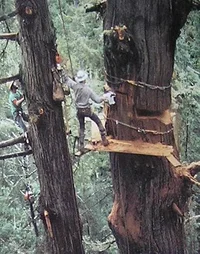
My business partner had an 090 AV for a short period of time. Beautiful saw, but a heavy bastard. Can only imagine what itbwould be like holding that moster up a 100 plus feet...whenever I see that saw I can't seem to get this image out of my head.

southsoundtree
Been here much more than a while
- Location
- Olympia, WA

Daniel
Carpal tunnel level member
- Location
- Suburban Philadelphia (Wayne)
Its no surprised that he feels cutting ones hinge when using a tapered hinges is a bad idea, or encouraging a top/log to come back towards/behind the stump is a “dangerous practice”.
@rico As with jerry Beranek's book, a careful reading of Graeme's post is called for. Lots of information with some very specific considerations..
Here's what he said:
As a general concept to retain the top closer to the stump this could be a dangerous practice. If we consider the concept of encouraging the fibres to hang on and we apply this to species renown to tear down we may in fact be creating a serious safety issue for the climber. I would consider other options if possible and encourage those acquiring experience the same.
I saw also a method to back release a heavy leaner with the notion that the saw couldn't be taken with the tree. This is quite wrong if it were to be applied in my place of work. The free grained timber I fall here will try to take that saw nearly every time. Despite high speed, gentle cutting the rupturing fibres upon the explosive departure will separate along the chain and bend it if not take the saw. It might work for some in their places of work but expect some well founded disagreement on the world stage of tree buzz.
It's important to get clear on the distinction between a dangerous practice (something generally dangerous) and a practice the "could be " dangerous. He refers to it as the latter and further qualifies that danger by specifically mentioning species that are prone to fibers tearing down (past the notch) as a safety issue for the climber.
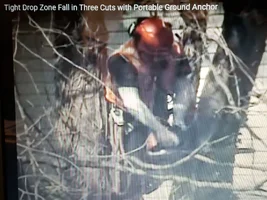
If you look closely at the video at 5:28 you'll see that I was not tied in below the cut, as my lanyard is unused, hanging at my side and the climbing line is tied into the adjacent lead. So any chance of the fibers tearing down the side of the hinge past the notch would not have affected me.
Whereas at the cut at 11:50 I specifically state that because I was tied in "right here" (below the cut) I didn't want to use a wide notch. I was going to use a narrower notch to get earlier separation.
And more careful reading Graeme's post shows that his warning about not using a swing dutchman refers to cutting "full sized" tree, which he pre-qualified by saying "Making statements regarding methods that rely on consistent fibres and characteristics to a world stage is a folly. " This would indicate some caution in the use of the tapered hinge and swing dutchman, the flip side of that coin is that they may have their used in specific scenarios and making blankets statement calling them dangerous and unproven bad ideas etc. is also folly.
Graeme clearly says that he uses the tapered hinge regularly in his normal work (whatever that is), so he clearly sees value in the method, though he also warns about making blanket statements with so many variables involved.. That seems like a very sound perspective to me... I would like to take it to the next level and start to consider, deliberate, and codify those variables, many of which have occured as somewhat intuitive to me.
Graeme's other statement: "Novelty methods of falling often are very limited in application in general tree work. Fallers are better equipped to consolidate sound core skills first." seems to make perfect sense, recognizing the value of novelty falling methods when applied to specific scenarios in general tree work, but having little or no relevance in logging..
Last edited:
To me that is the greatest tree work photo of all time. Back in the day any self respecting young logger had that poster hanging somewhere in his house!My business partner had an 090 AV for a short period of time. Beautiful saw, but a heavy bastard. Can only imagine what itbwould be like holding that moster up a 100 plus feet...whenever I see that saw I can't seem to get this image out of my head.
View attachment 56786
Last edited:

Hey Everyone, pretty sure this is my first post.
All the mudslinging aside, I think this is an important topic, and wanted to add my perspective.
It's very species dependent, but I use tapered hinges all the time.
I use them in-tree on larger lateral limbs to swing cut over low-risk obstacles, when just back-cutting directionally would either split or break free unpredictably. It creates a swing-drop motion that ends like a clean drop cut. Also in-tree, I use tapered hinges to reliably swing tops into lays up to 45 degrees from their attitude without having to set a hand line.
For me, the tapered hinge really shines when falling trees with strong hinge fiber on the ground. Even for trees with questionable fiber, if the hinge is put center stem (which is where I put most of my hinges), a tree with some lean can be swung into a lay. If you start adding pulling power and open-faced notches to the equation, you can achieve some pretty wild stuff. We have pulled big oaks leaning hard at 4:30 into lays at 12:00. With the tapered hinge, the tops swing around the axis of the stem with a rolling motion.
The common denominator here is lean. If there is no lean to counteract, a tapered hinge has a limited effect. This is why I choose an open-faced notch when I'm really trying to park a fair standing, back-leaning, or bare stem tree on a dime. The cool thing about leaning canopy, is that it's really just potential energy that can be committed to lateral movement. Furthermore, as canopy is somewhat fluid as a body, it's gravity changes as it moves. This sequential changing of gravitational center after the trigger event is what creates the unique swinging motion of a well-executed tapered hinge cut.
A big problem that I see with trying to teach the tapered hinge is that it's hard to quantify. I can't can't give you the calculus that explains the relationship of hinge thickness to stem diameter to offset from CoG to species (that would be one hell of an unused, underappreciated magnum opus!). If you don't understand the variables that need to be controlled, it can go badly. We all know that a "bad day" is very understated here in tree world. I have over-swung trees by leaving too much hinge. For me, this meant broken branches on other trees, because, for the record, I never use this technique over structures.
Also, fences are not structures. They are tree-hurdles.
All the mudslinging aside, I think this is an important topic, and wanted to add my perspective.
It's very species dependent, but I use tapered hinges all the time.
I use them in-tree on larger lateral limbs to swing cut over low-risk obstacles, when just back-cutting directionally would either split or break free unpredictably. It creates a swing-drop motion that ends like a clean drop cut. Also in-tree, I use tapered hinges to reliably swing tops into lays up to 45 degrees from their attitude without having to set a hand line.
For me, the tapered hinge really shines when falling trees with strong hinge fiber on the ground. Even for trees with questionable fiber, if the hinge is put center stem (which is where I put most of my hinges), a tree with some lean can be swung into a lay. If you start adding pulling power and open-faced notches to the equation, you can achieve some pretty wild stuff. We have pulled big oaks leaning hard at 4:30 into lays at 12:00. With the tapered hinge, the tops swing around the axis of the stem with a rolling motion.
The common denominator here is lean. If there is no lean to counteract, a tapered hinge has a limited effect. This is why I choose an open-faced notch when I'm really trying to park a fair standing, back-leaning, or bare stem tree on a dime. The cool thing about leaning canopy, is that it's really just potential energy that can be committed to lateral movement. Furthermore, as canopy is somewhat fluid as a body, it's gravity changes as it moves. This sequential changing of gravitational center after the trigger event is what creates the unique swinging motion of a well-executed tapered hinge cut.
A big problem that I see with trying to teach the tapered hinge is that it's hard to quantify. I can't can't give you the calculus that explains the relationship of hinge thickness to stem diameter to offset from CoG to species (that would be one hell of an unused, underappreciated magnum opus!). If you don't understand the variables that need to be controlled, it can go badly. We all know that a "bad day" is very understated here in tree world. I have over-swung trees by leaving too much hinge. For me, this meant broken branches on other trees, because, for the record, I never use this technique over structures.
Also, fences are not structures. They are tree-hurdles.
RopeShield
Carpal tunnel level member
- Location
- Ontario, Canada
@rico so very sad at the same time.
Be interesting to learn the reason for the removal.
We will look at these tree pics in the near future in the same way we see big game hunters and their trophies. Condemnation
Saving trees is commendable.
I don't speak for Jerry. But I bet it doesn't even come close to his proudest moments as a treeman.
His writing, study and photographs far exceed
Be interesting to learn the reason for the removal.
We will look at these tree pics in the near future in the same way we see big game hunters and their trophies. Condemnation
Saving trees is commendable.
I don't speak for Jerry. But I bet it doesn't even come close to his proudest moments as a treeman.
His writing, study and photographs far exceed

New threads New posts
-
test
-
-

-

-
 For Sale: 2018 Vermeer BC1000XL Chipper | 918 Run Hours | Deutz Diesel
- Started by Blue Ribbon Tree
- Replies: 2
-
AJ Could Have Climbing Work For Weeks and Weeks in BC . . . .
- Started by ghostice
- Replies: 2
-


