Tapered Hinge: Diar(y)rhea of a thread gone wrong and left un-moderated

Use Tapered Hinge against Side Lean?

  • Huh?

    Votes: 0 0.0%
  • Never

    Votes: 0 0.0%
  • Hardly

    Votes: 1 3.7%
  • Sometimes

    Votes: 15 55.6%
  • Preferably

    Votes: 7 25.9%
  • Religiously

    Votes: 4 14.8%

  • Total voters
    27
  • Poll closed .
Furthermore, as canopy is somewhat fluid as a body, it's gravity changes as it moves. This sequential changing of gravitational center after the trigger event is what creates the unique swinging motion of a well-executed tapered hinge cut. .

Mitch,

Welcome and thanks for posting.. Not only does your post indicate a great skill set, you write REALLY WELL!!!

That above quote is like poetry to my ears! And I think that the the OP ("useless info": formerly the tree spyder) would wholeheartedly agree with your perspective as I do.


Thank you so much for sharing and look forward to hearing more from you!!!
 
@rico so very sad at the same time.
Be interesting to learn the reason for the removal.
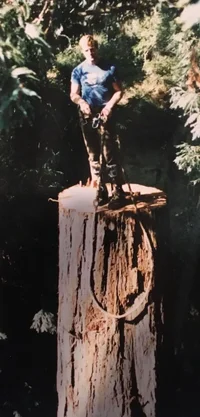
We will look at these tree pics in the near future in the same way we see big game hunters and their trophies. Condemnation
Saving trees is commendable.
I don't speak for Jerry. But I bet it doesn't even come close to his proudest moments as a treeman.
His writing, study and photographs far exceed

For anyone interested in learning more about the the rockport tree or Mr. Baranek in general I would strongly recommend August's interview as well as getting your hands on "the fundamentals of general tree work." Educated Climber has the .pdf version acailable on his website for a very reasonable price. Working climber DVD series is also invaluable....basically anything the man has been involved with is going to be good
 
Seeing that pic of Mr. B blowing a big top made me think of Hap Johnson's Coffee Break vid. I can't seem to find it but I encourage everyone to try and track it down. Amazing old-school goodness!

Found this one though. Ace tree. Nuff said!


A little coffee break moment from back in the day. Just got done blowing a 100-110 ft top at 135-145 ft. Sorry, but I just couldn't resist!

croppedcoffeebreak.webp
 
Any tree can be pulled to the lay without a directional felling cut IF pulled the correct direction, and IF pulled hard enough, and If bound enough to keep from splitting.

If you pull a tree opposite the lean, and it only has a strap, no face, you can used a mega-tapered hinge.


Try all these without a pull-rope and open lawns to yank stuff by a fast moving machine and you will have different results.

The smaller the tree, the easier it is tell how much you can yank.


Hard to differentiate between a tapered hinge, and a tapered hinge supported by a rope, and quick, hard pull.


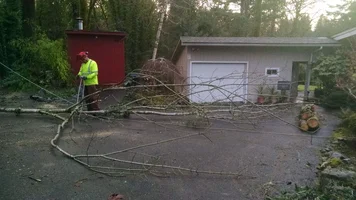
I swung an 80' maple, from over the cable line, into a tight lay between the power line and a weeping birch, 10' from the front door, no hinge. Just a super special SEATBELT CUT with an Equi-Altitude Release Cut. This resists splitting.

It the SBCEAR cut. I'm working out the acronym.


IMG_20190111_163115581.webp


Oh, I had a rope hanging a Lot of the top-tied tree weight hung out of a medium-sized fir.
 
Last edited:
@rico As with jerry Beranek's book, a careful reading of Graeme's post is called for. Lots of information with some very specific considerations..

Here's what he said:
As a general concept to retain the top closer to the stump this could be a dangerous practice. If we consider the concept of encouraging the fibres to hang on and we apply this to species renown to tear down we may in fact be creating a serious safety issue for the climber. I would consider other options if possible and encourage those acquiring experience the same.

I saw also a method to back release a heavy leaner with the notion that the saw couldn't be taken with the tree. This is quite wrong if it were to be applied in my place of work. The free grained timber I fall here will try to take that saw nearly every time. Despite high speed, gentle cutting the rupturing fibres upon the explosive departure will separate along the chain and bend it if not take the saw. It might work for some in their places of work but expect some well founded disagreement on the world stage of tree buzz.

It's important to get clear on the distinction between a dangerous practice (something generally dangerous) and a practice the "could be " dangerous. He refers to it as the latter and further qualifies that danger by specifically mentioning species that are prone to fibers tearing down (past the notch) as a safety issue for the climber.

If you look closely at the video at 5:28 you'll see that I was not tied in below the cut, as my lanyard is unused, hanging at my side and the climbing line is tied into the adjacent lead. So any chance of the fibers tearing down the side of the hinge past the notch would not have affected me.

Whereas at the cut at 11:50 I specifically state that because I was tied in "right here" (below the cut) I didn't want to use a wide notch. I was going to use a narrower notch to get earlier separation.

And more careful reading Graeme's post shows that his warning about not using a swing dutchman refers to cutting "full sized" tree, which he pre-qualified by saying "Making statements regarding methods that rely on consistent fibres and characteristics to a world stage is a folly. " This would indicate some caution in the use of the tapered hinge and swing dutchman, the flip side of that coin is that they may have their used in specific scenarios and making blankets statement calling them dangerous and unproven bad ideas etc. is also folly.

Graeme clearly says that he uses the tapered hinge regularly in his normal work (whatever that is), so he clearly sees value in the method, though he also warns about making blanket statements with so many variables involved.. That seems like a very sound perspective to me... I would like to take it to the next level and start to consider, deliberate, and codify those variables, many of which have occured as somewhat intuitive to me.

Graeme's other statement: "Novelty methods of falling often are very limited in application in general tree work. Fallers are better equipped to consolidate sound core skills first." seems to make perfect sense, recognizing the value of novelty falling methods when applied to specific scenarios in general tree work, but having little or no relevance in logging..View attachment 56788
Here we go, round and round again. No one is condoning your methods. Just read between the lines and manipulate the words to squeeze your ego in.
 
Here we go, round and round again. No one is condoning your methods. Just read between the lines and manipulate the words to squeeze your ego in.
It appears that Daniel missed the entire message/spirit behind Graeme’s post, and instead distorted it to try and support his dangerous, fucked up methods. Astonishing really.
 
Yes. Thanks for the input Graeme.. nice to hear from someone of your experience (you're work is awesome!!)

And Mark, if you managed to read this whole thread, all the pics of the swing dutchman I post are of relatively small diameter trees... It only makes sense that anything with a lot of mass would compress the heavy side of the tree if you tried a swing dutch. I never really thought about it consciously before all the back and forth on this thread.

One of the things I got clear on is that the bigger the tree, the less help you can count on from a tapered hinge, especially when using wedges and no pull line. With a high pull line, you can leave a wider hinge which has much more holding ability to fight the side lean. In that case (always the case for me) using the tapered hinge makes sense in that it helps throw everything to your advantage..

@Tony ... do me a favor and tell Graeme his use of the TH is pure B.S. Man up!


Still B.S.

Still keeps a sawyer in the danger zone longer than necessary. Still lacks any type of quantifiable predictability

"Shortening the hinge is a gamble, plain and simple. If that is your deal and you accept the risk I am not here to judge you." (Me)

"Novelty methods of falling often are very limited in application in general tree work. Fallers are better equipped to consolidate sound core skills first." (Graeme)

While you are incapable of offending me personally by asking me to "man up," I do take a professional offense to the sexist language.

Tony
 
It appears that Daniel missed the entire message/spirit behind Graeme’s post, and instead distorted it to try and support his dangerous, fucked up methods. Astonishing really.
Think we have a master gaslighter here.. either that or some physiological disorder..
 
IMG_0638.webpIMG_0638.webp
@rico As with jerry Beranek's book, a careful reading of Graeme's post is called for. Lots of information with some very specific considerations..

Here's what he said:
As a general concept to retain the top closer to the stump this could be a dangerous practice. If we consider the concept of encouraging the fibres to hang on and we apply this to species renown to tear down we may in fact be creating a serious safety issue for the climber. I would consider other options if possible and encourage those acquiring experience the same.

I saw also a method to back release a heavy leaner with the notion that the saw couldn't be taken with the tree. This is quite wrong if it were to be applied in my place of work. The free grained timber I fall here will try to take that saw nearly every time. Despite high speed, gentle cutting the rupturing fibres upon the explosive departure will separate along the chain and bend it if not take the saw. It might work for some in their places of work but expect some well founded disagreement on the world stage of tree buzz.

It's important to get clear on the distinction between a dangerous practice (something generally dangerous) and a practice the "could be " dangerous. He refers to it as the latter and further qualifies that danger by specifically mentioning species that are prone to fibers tearing down (past the notch) as a safety issue for the climber.

If you look closely at the video at 5:28 you'll see that I was not tied in below the cut, as my lanyard is unused, hanging at my side and the climbing line is tied into the adjacent lead. So any chance of the fibers tearing down the side of the hinge past the notch would not have affected me.

Whereas at the cut at 11:50 I specifically state that because I was tied in "right here" (below the cut) I didn't want to use a wide notch. I was going to use a narrower notch to get earlier separation.

And more careful reading Graeme's post shows that his warning about not using a swing dutchman refers to cutting "full sized" tree, which he pre-qualified by saying "Making statements regarding methods that rely on consistent fibres and characteristics to a world stage is a folly. " This would indicate some caution in the use of the tapered hinge and swing dutchman, the flip side of that coin is that they may have their used in specific scenarios and making blankets statement calling them dangerous and unproven bad ideas etc. is also folly.

Graeme clearly says that he uses the tapered hinge regularly in his normal work (whatever that is), so he clearly sees value in the method, though he also warns about making blanket statements with so many variables involved.. That seems like a very sound perspective to me... I would like to take it to the next level and start to consider, deliberate, and codify those variables, many of which have occured as somewhat intuitive to me.

Graeme's other statement: "Novelty methods of falling often are very limited in application in general tree work. Fallers are better equipped to consolidate sound core skills first." seems to make perfect sense, recognizing the value of novelty falling methods when applied to specific scenarios in general tree work, but having little or no relevance in logging..View attachment 56788
@rico As with jerry Beranek's book, a careful reading of Graeme's post is called for. Lots of information with some very specific considerations..

View attachment 56826I saw also a method to back release a heavy leaner with the notion that the saw couldn't be taken with the tree. This is quite wrong if it were to be applied in my place of work. The free grained timber I fall here will try to take that saw nearly every time. Despite high speed, gentle cutting the rupturing fibres upon the explosive departure will separate along the chain and bend it if not take the saw. It might work for some in their places of work but expect some well founded disagreement on the world stage of tree buzz.

Graeme clearly says that he uses the tapered hinge regularly in his normal work (whatever that is), so he clearly sees value in the method, though he also warns about making blanket statements with so many variables involved.. That seems like a very sound perspective to me... I would like to take it to the next level and start to consider, deliberate, and codify those variables, many of which have occured as somewhat intuitive to me.

Graeme's other statement: "Novelty methods of falling often are very limited in application in general tree work. Fallers are better equipped to consolidate sound core skills first." seems to make perfect sense, recognizing the value of novelty falling methods when applied to specific scenarios in general tree work, but having little or no relevance in logging..View attachment 56788
@rico

I saw also a method to back release a heavy leaner with the notion that the saw couldn't be taken with the tree. This is quite wrong if it were to be applied in my place of work. The free grained timber I fall here will try to take that saw nearly every time. Despite high speed, gentle cutting the rupturing fibres upon the explosive departure will separate along the chain and bend it if not take the saw. It might work for some in their places of work but expect some well founded disagreement on the world stage of tree buzz.

Graeme clearly says that he uses the tapered hinge regularly in his normal work (whatever that is), so he clearly sees value in the method, though he also warns about making blanket statements with so many variables involved.

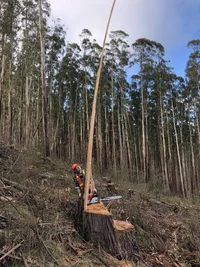
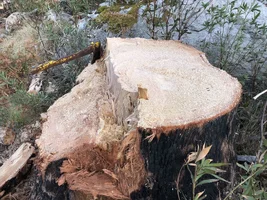
I thought I would post a couple of pics to best demonstrate what I have said. This picture shows how free the grain can react under moderate to high lean/ load. It is unsafe to stand to the rear of the tree as that tapered strap can whip back down upon release. The perspective doesn't do justice to the daily grind. The density of the trees in the background are consistant through the coupe. The stump is about average size and the trees are a good length. Consider the forces at moment of departure. This length of display is not common.
 
I can operate a chainsaw but not a computer. Appologies. I get in such a state.

What I thought I posted:

I thought I would post a couple of pics to best demonstrate what I have said. This picture shows how free the grain can be under moderate to high lean. It is unsafe to stand to the rear of the tree as that tapered strap can whip back down upon release. The perspective doesn't do justice to the daily grind. The density of the trees in the background are consistent through the coupe. The stump is about average size and the trees are a good length. The differences between the force to hold and depart are high. This display is uncommon.
 
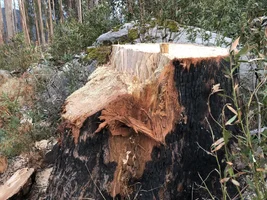
This shows a Humboldt with TH. The chunk of wood has already been cut but drawn out of the stump by adjoining uncut wood.
 

Attachments

  • IMG_1176.webp
    IMG_1176.webp
    1 MB · Views: 46
Last edited:
Wood pulled upwards from the outer cambium and bark. Inner wood retained with the stump. The sheering force between them at point of departure is high. A chain cuaght between them can be captive to either.
 

Attachments

  • IMG_1218.webp
    IMG_1218.webp
    1.3 MB · Views: 43
Last edited:
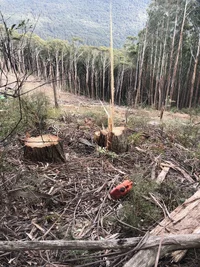
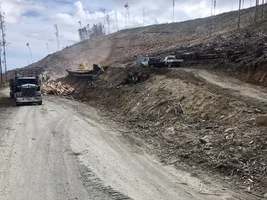
This is part of one of my coupes of which I am the only hand faller. The face on this coupe is almost 1.6 km long. The density of trees hand felled here is difficult to appreciate. The machines working in the distance rounding up Sunday's wood will give some perspective of the scale. When an opinion is stated regarding how any tree ought to be felled narrators must consider their audience, both experienced and learner. I don't have all the answers just an opinion, sometimes.
 

Attachments

  • IMG_1240.webp
    IMG_1240.webp
    980.7 KB · Views: 43
Looks like very difficult work to say the least. To put enough wood on the ground means minimizing time between fells and with that terrain.... it has to be a workout.


The picture of the Humboldt where the center fiber was pulled, was that a 1/4 cut method for the back cut? I'm just wondering how both sides were free and the center was last to pull.
 
Looks like very difficult work to say the least. To put enough wood on the ground means minimizing time between fells and with that terrain.... it has to be a workout.


The picture of the Humboldt where the center fiber was pulled, was that a 1/4 cut method for the back cut? I'm just wondering how both sides were free and the center was last to pull.

The picture of the Humboldt where the centre fibre was pulled, was that a 1/4 cut method for the back cut? I'm just wondering how both sides were free and the centre was last to pull.[/QUOTE]

It probably had a natural lean close to where it needed to go and looks like I just chased it around the stump and left a stronger hinge this side. If you look at the distribution of saw dust and lack of wedge marks I reckon that sums it up. That chunk of wood being drawn up can ruin a chain. Sometimes it happens.

I found the other pic with my axe so that is about 4 1/2 feet across the cut.
 

Attachments

  • IMG_1175.webp
    IMG_1175.webp
    1.1 MB · Views: 31
Looks like very difficult work to say the least. To put enough wood on the ground means minimizing time between fells and with that terrain.... it has to be a workout.


The picture of the Humboldt where the center fiber was pulled, was that a 1/4 cut method for the back cut? I'm just wondering how both sides were free and the center was last to pull.

It is a workout but there is no rush, the day is long. With 60 year old legs I "change back a gear" and minimise wasted effort. The natural slope is 25 - 45 degrees and the last few days have been in the 40's deg C, (and there is some donkey cutting down all his shade).
Despite this, when I can get to them through the undergrowth and crap I average a tree about every 4 - 5 minutes for 11 hours a day. 1 hour off for lunch and replace the lost fluids with cold beers end of day.

You have honed in correctly "minimizing time" though cutting wasted time doesn't mean cutting corners. While I am scarfing (notching) a tree I am looking around planning hours ahead of myself. How you move your fuel ahead of the work, cutting bridged logs while you are there and observing future hazards, all adds up. The “alpine ash” bush is unforgiving. All this is done while coordinating with the machines sorting the mess I make below.

The flow of wood onto trucks is the result of great teamwork rather than any individual.

Placing wedges in every tree is as big a waste of time and effort as not putting one in when you need to. Knowing when to is the result of experience. If I knew how, I would put up some short clips of sliding trees down to the landing and other stuff but alas there isn’t a “pull start” on my computer. I had to work a few Sunday’s and not allowed to work alone so I took up an assistant who took some pics. I put 16 litres of fuel through the falling saw so there was a lot going on.
 
It is a workout but there is no rush, the day is long. With 60 year old legs I "change back a gear" and minimise wasted effort. The natural slope is 25 - 45 degrees and the last few days have been in the 40's deg C, (and there is some donkey cutting down all his shade).
Despite this, when I can get to them through the undergrowth and crap I average a tree about every 4 - 5 minutes for 11 hours a day. 1 hour off for lunch and replace the lost fluids with cold beers end of day.

You have honed in correctly "minimizing time" though cutting wasted time doesn't mean cutting corners. While I am scarfing (notching) a tree I am looking around planning hours ahead of myself. How you move your fuel ahead of the work, cutting bridged logs while you are there and observing future hazards, all adds up. The “alpine ash” bush is unforgiving. All this is done while coordinating with the machines sorting the mess I make below.

The flow of wood onto trucks is the result of great teamwork rather than any individual.

Placing wedges in every tree is as big a waste of time and effort as not putting one in when you need to. Knowing when to is the result of experience. If I knew how, I would put up some short clips of sliding trees down to the landing and other stuff but alas there isn’t a “pull start” on my computer. I had to work a few Sunday’s and not allowed to work alone so I took up an assistant who took some pics. I put 16 litres of fuel through the falling saw so there was a lot going on.

Where about a in Vic are you cutting Graeme??
Would give my left but to come spend a couple days watching or falling with someone of your ability
 

New threads New posts

Back
Top Bottom