Tapered Hinge: Diar(y)rhea of a thread gone wrong and left un-moderated

Use Tapered Hinge against Side Lean?

  • Huh?

    Votes: 0 0.0%
  • Never

    Votes: 0 0.0%
  • Hardly

    Votes: 1 3.7%
  • Sometimes

    Votes: 15 55.6%
  • Preferably

    Votes: 7 25.9%
  • Religiously

    Votes: 4 14.8%

  • Total voters
    27
  • Poll closed .
Daniel, serious question on the locust.

In a situation like this where you have ropes pulling a heavy tree leaning that far over and you start the backcut and drive wedges, what is the reason for wedges at this point...is it to lessen the side load on the fibers to prevent their possible failure from the sideways pull, or can they actually exert enough force help straighten the tree without danger of snapping the hinge?
 
I don't normally use wedges because usually A pull line is often all that is required

However occasionally I will use wedges on a side leaner to prop up the lean side of the back cut

And have used them on back leaders successfully in conjunction with the Pull line

That said Wedges are not an area of expertise of mine and I would refer that question someone that's more familiar with their use.
 
Last edited:
Ok. Your undercut on the wee little locust was just another one of your perfect shelf cuts. You were just lazy, and didn’t take the time to clean it out, which may or may not have affected the outcome. I guess we will have to take your word on it.

We also learned from your lastest, revised storyline that you did, as I suspected, make multiple attempts at the backcut. You started with the ever popular, severely undershot backcut, but alas it didn’t work, so you took another stab at it, destroying all your hinge in the process. Fucking multiple attempts at a backcut. Really? This one really takes the cake bro.

We also learn in the latest narrative that you had no intention of this tree hitting your undercuts lay, but instead you intended to lose is only slightly sideways. A highly unpredictable method I have seen used a 1000 times with varying degrees of success. A technique that should never be used around valuables, but lucky for you it looks like you had a 100-150 Degrees off open space for this meager little side leaner to land without risk of hitting anything.

Is it just me, or do others see problems with this hackery and utter nonsense?

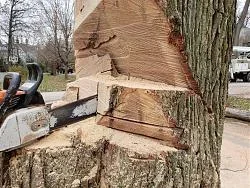
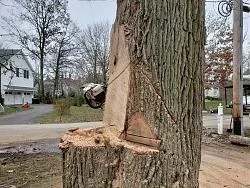
Now that we have that all sorted, maybe you could explain your reasoning behind the undercut with a small bar on the Oak that you posted over at treehouse. As I said earlier, it is one of the worst attempts at an undercut from a so-called pro that I can ever remember seeing , so I’m really looking forward to this one. I’m here to learn after all.
 
Last edited:
Daniel, serious question on the locust.

In a situation like this where you have ropes pulling a heavy tree leaning that far over and you start the backcut and drive wedges, what is the reason for wedges at this point...is it to lessen the side load on the fibers to prevent their possible failure from the sideways pull, or can they actually exert enough force help straighten the tree without danger of snapping the hinge?
Wedges and tree jacks function by lifting and pushing the weight of the tree into the undercut. They can in fact be used to counteract a side lean with great success if one knows what they are doing. A good faller can overcome a pretty decent lean with wedges, and overcome serious shit with treejacks. Many fallers, including myself actually start with the back-cut when using treejacks. You begin your backcut, then create a notch for your jack to sit in, then continue with you backcut while putting tension on your jack, while watching your gauge. Once you get it loaded up like you want, you then make your undercut. If things are going well you will see the pressure on your jacks go down once the undercut is done, telling you that you are already moving your tree in the right direction. You then continue with your backcut (without cutting your hinge), slowly jacking and watching you gauges, and pounding wedges if you choose, till she goes. The combination of a treejack ( or wedges for that matter), a properly set tag line, and a well executed cut can overcome some seriously crazy leans.
 
Last edited:
Hey rico

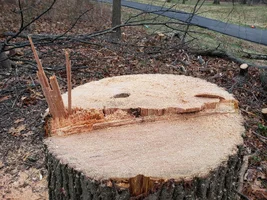
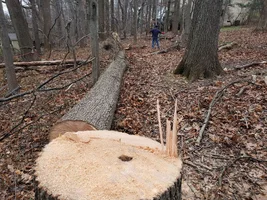
Haha cut another special for you on this side leaner

Drop zone was right between the two trees, slightly favoring the small maple to protect the oak

Tough to see in photo but depression in leaves shows the tree hit perfectly and rolled left 20181203_151604.webp20181203_151539.webp
 
Hey rico

Haha cut another special for you on this side leaner

Drop zone was right between the two trees, slightly favoring the small maple to protect the oak

Tough to see in photo but depression in leaves shows the tree hit perfectly and rolled left View attachment 55678View attachment 55679
More bypass and severed hinge. I would expect nothing less buddy!

Now onto other matters- "You know how much harder it is to pull a tree over with a back cut, below the face. I put the saw down and went out to help pull, but the holding wood was too strong. When the tree didn't budge on the low back cut, I made a second back cut a little higher and little deeper until the tree did move..."

"I've been experimenting with intentionally low back cuts and staggered back cuts etc... This one worked"

These are your words in the same post about the exact same cut. Seriously conflicting statements buddy. I won't go so far as to say you are full of shit, but I do find your ever changing stories, nonsensical answers, and conflicting narratives very cururious?

For the 3rd time, I would really love to hear your expert thoughts/explanations on this amazing attempt at an undercut with an undersized saw? I pretty sure you already know my feelings on this atrocity, but I'm just a dumbass west coaster who has been falling trees with an undersized saw most of my life, so what the fuck do I know. A penny for your thought bro!

short bar bisect.webpshort bar pangle.webp
 
When felling ALWAYS use wedges if trunk diameter allows regardless of lean. If one to two folks can pull a tree with a tag it can be wedged without breaking a sweat. Wedges are your backup plan if something goes wrong, sudden breeze, pulling person steps in a hornet nest, skid steer stalls or throws a track.

@rico I’d love to get into jacking trees, I’d love to learn from the greatest tree jacker around. Fur reals!

@Daniel you get off on this don’t you?
 
I asked many questions, received 0 answers.

Tapered hinge isn’t up for debate here, it’s a good tool in the box.

I beg to disagree... we have me dent, ken, and you on one side, and arbormaster, Tim Ard, arboricultural training Canada and Tony Tresselt on the other side with Rico somewhere in the middle...

What can I answer for you?
 
I beg to disagree... we have me dent, ken, and you on one side, and arbormaster, Tim Ard, arboricultural training Canada and Tony Tresselt on the other side with Rico somewhere in the middle...

What can I answer for you?
Scroll back. Basically why in the hell did you bore cut the dead tree on the swine set? You knew your bar was short right?

Do you trust these cuts with your life or around targets? Are you using them in conjunction with a tag?
I’m specifically asking about the ones in the photos in this thread, for the love of god/Gaia please let’s cover the points before stoking the fires.

Also my most recent question “ you get off on this right?”
 
This vid at 1:40 shows a heavy front leaning locust that came down really slowly and moved significantly left during the fall... the back cut on the left side was low. This is the tree that got me thinking about the possible benefits of an intentionally low back cut. Just happens to be another locust!


Just actually watched this thing in its entirety. To the untrained eye it would appear that both trees went to the left a bit? Gee I wonder why? We will keep this one in the que for future debate and schooling courtesy of the charlatan otherwise know as Daniel, but not until I get some schooling on making undercuts with an undersized saw first.


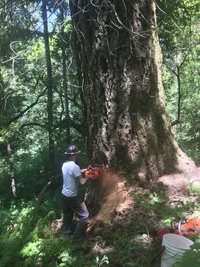
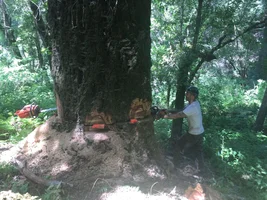
Falling a little near 6 footer with a 36" bar. Help me Mr. Murphy!

IMG_0882.webpIMG_0889.webp
 
Last edited:
Just actually watched this thing in its entirety. To the untrained eye it would appear that both trees went to the left a bit? Gee I wonder why? We will keep this one in the que for future debate and schooling courtesy of the charlatan otherwise know as Daniel, but not until I get some schooling on making undercuts with an undersized saw first.


Falling a little near 6 footer with a 36" bar. Help me Mr. Murphy!

View attachment 55682View attachment 55683
Well obviously you got one saw stuck in the tree.
 
Well obviously you got one saw stuck in the tree.
Nope. I frequently leave my bigger falling saw in the backcut, but slip it out a bit so I don’t hit the tip, then use a smaller saw to caress the far side hinge. Sometimes I will pull the big saw completely out of the backcut and rest the bar in the undercut while I am touching up my far side hinge with a smaller saw. I always try and get my far side hinge sorted before I commit to finishing my Backcuts. Just something I do when cutting with an undersized bar. I have seen the disasterous results of destroying your far side hinge when in bigger wood, so its something I try my best not to do.
 
Last edited:

New threads New posts

Back
Top Bottom