Tapered Hinge: Diar(y)rhea of a thread gone wrong and left un-moderated

Use Tapered Hinge against Side Lean?

  • Huh?

    Votes: 0 0.0%
  • Never

    Votes: 0 0.0%
  • Hardly

    Votes: 1 3.7%
  • Sometimes

    Votes: 15 55.6%
  • Preferably

    Votes: 7 25.9%
  • Religiously

    Votes: 4 14.8%

  • Total voters
    27
  • Poll closed .
I'll get a pic of tomorrow's tree. You ain't seen nothin yet!

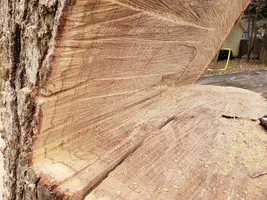
Just actually watched this thing in its entirety. To the untrained eye it would appear that both trees went to the left a bit? Gee I wonder why? We will keep this one in the que for future debate and schooling courtesy of the charlatan otherwise know as Daniel, but not until I get some schooling on making undercuts with an undersized saw first.


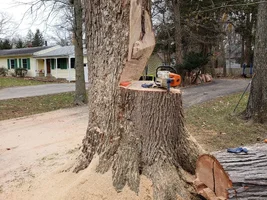
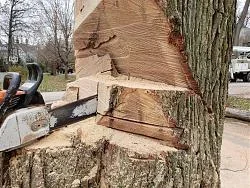
Falling a little near 6 footer with a 36" bar. Help me Mr. Murphy!

View attachment 55682View attachment 55683
 
Nope. I frequently leave my bigger falling saw in the backcut, but slip it out a bit so I don’t hit the tip, then use a smaller saw to caress the far side hinge. Sometimes I will pull the big saw completely out of the backcut and rest the bar in the undercut while I am touching up my far side hinge with a smaller saw. I always try and get my far side hinge sorted before I commit to finishing my Backcuts. Just something I do when cutting with an undersized bar. I have seen the disasterous results of destroying your far side hinge when in bigger wood, so its something I try my best not to do.
you didn't read my tone correctly, it's in the white space between the black squiggles.
:love:
 
I think hitting your lay, with a spar of a dependably hinging species(your oaks are pretty dependable, right?) at 50' is good.

I'm guessing he hit his lay at 100'+, maybe 125'+, looking at the butt.


Are you having the confidence to scare a house and shed like that?

People can decide for themselves which is a better fall.
 
  • Like
Reactions: evo
I think hitting your lay, with a spar of a dependably hinging species(your oaks are pretty dependable, right?) at 50' is good.

I'm guessing he hit his lay at 100'+, maybe 125'+, looking at the butt.


Are you having the confidence to scare a house and shed like that?

People can decide for themselves which is a better fall.
I've always wondered what the story is on this.. Obviously the hammer the deck, looks like a POS mobile home.. Were they removing the tree so the local FD could burn it to the ground for practice?
 
No, keeper structures... Obviously not the Ritz.

Corregated metal is not a tile roof. A little room for error with minor damage.

I read he sweated that cut for three nights, hardly sleeping decently.
.


.
 
Scroll back. Basically why in the hell did you bore cut the dead tree on the swine set? You knew your bar was short right?

Do you trust these cuts with your life or around targets? Are you using them in conjunction with a tag?
I’m specifically asking about the ones in the photos in this thread, for the love of god/Gaia please let’s cover the points before stoking the fires.

Also my most recent question “ you get off on this right?”

You could say that... though not sure exactly what you mean by "This". I enjoy using creativity, skill, and experience to fall a tree in a way that no one else would try. I enjoy showing some of "this" on video and discussing the principles of tree falling and rigging with other pros on the forums... I don't enjoy the ugly name calling and mean attitudes. However a heated debate is still a debate, which gets the wheels turning.. I usually learn something.. Often Just from re-thinking the work enough to put it into words.. Rico is not the first to harshly criticize my techniques. But they work.. they get the job done... and on the very few occasions that they haven't in the last 35 years, it has been in low risk situations and I have always tried to learn everything possible from failure.. The only way to learn the limits of any technique is to exceed them...

And yes I trust my life to my falling and rigging skills when used to take out big tops etc. With falling cuts, I almost always like a tag line in anything risky, and get very particular about the direction of pull with floating redirects if necessary. With taking big tops and rigging, of course try to protect myself by not getting in a vulnerable position, should the the hinge or tie in point fail. And I have a lot of confidence around targets, but we all have our risk vs reward limits. Most of the really dicey cuts are made around targets of low value.

That big tulip (I haven't cut a true poplar in a while) looked a lot more dangerous than it was. The key there was getting access with the bucket truck from the neighbor's side... Once that was accomplished there was nothing over me or the bucket and the tree would have to throw something backwards to put me in danger. That wasn't a likely scenario.

The client made it clear they didn't care about the maples or the swingset. I had originally planned to take the top out in two or three cuts, cutting it smaller would have made it impossible to clear the maples cleanly... Damaging the maples wasn't going to be a problem for the client, but it would mean more work for me if I had to remove one or both of them. Honestly I was trying to not hit the swingset too, but there would be no penalty for hitting the swingset, so I was favoring protecting the maples. And I was actually surprised when the swingset did get hit. I thought I had the distance to clear the swingset before the top branches headed to the right, if that makes sense... Perhaps if I had come down another 10' it would have cleared the swings. If the lay was 4-5' feet to the left it would have cleared the swings but may not have cleared the maples..

As far as the plunge cut goes, that's SOP for me, especially on large tulips, with or without a short bar. I AM very careful to avoid stump shot on tulips. Plunge cutting dials in the exact height of the back cut reliable enough for an east coast arb. Stump shot makes tulip hinges very unreliable against side lean, though that wasn't a problem here as the thing had significant front lean.

Why would plunge cutting with a short bar be a problem? I do it all the time... Plunge from both sides then come out the back... In this case I didn't plunge both sides though.. I plunged from the right, came up to create a straight hinge about 3" width, and then came out the back before moving the bucket and finishing the back cut from the left side, with the saw cutting forward towards the hinge.. There was no chance of barber chair with this method... And it was a given that the hinge was not going to perfectly even across, but the uneven part of the hinge was not going to be wide enough to cause a problem, especially on dead tulip. And the top was leaning slightly right, which would have counter acted any left pull from the hinge. I was actually a little surprised given how dead that thing was that the back cut didn't blow up before I got around to the left side... There are a lot of unspoken factors that get considered in such situations.. takes a while to put them all into words..

 
I think hitting your lay, with a spar of a dependably hinging species(your oaks are pretty dependable, right?) at 50' is good.

Are you having the confidence to scare a house and shed like that?

People can decide for themselves which is a better fall.

Our oaks out east certainly don’t have a dependable hinge in my opinion. Especially the red oak. They can hold well, or they can fail and go with the lean. It all depends on its fibers and how interlocked they are. And you never know what you are gonna get till you start cutting things. That’s why I like to start small with the limbs to get an idea of how a tree is going to react. Let’s me know how aggressive I can be and what I need to do to make the wood conform to my desires. White oak, pin oak and the chestnut oaks (alive of course) would be considered dependable in my book.
@New2trees wedges as stated are a superb back up as long as you keep up with them. They have saved our bacon a couple times in different situations. Once in particular, a heavy back leaning white birch over a house. An inexperienced operator, an old rope and a slightly underdressed bowline on a bite. Trees cut (big hinge) ready to be pulled, winch line was pulled quickly shocking the rope snapping the line. If there weren’t wedges that were tight that tree was gonna be on the house. We got another (bigger) line set, cut a little more hinge and pulled it over without any further trouble.
Moral - wedges should be used when space allows it in the back cut, or at the very least have them handy just in case you read it wrong... I mean we don’t make mistakes, we planned it that way.
 
"I made the decision to cut low to clear the maples knowing the swing set would probably get hit.."

"Honestly I was trying to not hit the swingset"

"I was actually surprised when the swingset did get hit"

"Rico is not the first to harshly criticize my techniques. But they work.. they get the job done..".

Again all your own words Danny. So you knew the swingset was gonna get hit, but you were trying not to hit it, and were actually surprised when it did get hit. Yea, your techniques work Daniel, they really get the job done? Fucking unbelievable really!

I'm starting to fear that you are not going to explain your reasons for making your undercut the way you did, on the Oak with the undersized bar. That would be a another teaching moment lost buddy, and fairly selfish on your part. If your not going to enlighten us on this subject, I will be forced to move on to my questions concerning some of your other amazing techniques!
 
Last edited:
Thanks to Evo and Flyingsquirrel25 for additional information on wedge usage.

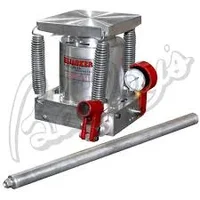
Rico, as a past auto mechanic and fabricator the use of bottle jacks on trees has always fascinated me. I have watched vids of trees being jacked over but never knew some of the jacks incorporated gauges, must provide a lot of feedback once you learn how to read it.
 
"I made the decision to cut low to clear the maples knowing the swing set would probably get hit.."

"Honestly I was trying to not hit the swingset"

"I was actually surprised when the swingset did get hit"

"Rico is not the first to harshly criticize my techniques. But they work.. they get the job done..".

Again all your own words Danny. So you knew the swingset was gonna get hit, but you were trying not to hit it, and were actually surprised when it did get hit. Yea, your techniques work Daniel, they really get the job done? Fucking unbelievable really!

I'm starting to fear that you are not going to explain your reasons for making your undercut the way you did, on the Oak with the undersized bar. That would be a another teaching moment lost buddy, and fairly selfish on your part. If your not going to enlighten us on this subject, I will be forced to move on to my questions concerning some of your other amazing techniques!

Could probably get hit, that is there was a fair chance of it getting hit. It didn't materially matter though. The only penalty is having to listen to you go off on it! ;)
 
1. Gosh Daniel, that certainly was not an step by step explanation of the Oak stump debacle? A little more effort would be appreciated next time buddy.

This is clearly the work of a man that doesn't have a fucking clue about what he is doing. Doesn't seem to stop you from making vids on the subject, and spreading the word on this amazing groundbreaking technique though.
short bar bisect.webp
The new guy Bry just walked in and saw this cut and said “what the fuck!“. He then followed it up by saying “ I hope no one takes this guy seriously, or someone is gonna get hurt”. Nuff said.

2. So you admitted to hitting a structure that you intended to Not hit, and were actually surprised when you did hit the swing set. You then have the nerve to tell us that your techniques work. Am I missing something here, or are you really that full of shit?
 
Last edited:
Thanks to Evo and Flyingsquirrel25 for additional information on wedge usage.

Rico, as a past auto mechanic and fabricator the use of bottle jacks on trees has always fascinated me. I have watched vids of trees being jacked over but never knew some of the jacks incorporated gauges, must provide a lot of feedback once you learn how to read it.
Yea the gauge is key. Really lets you know how things are going.
I used to run the old Silvey double jacks, but I now use a single Salt Creek Hi Jack. Killer little jack that is light weight and pushes like a mofo. All I really need for my work these days.

Unknown.webp
 
Well it would appear that after catching shit for that horrendous undercut on the Oak, you have made a little vid attempting to explaining your so-called plate cut. Why not just learn to make a proper under cut like any halfway competent faller has been doing since the dawn of time? Nope. That would take some actually learning and skill, so instead you choose to try and reinvent the wheel with yet more hackery.

At the beginning you tell us this is a side leaner. Towards the end you admitted that “the under cut is not perfect”, but its ok because your hinge will come save the day. Why not take 30 seconds to clean up the bypass and make it right? This is a side leaner which mean you are probably gonna use your world famous TB, which also mean we can count on you destroying your hinge. How is your destroyed hinge gonna make up for yet another subpar undercut Danny?

To anyone listening I would urge you to spend the time and learn how to do this stuff properly. Leave this kind of hackery to Daniel, and Daniel alone.

 
Last edited:
That's one ram... Silvery made connected double-ram jacks, too.

Two 16 Sq.inch Rams, at 5,000 psi = "gentle persuation".

I've used them under 10 times. Jacking big rotten trees, and wedging over dozens of dead and rotten trees per day doesn't leave much time for theatrics and Hollywood.


In case anyone wonders wedges can lift a F-ton, when used by a skilled practitioner. Wedges and ax are considered ppe for fallers, by some.

I'll try to set up a triple hinge stack, if I can...I have to high stump a tree from a springboard, so it is not an ideal set up for the triple-wedge, and it's a tree that could use a double-stack, if that, as it's not back-leaning.

Stacking the three wedges gives amazing lift for back-leaners.
 
No doubt the Silvey’s are a way more powerful tool than the Salt Creek, but the HI Jack is all I need these days. Whenever I get into something gnarly these days I simply borrow a buddies old Silveys.
 
Let’s start with the easy tree.. This was a very simple straight forward tree that any competent tree man could have gently hinged to the right, laying it out in the big open area. Daniel chose to instead give us all a tutorial on what Not To Do. We have no idea of the state of the undercut, but judging by the late swing to the left, it was most likely a hot mess. He then chose to use an backcut that was undershot by at least a foot. WTF? The stump pull, big swing to the left, and rolling into the only decent mature trees in the picture kind of speaks for itself. The very definition of a bad cut. Hackery is, as hackery does!

Now the more difficult of the 2. Everything seemed to be going relatively well until his backcut. This time he chooses to use an overshot backcut that is so high it damn near misses his undercut all together. Again I have to ask why? So he get this thing stood up, and it’s looking good, but he decides to run in and butcher his near side hinge causing this tree to go hard to the left, landing on a bunch of small tree and shrubs. That my friend is what’s known as losing a tree over sideways. He tells us thats what he intended to do, but I call bullshit. So his intent was to destroy a bunch of trees and shrubs, instead of using the clearly visible open space in the background. More nonsensical nonsense.

At worst Daniel doesn’t know what the fuck he is doing. At best he simply doesn’t give a shit. My guess is it’s a little of both. Either way, both are the tell tale signs of a hack.
 
Last edited:

New threads New posts

Back
Top Bottom