suggestions for saving this cracked oak??

[ QUOTE ]
Heck, you never mentioned duck tape as an option. I stand corrected. Good luck.

[/ QUOTE ]

Sorry, I forgot to describe the purpose of the tape. I just added it to the post with the photo.
 
[ QUOTE ]
17 photos, verbal descriptions, response to comments, public forum, all of which has been made known to, viewed, and read by the owner of the tree.

No snake oil here. No perfect solution, but no snake oil.

[/ QUOTE ]

Well done Mark!

Although I was of the group that suggested removal I'm all for keeping such a tree when an informed owner decides that is what they want to go. It would be great if you or the owner would keep us updated as the years pass.

Thanks for bringing a great subject to the Buzz!


(.....and now for some follow up photos!)
 
[ QUOTE ]
[ QUOTE ]


cut it down already !!!!!!!!!! dont be foolish !!!!

[/ QUOTE ]

Every solution for a hammer is to hit a nail.

<font color="blue">I prefer my old 1990 mutter of:

If the only tool you have is a saw, all problems are logs.

(We ain't carpenters.)</font>

[/ QUOTE ]


bw
 
A derecho is a storm that extends at least 240mi
with winds &gt;58mph (not 85 --heck, thats up in the record-high
range, of this recent one). Not that it matters much to the various
people in its path (that it came a ways and will keep going).
Okay, close : here's Wikipedia
[ QUOTE ]
According to the National Weather Service criterion, a derecho is classified as a band of storms that have winds of at least 50 knots (93 km/h; 58 mph) along the entire span of the storm front, maintained over a time span of at least six hours.

[/ QUOTE ]

In the land of big winds (U.S. Congress, et al. :o), nevertheless
we got hammered and lost power for days,
just as it was getting extra-toasty! What could be worse?
Well, I heard that Congress was going to look into doing something
about it!

Anyway, to my casual observations, it seems as though OAKS were
more in the horizontal position than other big trees, such as tulip
poplars. And some of them sported rotted, carpenter-ant'd (?)
ground parts; some just upturned their big rootballs (!). YMMV.
Our area's big tulip trees shed a lot of limbs, but I didn't see any
go down.

*kN*

ps:
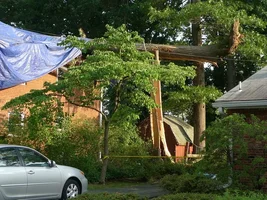
I'll try a photo : this was taken not too far distant from home,
where I have mid-wk bike rides. The horizontalness is slightly
<u>below</u> the house's roof line; but I don't think that this is
where fatalities occurred.

 

Attachments

  • 330258-treefall-Annandale-P1140694-M800.webp
    330258-treefall-Annandale-P1140694-M800.webp
    169.6 KB · Views: 70
Full disclosure = no snake oil, true.

"A permanent guy system was ruled out because there is no adequate anchor opposite the lean.
Props were ruled out because they would require some mix of large props, footers, framework etc.
Through bolting is still a possibility, but bracing an already split shell may not provide a lot of additional support.
The thought now is something between reduction and retrenchment."

Sounds like systematic assessment, by the book. Those who disagree, should first buy the book. ;)

I laugh at the universe. :&lt;0
 
I have not viewed this post, for fear it would suck me in and I'd spend time on it.

It's been alive for a while, so today i was tempted to look at it. yup sucked me in.

That tree is going to fail unless serious time and money put into it.

I used to do cabling&amp; bracing things just barely adequate years ago, in order to keep costs down for the customer and so that i would do the job. Stupid.

After plenty of work and plenty of cabling and bracing to do over the years, I gave thought about why would i do such a thing and worry on strong storms. Do it right, do it heavy duty.

THAT tree needs lots of attention, or else removal.

Here is my current plan for that tree based on the photos. I read most posts and saw all pictures. I may have skimmed over some posts fast and missed something.

1. Bolt the trunk. That back strap is the only part that is really stable and not moving. bolt back strap to the leaning side. plus bolt tree as if back strap is not there to prevent a crack between the two halves.

2. Crown reduce all long limbs, especially top limbs. Take out 15% foliage, mostly tips back shorter, to adequate junctions.

3. Install prop supports on leaning side. 3 props. Use T-poles and I beams welded. Go to the bases of big lower limbs so the U's don't have to be so huge. fabricate the U shapes big enough for air gap around limbs for many yrs of growth. run 3/4" or 1 in threaded rod through the limb and bolt to the U. no concrete needed at base of the poles. Not hard to do!

4. Install guy cables. Using the first 8 feet of the lower trunk of larger trees if in somewhat correct locations. And or dig and pour concrete anchors. If they own the land, then there is room for anchors.

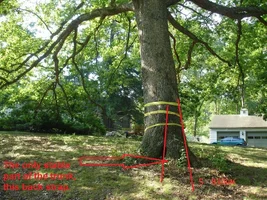
see following diagrams.
330321-1DIAGRAMSCrackedoakMahkAdamsbackstrap.jpg


i wrote on picture, the "only stable part of the trunk". Not entirely true, could have used better wording, as the backstrap is definitely a strong root flare, but the amount of hollow in the trunk has created such thin walls that the bending of the trunk in wind caused the tree to seperate from the firm holding backstrap area. I'm sure the other flares have some strength too...
 

Attachments

  • 330321-1DIAGRAMSCrackedoakMahkAdamsbackstrap.webp
    330321-1DIAGRAMSCrackedoakMahkAdamsbackstrap.webp
    398.6 KB · Views: 38
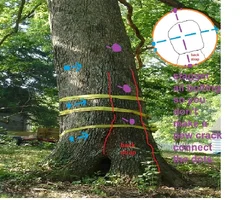
bolting of trunk, true size and of trunk may require more or less bolting.

3/4" to 1" threaded rods likely with nuts and washers.

330322-2diagramsboltingmahkadams.jpg
 

Attachments

  • 330322-2diagramsboltingmahkadams.webp
    330322-2diagramsboltingmahkadams.webp
    235.2 KB · Views: 30
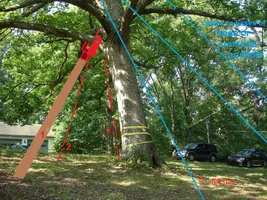
telephone poles.

just drew one pole, dotted lines for other ones:

330332-3DIAGRAMSCrackedoakMahkAdams2leanbracescables.jpg
 

Attachments

  • 330332-3DIAGRAMSCrackedoakMahkAdams2leanbracescables.webp
    330332-3DIAGRAMSCrackedoakMahkAdams2leanbracescables.webp
    402.3 KB · Views: 20
X Man,
Thanks for taking the time to illustrate your take on this oak. I have very little experience with guying and propping. Your posts showed a rookie some cool options. I have been following the thread closely. there is a ton of knowledge on this forum and the fact that you took the time to share is awesome!
 
By the looks of that debris field you have gone to work on it. No pics of the tree now? Great looking tree. I love white oak. More updates. This one has to pull through.
 
Yeah, well..... Fine, I'll put on lightning protection and a dome to protect against tornadoes and a prayer against armageddon.
 
I am also curious how the end result turned out. Did you produce supports? Pics?

And an aside:

Yesterday I cleaned up a very wide Aesculus which had grown unimpeded and without any maintenance pruning as per homeowner. It had sustained damage in the storm that came through in late June. As I climbed and removed damaged limbs and cleaned up torn stubs I was reminded of Tom's post in this thread a while back (Erk Brudi/tennis ball on a dowel/reducing windage).

I noted that the tree tore at the exact same diameter and radius from the center of mass on each leader. Every single major branching lost a substantial limb at the same point along its length, but interestingly each broke at a point where end weight reduction pruning might have occurred, leaving enough leaf mass to sustain the branch.

Makes sense in a way as it was likely the combination of wind force, strength of the particular species and its unique fracture angle, and the moment arm related to the length of the major branchings which led to this effect.

Anyway, it seems to lend credence to the 'reducing the canopy to reduce the forces upon the tree' approach to ameliorating risk.
 
"Yesterday I cleaned up a very wide Aesculus which had grown unimpeded and without any maintenance pruning as per homeowner. It had sustained damage in the storm that came through in late June. As I climbed and removed damaged limbs and cleaned up torn stubs I was reminded of Tom's post in this thread a while back (Erk Brudi/tennis ball on a dowel/reducing windage).
I noted that the tree tore at the exact same diameter and radius from the center of mass on each leader. Every single major branching lost a substantial limb at the same point along its length, but interestingly each broke at a point where end weight reduction pruning might have occurred, leaving enough leaf mass to sustain the branch.
Makes sense in a way as it was likely the combination of wind force, strength of the particular species and its unique fracture angle, and the moment arm related to the length of the major branchings which led to this effect.
Anyway, it seems to lend credence to the 'reducing the canopy to reduce the forces upon the tree' approach to ameliorating risk."

Ah, but it's HOW that reducing happens that matters.

O did you happen to snap a pic or 20?
confused.gif

Darn! Anyway, great description of a natural phenomenon that should be failiar to tree folk, shedding at ZRTs, self-restoring storm damage.

Selective Heading Cuts, Music to my ears!
N o
grin.gif
 
Noggin,

Haven't been in this thread for a while. My fingers must have had dislexia that day. Thanks for the correction, I did know that, 85 mph is the wind speed at which a tree canopy can no longer compress according to Dr. Coder.
 

New threads New posts

Back
Top Bottom