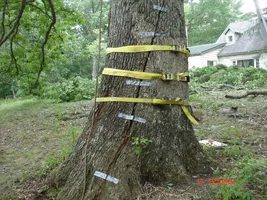
suggestions for saving this cracked oak??

[ QUOTE ]
since it is in a high risk area that is why i believe it should be removed !!!!!!

[/ QUOTE ]
grin.gif

You are just pulling my leg right? How can a private property and (after pruning) nothing to hit but other trees be a high risk area.
 
I've been watching this thread but couldn't decide what I thought about that tree. It's got some big factors working against it. I think if left to itself, it would ultimately fail somewhere around the cracks.

The cracks complicate things bigtime because they weaken the structural tube... it's not a tube anymore, it's a tube with a weak seam. Where are the cracks in relation to the lean? If the cracks are on the 'high' side, they don't cause as much loss of buckling strength as they would were they on the low side.

Am I right that, other than the top 5-10' hitting the house, there are no targets? If so, I wouldn't be opposed to removing that top section if it means saving the tree. That would also make everyone safer in terms of liability.

I think retrenchment, which is pretty new to me, makes some sense. Some oak trees retrench themselves if you leave'em alone. I think it's a risk because the tree is old and simply may not recover but post oaks are resilient in good soil... Which makes me wonder, just what are the growing conditions? Does it have a future in terms of being able to keep the soil healthy and utility companies from trenching through roots and stuff?

I would try to save it assuming I could rule out that it would hit unacceptable targets. I think I would bolt the cracks and prune it, then inspect fairly often. I like the idea of using a plumb line to measure change. The tree will twist as it fails and you may be able to detect that with the plumb line if the failure is gradual.

Of course it may fall over in clear air next week killing three people and a dog, in which case... well, I'll delete this post.
 
I have seen many times a mature tree removal affect the neighbouring trees, sometimes to a severe decline and even death.
Dieback through the grafted roots or decaying rooots over the next years should also be considered.

I am not there but it looks like moderate crown reduction and cable to support trees.

Best of luck.
 
It seems that the tree is in the process of mitigating its own risk, by growing lower branches that are close to reaching the ground. Assuming they're able to make contact, they'll act as outriggers and go a long way toward keeping the tree upright. Considering their close proximity to the ground, those branches might be able to be propped now, with ground based supports, to help stabilize the trunk.

Again, it's all going to depend on the degree of risk the tree owner is willing to assume.
 
lost one long post so heres the gist per ansi:

scope--cracking oak
objective--reduce risk of damage and tree loss

specs--

1. reduce 10' off top
2. reduce sprawl to lessen lean. <6" cuts, <10% off
3. prop lower limbs
4. install tree-to-tree guy. 3 and 4 per a300 part 3. spell out details based on onsite inspection.

jomoco, dandelcorbin, zale, you guys are sooo predictable. those boxes are kinda tight aren't they?

retrenchment is an option but 1 loses more benefit$ 2. makes more me$$ 3. looks uglier longer.

cervi, it actually depends primarily on the arborist's ability to communicate to the owner all reasonable options. that comes first, as long as we're tautologizing...

welcome baqck mahk!
 
Great discussion! We don't have big deciduous trees in the high desert here, but regardless, always lean toward preservation over decimation... I think a lot of the points stated are very good and if anything, could give the tree several (or many?) more years of glory. I would lean toward guying the tree, along with crown reduction instead of retrenchment. I think the benefits of really going through the tree and reducing end weight would greatly benefit overall 'fulcrum' on the tree. With cracks that large, liability is certainly an issue, can a waiver/report be written and signed by the homeowner acknowledging liability and risks associated? I am not versed in liabilities like that, but if a homeowner is willing to assume risk and put down the money to save it... save it.
 
If those straps were not around the tree, it would most likely be on the ground by now. I've probably preserved more trees than I have cut down but sometimes you need to know "when to say when".

Its unfortunate the tree is in the condition it is but again, thats NATURE! I think it shows a profound lack of humility to think we can save this tree.
 
hey treepotter, not joking . did you read the post !! the tree can hit the house . plus it can also hit healthy trees , i would not want to hit healthy trees ,is that not a risk ? just because you may hack it down and reduce it therefore the only target would be other trees , i would rather preserve the healthy trees over this tree that will surely go anyways . since this tree is in a yard where children play , pets ect . that also makes it high risk . you need to think more conscientious !!!!!!!!!!!!
grin.gif
 
I would encourage you to look into substantial mechanical support, in combination with appropriate retrenchment pruning.

There are a few arborists from Longwood PA on ths forum. There are several examples of sizeable specimens supported by telephone-poles with cement and steel foundations. The support does not damage the visual component. In fact, it shows preservation-minded creativity and willingness to accept natural imperfection.

The risk is your call.
 
[ QUOTE ]
Its unfortunate the tree is in the condition it is but again, thats NATURE!

[/ QUOTE ]
Hà. Got you on that one.
grin.gif
So when we would let nature take it's course? Remove the house and keep the Husqies and Stihls from the property. The tree would break, rejuvenate and would grow out to be the most beautiful tree in the whole wide world. But If you think you would 'help' that tree by cutting it down.
confused.gif

Just kidding, but I still think it's inappropriate to say that a private garden with a house that's out of reach after pruning is a high risk zone. And after all, this thread is called [ QUOTE ]
suggestions for saving this cracked oak??

[/ QUOTE ] not [ QUOTE ]
What saw to use best to take this down

[/ QUOTE ]
 
[ QUOTE ]
lost one long post so heres the gist per ansi:

scope--cracking oak
objective--reduce risk of damage and tree loss

specs--

1. reduce 10' off top
2. reduce sprawl to lessen lean. <6" cuts, <10% off
3. prop lower limbs
4. install tree-to-tree guy. 3 and 4 per a300 part 3. spell out details based on onsite inspection.

jomoco, dandelcorbin, zale, you guys are sooo predictable. those boxes are kinda tight aren't they?

retrenchment is an option but 1 loses more benefit$ 2. makes more me$$ 3. looks uglier longer.

cervi, it actually depends primarily on the arborist's ability to communicate to the owner all reasonable options. that comes first, as long as we're tautologizing...

welcome baqck mahk!

[/ QUOTE ]

I laugh in your general direction.

329772-DSC09438.JPG


329775-DSC09405.JPG
 
Root collar excavation will tell alot about the progression of fungus....... I'll bet dollars to donuts that the flare is punky, soft and substantially compromised.....
That last photo looks like gingivitis to me....

Keeping a structurally imperfect tree requires a structurally 'perfect' cabling system.. if that does not exist, nor can be built.... I don't think it can be saved...

The unknowns are too great... ie: How much crown reduction (retrenchment) and pruning is required? How much weight will the stem hold (out of plumb)....?
What is the tipping weight?
How is the max tipping weight changing over time?
How fast is the rot progressing?
How much root is holding?
How do you accurately measure any of these things?
I don't believe you can.

I think simply removing weight/height as a solution has too many variables to count on....

Positive structural, calculated support is the primary way that I see this tree staying in the environment. Coupled with reducing it's size to keep it from hitting exposed targets... Calculate with green log weight chart, calculate holding capacity of cabling system... remove some weight/height(calculate that).... create a formula for safety factor to account for windshear... rods to hold the crack(s) from spreading.....

I agree... if you put alot of thought and effort into saving this tree.. it can be done.
But anything short of a full effort is asking for trouble and a potential waste of time.

Guy's right about communicating to the homeowner...
This costs and will need consistent longterm care.
If they've got the stomach for it, the interest and the pocketbook to match... I say go for it.... no promises.

Cause like Blinky said... if it falls over tomorrow on a calm day.... "where's that delete button"?
 
It all comes down to risk tolerance of all the concerned parties, owner, you and anyone else who may represent a target. Has the owner given you a save at all cost option? What sort of budget would they have going forward? How much are they willing to invest in the assessment and consultation?

Have you done the hazard assessment? What are the targets, frequency of pedestrian or vehicular traffic? What of the neighbors? Does this pose any risk to the street side or is it well removed from there?

How much of a change in the tree's appearance are they willing to accept or do they have it in their heads that it will look the same? It strikes me that they are looking at is current form and hoping to save that not necessarily the pruned options put forth thus far. Many questions to answer before actionable recommendations can be formulated.
 
A permanent guy system was ruled out because there is no adequate anchor opposite the lean.

Props were ruled out because they would require some mix of large props, footers, framework etc.

Through bolting is still a possibility, but bracing an already split shell may not provide a lot of additional support.

The thought now is something between reduction and retrenchment.

To make the tree safe to climb, we removed the one support rope, and installed two separate ropes each of which was set up as runner tackle (so each provided approximately a 2:1 MA), and one set up as a single line tied directly to the tree (1:1 MA). All three support lines were tensioned with a 10:1 pulley system. The binder straps were left as they were.


A plumb line had been discussed over a year ago, but never installed.

The owner, however, did contribute his own clever technique. He placed pieces of duct tape across the crack in several places, then used calipers to measure the size of the crack at each piece of tape. That measurement was then written on the tape so that progress could be measured both during the job and after the work was completed. He also draw a line on each piece of tape directly at each edge of the crack to make sure it was lined up properly if it became loose. Also, when the tape was put on it was taut, so any closing of the crack would be shown by a bit of slack in the tape. Even in the photo each piece of tape shows some slack, indicating that the crack has already started to close.


<font color="purple"> Photo 17 owner's addition (see attachment)</font>

 

Attachments

  • 330185-DSC09447.webp
    330185-DSC09447.webp
    379.7 KB · Views: 101
[ QUOTE ]
Say the homeowner signs the waiver and you crown reduce, cable and bolt etc. and the tree still fails injuring someone. If you think you are protected you are wrong. You are selling that homeowner snake oil.

[/ QUOTE ]


17 photos, verbal descriptions, response to comments, public forum, all of which has been made known to, viewed, and read by the owner of the tree.

No snake oil here. No perfect solution, but no snake oil.
 

New threads New posts

Back
Top Bottom