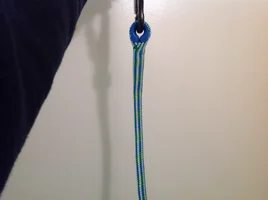
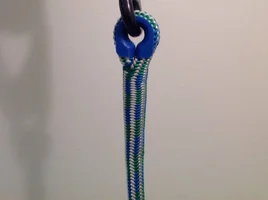
That lump might be what is called a stress riser. It would be the result of fibers backing over themselves from altering a poor bury, or simply the lack of a smooth, gradual tapering cut of the fibers. Sharp scissors are so darn important, especially with high mod fibers in Class 2 ropes.
A sharp stress riser will usually be the point of failure in a splice because energy is asymmetrically focused into that area under load. Even a careful and diligent splicing job usually results in point of failure to be right at the beginning of the taper. If this failure occurs at a higher load than the average breaking strength of the rope itself, the point of failure is moot.
Your work looks great, especially for the first you've ever done. Keep it up!
FWIW, our chapter had a splicing workshop at Yale Cordage in 2013. It was awesome. We got to break stuff and all. We did numerous Class 1 DB splices with DE (Double Esterlon). That stuff goes together like a dream, and truly exhibits why lock stitching is important, as the splice can back out FAR easier than any other DB splice I have done (Like Tachyon, Blue Moon, etc...). I would say a rope like DE is probably the best to practice with, since the techniques can easily be transferred to a more difficult cordage, and the practice will show it's value.