Rope Wrench Ruminations

off topic...my favorite setup is using the pinto pulley with hitch and RW. I girth hitch the tether of the rope wrench to the becket of the pulley and it works great! It also keeps the rope wrench turned away from the climber. Anybody else?
 
My Rope Wrench arrived just the other day, ‘Made in Detroit’ nice touch Kevin!

Haven’t tried it yet but even owning one is already a step further than I ever thought I’d take in regards to using SRT to work a tree....seems as I could not see where its place would be in crane-removals or even offer a significant advantage in manual-rigging or free-fall tree removals. But I have the opportunity now so will take it slow and keep an open mind.

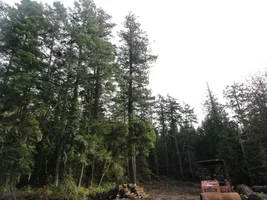
We often use SRT to access some of the tall groups of conifers out here in Victoria....generally we have been windfirming or deadwooding. The majority of the trees are between 140 – 170ft, for which I use a single 60 meter line throughout. The big-shot gets us to around the 100ft mark with reasonable accuracy and then its a case of much clipping in and out for the remainder to reach the eventual TIP, working that side on the way up, and then coming/working down the other. After which you would jump across to the next tree and repeat the process etc. I’ll take a rope bag up with me if we’re absent of a ground-worker so I don’t have to worry about my lines getting snagged up. In the photo I’m in the top-left-corner of the furthest tree to the right which typifies the situation, you have to look quite closely.

If on a sole tree that I could somehow shoot a 340ft line (not that I have one) to a 150 TIP and have it make its way down the other side of the tree it would work a treat, but it’s just not going to happen to the best of my ability at present....and further still we are often working on groups of trees so being able to complete the work without having to come down and start over on the next tree is quite a big factor.

Pruning sole residential, trees I can grasp some of what you guys are raving about. Advice would be most appreciated, and not forgetting the crane stuff either in case I’ve overlooked something. Thanks
302170-DSC01594.JPG
 

Attachments

  • 302170-DSC01594.webp
    302170-DSC01594.webp
    110.7 KB · Views: 88
"...I could somehow shoot a 340ft line (not that I have one) to a 150 TIP and have it make its way down the other side of the tree it would work a treat,..."

I would first say to think about isolating your TIP if you're working the tree on ascent. It can be tricky to limb a tall central leader species with a base tied anchor point as your anchor side of the line will be vulnerable to the saw. Unless the base tie is in another tree I would try to isolate. I hope that makes sense.

IF! your line is long enough, perhaps begin as usual, then isolate a limb in a large ring small ring FS. Leave a retrieval tail (which could be a throw line) and tie an Alpine Butterfly as a stopper against the small ring. Descend a bit and swing to the next tree and work both sides of the tree off the lanyards to the top. Set the line over a decent limb and descend to swing again, etc... When you're done, just descend to the ground and disconnect. Head over tho the first tree and pull the retrieval line. Make sure to have an overhand knot in the line to hit the small ring, or put a retrieval ball in the eye splice if you have one.
 
I have been climbing on a borrowed rope wench for about a month now, and I am dreading giving it back. There are some trees now that i just see as SRT being the most efficient way to work the canopy.

Don't worry Bugg, I'll get your wench back to you soon.
 
[ QUOTE ]
I have been climbing on a borrowed rope wench for about a month now, and I am dreading giving it back. There are some trees now that i just see as SRT being the most efficient way to work the canopy.

Don't worry Bugg, I'll get your wench back to you soon.

[/ QUOTE ]


NUFF said ...
 
[ QUOTE ]
"...I could somehow shoot a 340ft line (not that I have one) to a 150 TIP and have it make its way down the other side of the tree it would work a treat,..."

I would first say to think about isolating your TIP if you're working the tree on ascent. It can be tricky to limb a tall central leader species with a base tied anchor point as your anchor side of the line will be vulnerable to the saw. Unless the base tie is in another tree I would try to isolate. I hope that makes sense.

IF! your line is long enough, perhaps begin as usual, then isolate a limb in a large ring small ring FS. Leave a retrieval tail (which could be a throw line) and tie an Alpine Butterfly as a stopper against the small ring. Descend a bit and swing to the next tree and work both sides of the tree off the lanyards to the top. Set the line over a decent limb and descend to swing again, etc... When you're done, just descend to the ground and disconnect. Head over tho the first tree and pull the retrieval line. Make sure to have an overhand knot in the line to hit the small ring, or put a retrieval ball in the eye splice if you have one.

[/ QUOTE ]

Sounds great, but not sure how realistic, especially against the clock. I'm going to realistically ascend the first hundred feet of which, like I said earier is about right for the big-shot, although probably not by isolating a limb either but regardless of that. Then what for the rest of the ascent on that first tree? At what point do I get the benefit of my single line thereafter.

I've also come to the conclusion that the Friction savers are often too risky to use in many of these old firs....its like snag city up there, and a long way and time lost in climbing back up to retreive it. Not trying to sound negative, just explaining the situation how it is in the hope that I'm overlooking something? Thanks again
 
hey Tom-

Is that Yale kernmaster in your pics? if it is, it would be great to know what you think of it. I know there were some questions about it a little bit ago. of course thats another thread. and may even have been answered, but I missed it in my ignorance. Anyways, sorry for that derail...

[ QUOTE ]
my favorite setup is using the pinto pulley with hitch and RW. I girth hitch the tether of the rope wrench to the becket of the pulley and it works great! It also keeps the rope wrench turned away from the climber. Anybody else?

[/ QUOTE ]

that sounds like a GENIUS idea!

And loved the observations and pointers in the OP, Cary.
 
Reg, what I have found works best, for me, on trees I don't want to mess with trying to set a line at the top (such as conifers in your pic), is I will set up Ddrt with the rw in place. I will climb the tree lanyard over lanyard. When I reach my tip I will install a monkey's tail and some sort of pull down line. This saves putting the cs around the tree and the possibility of it getting stuck. Also I don't have to worry about that life support line hiding on the other side of the tree waiting to be cut. The only issues we have found is sometimes the hitch on the tail gets pushed by the tree, but we solved that by installing a alpine butterfly under it. The other issue is you kinda want to decsend near you pull down line as not to create to much friction to retrieve the anchor. Hope this is helpful.
 
Hey Reg,

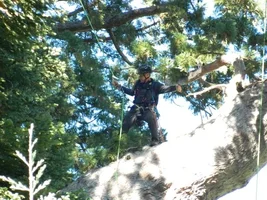
I recently came across this exact problem when ascending up some rather large trees in the High Sierra's...What I found to work best was to install the access line as high as I could get it either anchored to the ground or send up with a running bowline. I carried up a 120' line with me during the ascent so that once I got to the top of the access line I could pull out a throwball and set the lanyard up another 60' or so...I found it best to send up another running bowline to anchor off the lanyard. With the removable pin on the RW it was easy to switch off the initial access line and then transfer to the lanyard. After you get off the access line you can either untie the bowline or have your groundie disconnect the basal anchor and then take it with you while you ascend the shorter line.

Once at the top you can reset the super long access line or leave the access line installed lower and just work the top with your secondary line depending on the height of the tree.

Worked super smoothly and was unbelievably efficient compared to what could have been achieved with Doubled Rope.
 

Attachments

  • 302210-RWsequoia.webp
    302210-RWsequoia.webp
    83.4 KB · Views: 112
[ QUOTE ]
Reg, what I have found works best, for me, on trees I don't want to mess with trying to set a line at the top (such as conifers in your pic), is I will set up Ddrt with the rw in place. I will climb the tree lanyard over lanyard. When I reach my tip I will install a monkey's tail and some sort of pull down line. This saves putting the cs around the tree and the possibility of it getting stuck. Also I don't have to worry about that life support line hiding on the other side of the tree waiting to be cut. The only issues we have found is sometimes the hitch on the tail gets pushed by the tree, but we solved that by installing a alpine butterfly under it. The other issue is you kinda want to decsend near you pull down line as not to create to much friction to retrieve the anchor. Hope this is helpful.

[/ QUOTE ]

Appreciate your imput FS, thanks.Pull-down lines at 160ft, is that a seperate line you are refering to? Do I have to take that with me to the next tree if I want to re-set my tie-in? or do I have to stay tied into tree no.1 and then set the line over an adequately strong limb in the top of tree.2?

Doesn't really sound like I'm gaining anything to be honest....or at least nobody has said what I stand to gain?

Any thoughts/experience on crane-removals, anyone?

Apart from Trev's does anyone know of a working SRT vid on youtube, I dont mean rec-climbing? Thanks
 
[ QUOTE ]
[ QUOTE ]
Reg, what I have found works best, for me, on trees I don't want to mess with trying to set a line at the top (such as conifers in your pic), is I will set up Ddrt with the rw in place. I will climb the tree lanyard over lanyard. When I reach my tip I will install a monkey's tail and some sort of pull down line. This saves putting the cs around the tree and the possibility of it getting stuck. Also I don't have to worry about that life support line hiding on the other side of the tree waiting to be cut. The only issues we have found is sometimes the hitch on the tail gets pushed by the tree, but we solved that by installing a alpine butterfly under it. The other issue is you kinda want to decsend near you pull down line as not to create to much friction to retrieve the anchor. Hope this is helpful.

[/ QUOTE ]

Appreciate your imput FS, thanks.Pull-down lines at 160ft, is that a seperate line you are refering to? Do I have to take that with me to the next tree if I want to re-set my tie-in? or do I have to stay tied into tree no.1 and then set the line over an adequately strong limb in the top of tree.2?

Doesn't really sound like I'm gaining anything to be honest....or at least nobody has said what I stand to gain?

Any thoughts/experience on crane-removals, anyone?

Apart from Trev's does anyone know of a working SRT vid on youtube, I dont mean rec-climbing? Thanks

[/ QUOTE ]

I am not sure if there is a video of it. But I recall someone in a thread that had a picture that they overlayed red dots of where they redirected with SRT and worked the tree. It may be a video. Just something I remember.
 
http://www.youtube.com/watch?v=uaLDTR5W2tQ this was a big old sugar maple that I deadwooded on the RW/SRT.

It wasn't until I got up in the tree that myself and a friend who is a 30 yr. experience forestry tech saw a large limb that had a huge rot hole at a weak spot, he suggested we take that limb out to prevent it failing and doing damage to rest of the tree, wires and passing vehicles on the highway.

I blocked that whole limb down without spurs, since I was only deadwooding it, I never even packed them :)

the RW allowed me to weave in and out of other limbs as I chunked it down without changing my friction.

DRT would have made me stick to one side of the limb, which with spurs, would be easy.

(I have since shortened my tether by a few inches and added a DMM thimble to it.)


Having the option to redirect to put myself in optimum positions was a great help on this unexpected tidbit.


Deadwooded that whole tree in about an hour on the RW, it saved me literally another whole hour or more that if I did it DRT, since I used multiple redirects that simply pull out when you remove your TIP from the ground.
 
[ QUOTE ]
...Doesn't really sound like I'm gaining anything to be honest....or at least nobody has said what I stand to gain?
Any thoughts/experience on crane-removals, anyone?

[/ QUOTE ]

Reg, there is going to be some head scratching in utilizing SRT per your requirements.
How are you ascending the first 100' now? A well-tuned frog-walker, on a tall, excurrent tree, where your boots come in contact with the tree, is as easy as walking up a ladder and a lot safer. Get this part right first, as it is the base to which everything else is added.
Also, in regards to working the tree on your way up with a basal tie, on an excurrent tree, please use extreme caution. That taut line can easily be cut. Cutting the line below you when on doubled rope, will just shorten your line. Cutting the down line on the basal tie, could be your last cut...ever.
In a situation like this, I will have my tied-off leg over the outside of the canopy. Obviously this takes some fenagling with your shot placement and does require analyzation in determining that it will stay secure. But it is worth the extra effort keeping the down line away from the work area.
On most removals and crane work I will use a length of rope long enough to reach the ground from a choked tie in one pitch. This, of course, will depend on just what you are doing, especially with the crane. This is where it can get complicated and you just have to try different options and see what works well for you.
In most situations you will be able to work a tree with half the amount of rope than what you normally would. In most cases this will negate the need for a rope bag, as the odds of the rope getting tangled are much reduced.
A small bag of throwline can easily hold enough to attach to the tied end of a choke, tied rope to allow it to be retrieved from the ground in an emergency.

Dave
 
You can often tie off on a remote tree and that pulls your line away from cutting zone. To advance you can use a long lanyard and you can throw bites up over the next set of branches. Just stay on the right side of the branch.
 
[ QUOTE ]
http://www.youtube.com/watch?v=uaLDTR5W2tQ this was a big old sugar maple that I deadwooded on the RW/SRT.

It wasn't until I got up in the tree that myself and a friend who is a 30 yr. experience forestry tech saw a large limb that had a huge rot hole at a weak spot, he suggested we take that limb out to prevent it failing and doing damage to rest of the tree, wires and passing vehicles on the highway.

I blocked that whole limb down without spurs, since I was only deadwooding it, I never even packed them :)

the RW allowed me to weave in and out of other limbs as I chunked it down without changing my friction.

DRT would have made me stick to one side of the limb, which with spurs, would be easy.

(I have since shortened my tether by a few inches and added a DMM thimble to it.)


Having the option to redirect to put myself in optimum positions was a great help on this unexpected tidbit.


Deadwooded that whole tree in about an hour on the RW, it saved me literally another whole hour or more that if I did it DRT, since I used multiple redirects that simply pull out when you remove your TIP from the ground.

[/ QUOTE ]

Do you have any other footage of that job other than cutting that one limb i.e. some actual climbing or movement of some kind, all those re-di's you spoke of perhaps? Thanks again.

 

New threads New posts

Back
Top Bottom