Chaplain242
Branched out member
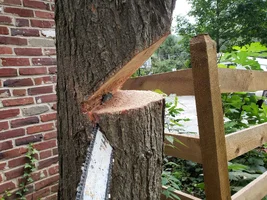
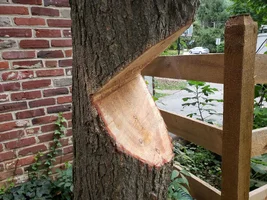
The technique has a use for certain situations, especially when resources are scarce. But trouble with combining the cuts into a 'stangle is the propensity to BBC, and also unpredictable behaviours when finishing the back cut to spear cut the top down. Even if just risk of chainsaw damage.
When I use it (in certain situations when short of daylight, or short of sufficiently trained help on the ground, or just being a safer option) I do it as was recommended to me by an older arborist to separate the cuts. Do a very narrow standard scarf and carefully cut the back cut (with sufficient height to stop kick back of the top) until the scarf closes, then wedge the back cut.
Then go higher on the spar and do the spear cut as a separate operation. Preferably use a rigging line thrown over a higher branch union for a groundy to restrain the top leaning back in case of wind etc (not to pull hard as that often defeats the intended spear cut).
Can be very helpful especially when in close proximity to other trees that laying over would just get caught up; or in the case of leaning the top to enable the spear cut as the other side has no drop zone or has targets. Also use it when I really dont trust climbing on a certain tree.
Also ground personnel are kept far away from the action of falling tops catching other trees on he way down, or groundys having to pull down caught up branches or tops, as the weight combined with the spear cut usually gets down in one go.
Certainly only for certain situations and is a 'handle with care' technique as things can go wrong. But also can be the lesser of many evils in some situations...
Should also add that if doing any spars of size, that I use a series of staggered plunge cuts to form the lower spear cut leaving a thin top release cut so that chance of BBC is almost none...
When I use it (in certain situations when short of daylight, or short of sufficiently trained help on the ground, or just being a safer option) I do it as was recommended to me by an older arborist to separate the cuts. Do a very narrow standard scarf and carefully cut the back cut (with sufficient height to stop kick back of the top) until the scarf closes, then wedge the back cut.
Then go higher on the spar and do the spear cut as a separate operation. Preferably use a rigging line thrown over a higher branch union for a groundy to restrain the top leaning back in case of wind etc (not to pull hard as that often defeats the intended spear cut).
Can be very helpful especially when in close proximity to other trees that laying over would just get caught up; or in the case of leaning the top to enable the spear cut as the other side has no drop zone or has targets. Also use it when I really dont trust climbing on a certain tree.
Also ground personnel are kept far away from the action of falling tops catching other trees on he way down, or groundys having to pull down caught up branches or tops, as the weight combined with the spear cut usually gets down in one go.
Certainly only for certain situations and is a 'handle with care' technique as things can go wrong. But also can be the lesser of many evils in some situations...
Should also add that if doing any spars of size, that I use a series of staggered plunge cuts to form the lower spear cut leaving a thin top release cut so that chance of BBC is almost none...
Last edited:


 we can always hope)