Puzzled about back ups

Wow, my thread has generated some interesting conversation.

Here is what I have learned so far as it pertains to my thread title:

ALL the equipment used to ascend a rope should be good enough to hold you safely on it's own. Wether it is a back up or not.

And as this thread has drifted into different topic areas I have learned this:

Rope access for each trade appears to have different techniques and governing rules. For example:
In my high angle rescue courses, two separate ropes and systems are mandatory.
But in helicopter rescue, only one line is used to lift an injured person up into the helicopter, no back up.

Here are four examples of trades which DONT use the two rope back up system:

High rise window washing, the window washers use only one rope to rappel down the side of a building.
In yacht sailing, one single rope is used to climb the mast of the ship for inspection above.
Also painters painting the side of a building use a platform which is lowered, or raised, with one rope at each end of the platform. Under the double redundancy system, the platform should have FOUR ropes.


And in the recreational climbing world, rock climbers only use one rope.

---just being sarcastic here, but maybe we should have two different means of attaching ropes to our bodies? Like a flat webbing saddle UNDERNEATH our primary saddle?---

I dont think it is unsafe to only use one rope to ascend a tree. Ropes have been proven through the test of time to be a reliable link in the PPE system.

What does consistently fail is the tree which we are climbing.

So arbor addict, think about that when you set your two different lines to ascend a tree. You mentioned setting two lines just a few feet apart.
If the top of the tree should fail, both of your lines would be involved in that failure.
UNLESS, you set those two separate lines in two different leaders of the same tree.
But then, your redundant system would not work.


I do have a comment to make which I have not seen mentioned (yet) in this thread:

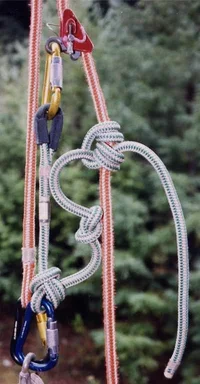
In sohners picture, see atttachment, the back up prussic will become splayed apart as you approach the branch which the doubled ascent line is thrown over.
Also with ascenders, they can fail in the same situation.


For any climber approaching the top of a doubled ascent line, it is best to stop BEFORE the rope become splayed apart from the branch.
So when you set the line, think about how you will 'mount' the tree from 3 or 4 feet BELOW the branch.
108416-dualcenderbackup.jpg
 

Attachments

  • 108467-climbsystem.webp
    108467-climbsystem.webp
    45.8 KB · Views: 155
[ QUOTE ]

Here are four examples of trades [that] DONT use the two rope back up system:

High rise window washing, the window washers use only one rope to rappel down the side of a building.

[/ QUOTE ]
Not so in some parts (at least) in the States: I've seen a solid-braid nylon
rope used through the descender (some sort of coil hidden within a shell),
and a separate, kernmantle rope used with Jumar or other ascenders, as
a safety line. And workers using a mobile suspended platform usually
have a safety line, with the platform running on wire rope. (Sometime
recently, though, there was a report of such a platform falling a great
height, resulting a death and an amazing survival--I don't know details.)

[ QUOTE ]
And in the recreational climbing world, rock climbers only use one rope.

[/ QUOTE ]
With the exceptions of using "half" & "twin" ropes--the latter aimed at
zig-zag routes which would generate much drag otherwise, and the latter
is regarded as being partially redundant and better resistant vs. cutting,
the only way rockclimbing ropes have been regarded as failing.

*kN*
 
Haven't used a figure-eight as a stopper knot since I started using the Blake's hitch. The Blake's hitch DOES NOT run out the tail. The reason that the stopper knot has been used through out the years is because the Taut line hitch would run off the end of your line if not careful.
I would never use a Taut line hitch with out a figure eight stopper knot on the end.
 
[ QUOTE ]
I see more and more back up systems in use today than I did just a few years ago. It's all ok.

[/ QUOTE ]

When a wise man speaks we should listen, for indeed we all know Mr Beranek is a wise man.

Thank you for saying my back up rope system on SRT is 'ok' Mr Beranek, I'm so used to naysayers like frans and masterblaster continually berating my approach to treeclimbing. I believe my system is safer, and it is the passion and intensity of this belief that makes me right and people like frans wrong.

Thank you

Gary

Amen
 
[ QUOTE ]

In sohners picture, see atttachment, the back up prussic will become splayed apart as you approach the branch which the doubled ascent line is thrown over.
Also with ascenders, they can fail in the same situation.


For any climber approaching the top of a doubled ascent line, it is best to stop BEFORE the rope become splayed apart from the branch.
So when you set the line, think about how you will 'mount' the tree from 3 or 4 feet BELOW the branch.


[/ QUOTE ]

Most climbers I have seen that use a system like sohners will tie a butterfly and leave a long tail midline so as to cinch the rope together under the branch/anchor point - there will be no splaying of the rope when this technique is used.

Alternatively you can use biner midline tied with a clove hitch and run the rope up to the anchor point choking beneath the branch - again the two sides of the rope will sit together under the branch/anchor point.

And as for your use of the term 'mount' when referring to climbing into the tree, I find it offensive. People should not 'mount' trees. It just isn't right.

108416-dualcenderbackup.jpg


[/ QUOTE ]

Thank you

Gary

Amen
 
Those are great example of how each person and company can do the same task differently, knudeNoggin.

So it seems like there is a great variety in how folks approach back ups even within each trade or occupation.
I am thinking that EXCEPT for the rescue occupation which MANDATES a two rope system, having two separate back up systems is up to the individual's preference or determined by the individual company policy.

I am thinking that it is incorrect to say that NOT using a two rope back up system is unsafe.


Arboraddict, if you could post some pictures of how you employ a two rope back up system to enter a tree, it would be very helpful and educational.
 
[ QUOTE ]


I am thinking that it is incorrect to say that NOT using a two rope back up system is unsafe.

[/ QUOTE ]

Nobody said it was unsafe, somebody said it was safer to use a back up rope as well as the primary SRT line.


.
[ QUOTE ]

Arboraddict, if you could post some pictures of how you employ a two rope back up system to enter a tree, it would be very helpful and educational.

[/ QUOTE ]

I'll get onto it.

Thank you

Gary

Amen
 
Thanks Frans for getting it set right.

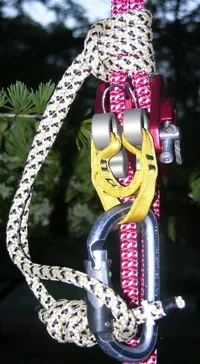
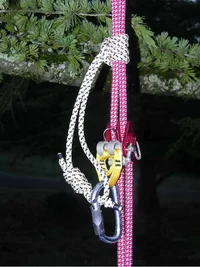
I agree with you regarding the rope and the spread that can develop when getting close to the branch. The Dualcender doesn't have that problem with slipping down the line like just a prusik would have if it was being used alone and with out the dualcender. You'll get only so close and then the Dualcender will not go up any further. The Prusik will become somewhat deactivated when the diastance to the branch gets closer. It is best to keep at least a five to one ratio when approaching the underside of the branch with the aid of a Prusik attachment. ( if the branch diameter is five inches then it is best to stop twenty five inches below the limb for a good margin of safety 5-1) The same should be respected with the Dualcender with a back-up prusik.
 

Attachments

  • 108485-dualcenderbackup2.webp
    108485-dualcenderbackup2.webp
    77.4 KB · Views: 159
sohner wrote:


[ QUOTE ]
When I climb up into a tree using a double line I also use a back-up for the dualcender.

[/ QUOTE ]


and showed the photo in the attachment.


WWCTreecrew wrote:

[ QUOTE ]
umm... that definitely won't work.

[/ QUOTE ]


Tom D.. wrote:

[ QUOTE ]
Will too...figure it out...there are pieces left out of the pic for clarity. :)

[/ QUOTE ]


I'm not sure I understand. Is the Prusik intended to be a backup in case one of the cams fails? I haven't tried the Prusik as a backup with the Dualcender, but I have tried it with several other two-cam ascender systems. If one of the cams fails the one functioning cam will pull the rope through the Prusik.

What's missing?
 

Attachments

It would seem the greater safety issue is the security of the tree and the TIP rather than the rope or the gear. Of all the rock climbers out there, and cavers, it is extremely rare for a rope to fail unless it is cut or 'cut' by abrasion, neither of which is likely in a tree. Cavers commonly do 600 foot descents/ascents on 9 and 10mm all nylon rope and there are very few accidents, and of the accidents there are even fewer due to rope failures, including failures due to rope weakening by knots or knots failing.

A group descended and ascended El Capitan on one single, 3000 foot length of PMI 11mm EzBend rope. There were no backups. Of course great care was taken to insure a 'bomb' proof TIP and no abrasion.

The concept of backups have been used extensively in rock climbing, but not two ropes, but rather two equalized TIPs. I know some cavers that are very critical of this practice opining that if you aren't sure of a single TIP, then use another you are sure of. The problem is that if the one TIP fails, the other will be shock loaded and likely fail also.

If you recall some of the numbers I calculated and posted in some tables, it takes very little free fall to generate very high loads on a rope and TIP. Hence if the primary failed catastrophically, the second will likely be shock loaded severely.

The on-rope load rating of toothed ascenders is only 4kN (900 lbs). If they start to slip, they can tear, and peal the outer cover off the rope. So if the primary has failed, and the backup is shock loaded, which it will be, it is very likely the ascender will slip and destroy the backup rope.

It goes back to the cavers' philosophy, if you have to have two TIPs, you need to use a different TIP or a whole different approach.
 
[ QUOTE ]
sohner wrote:


[ QUOTE ]
When I climb up into a tree using a double line I also use a back-up for the dualcender.

[/ QUOTE ]


and showed the photo in the attachment.


WWCTreecrew wrote:

[ QUOTE ]
umm... that definitely won't work.

[/ QUOTE ]


Tom D.. wrote:

[ QUOTE ]
Will too...figure it out...there are pieces left out of the pic for clarity. :)

[/ QUOTE ]


I'm not sure I understand. Is the Prusik intended to be a backup in case one of the cams fails? I haven't tried the Prusik as a backup with the Dualcender, but I have tried it with several other two-cam ascender systems. If one of the cams fails the one functioning cam will pull the rope through the Prusik.

What's missing?

[/ QUOTE ]


I'm not being funny when I say I had the same questions about those posts.


SZ
 
Oops...my bad in a big way...sorry
crazy.gif


the piece I saw missing was the front D tie in point on the harness.

My SRT-noggin passed up the slipping rope issue in a DdRT setup.

Back to normal programming
santa.gif
 
[ QUOTE ]
The Dualcender doesn't have that problem with slipping down the line like just a prusik would have if it was being used alone and with out the dualcender.

[/ QUOTE ]

I have not worked with the dualcender very much. Thanks for the education. I will pull mine out and work with it more.
 
[ QUOTE ]
It would seem the greater safety issue is the security of the tree and the TIP rather than the rope or the gear. Of all the rock climbers out there, and cavers, it is extremely rare for a rope to fail unless it is cut or 'cut' by abrasion, neither of which is likely in a tree. Cavers commonly do 600 foot descents/ascents on 9 and 10mm all nylon rope and there are very few accidents, and of the accidents there are even fewer due to rope failures, including failures due to rope weakening by knots or knots failing.
----
----
I think the point ArborAddict, is not that the second rope is safer; but is it marginally more safe? That is, do the costs of working with a second line outweigh the added benefits in safety? Could you make a better case for the second rope than your assertion that it is safer?

[/ QUOTE ]
Another way to approach this issue is to ask How many accidents/injuries
would have been prevented by there having been a 2nd, back-up/safety line?

--to which must come a further question How many accidents might be
induced by the added bother & demands of using a 2nd line?

As for Tom's musing that THREE would be safer yet, I wonder how one could
ever establish that--and the 2nd question above points to a likely negative
answer. If there are no failures of a primary line, how can it be established
as "safer" to have another line? (kinda reminds me of the occasionally read
nonsense about some knot being "stronger than the rope"--measure that)

[ QUOTE ]
A group descended and ascended El Capitan on one single, 3000 foot length of PMI 11mm EzBend rope. There were no backups.

[/ QUOTE ]
I recall reading of a fatality presumed (it's hard to tell for sure) to have resulted
from an abseil of such length coming from the change in friction as the
rappeller descended and had thus less (weight of) rope beneath him.

[ QUOTE ]
The problem is that if the one TIP fails, the other will be shock loaded and likely fail also.

[/ QUOTE ]
Not so--at least not so for the fallen load upon dynamic rope. This was assertion was
tested in preparing for the revision of John Long's <u>Rock Climbing Anchors, 2nd ed.</u>,
which presents test data on various supposed equalizing anchors.

[ QUOTE ]
... it takes very little free fall to generate very high loads on a rope and TIP. Hence if the primary failed catastrophically, the second will likely be shock loaded severely.

[/ QUOTE ]
Did this have a fair amount of rope in the system? Short falls but with little
rope out have thus higher "fall factors" and generate greater impact forces,
esp. with "static" rope (and much so w/very static hi-mod lanyards!).

*kN*
 
[ QUOTE ]
A group descended and ascended El Capitan on one single, 3000 foot length of PMI 11mm EzBend rope. There were no backups.
[ QUOTE ]
I recall reading of a fatality presumed (it's hard to tell for sure) to have resulted from an abseil of such length coming from the change in friction as the rappeller descended and had thus less (weight of) rope beneath him.

[/ QUOTE ]

[/ QUOTE ]
That could be but, in the video of the event, there were no accidents of any kind. But that's not really the point. The point is that they ascended and descended for nearly 3000 feet on a single rope without a backup line.

[ QUOTE ]
The problem is that if the one TIP fails, the other will be shock loaded and likely fail also.

[ QUOTE ]
Not so--at least not so for the fallen load upon dynamic rope. This was assertion was tested in preparing for the revision of John Long's <u>Rock Climbing Anchors, 2nd ed.</u>,
which presents test data on various supposed equalizing anchors.

[/ QUOTE ]

[/ QUOTE ]

We're mixing some things. Tree climbers don't use dynamic rope. And, we are talking about the benefits of dual ropes and dual TIPs. In rock climbing multiple anchors are purportedly equalized, if there is such a thing, to distribute the load of a single rope equally over the anchors. But in tree work, we typically work from the bottom up which requires TIPs to be established and installed from ground level.

If a tree climber used two ropes and two TIPs, the load would not be equalized. One rope and one TIP would bear the entire load and the other would not bear any load. Hence, if the primary failed suddenly, the entire load would have to be caught by the backup. The shock loading would be dependent on how far the climber fell before the rope started catching him, how much rope was between him and the backup TIP, the elasticity of the rope and how much the climber weighed. So if the primary TIP broke catastrophically, there could be severe loading on the backup depending on the specific situation and configuration and it would likely fail as well. If the primary failed under just the climber's weight, and the backup TIP, etc. would not fail due to shock loading, which would always be more than the climber's weight, it should have been the TIP.

[ QUOTE ]
... it takes very little free fall to generate very high loads on a rope and TIP. Hence if the primary failed catastrophically, the second will likely be shock loaded severely.

[ QUOTE ]
Did this have a fair amount of rope in the system? Short falls but with little rope out have thus higher "fall factors" and generate greater impact forces, esp. with "static" rope (and much so w/very static hi-mod lanyards!).

[/ QUOTE ]

The calulations I did were compared to actual measured tests results and my calculations were within about 5% average of the test results. The calulations include all the factors included in the real-world testing right down to the stretch characteristic of the rope. I analyzed falls on short rope, long falls on long ropes, etc.

For an arborist, the worst shock load would occur when he is near the TIP. The length of rope is minimal in this situation and the shock loads are maximized.

The shock loading is exacerbated by low stretch rope and DdRT configurations and a lanyard represent a very low stretch rope and hence would generate higher shock loads for a given free fall and rope involvement than a single rope.
 
3000 feet of rope must heavy as hell. I've climbed the captain twice, I would be skeered to jug it all at once. That thing is so overhanging in parts you be hanging way out in space.....WILD! I still ain't gonna set two ropes to access a tree....I'll leave that to the tech weenies.
 

New threads New posts

Back
Top Bottom