Norway Spruce tree felling question....

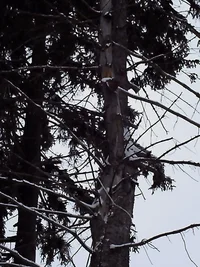
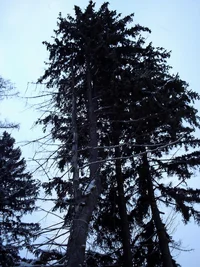
I'm removing some Norway Spruce for my neighbor, just a charity job in lieu of the saw logs, I have a question about one of the trees. The tree in question is roughly 100' tall and maybe 22"-24" DBH. It's an edge tree with most of the weight favoring one side (away from the lay). It has two tops that are roughly 30' tall or so, and is very limby, lots of weight on all sides. The problem I'm worried about lies roughly 30' up the tree where an old sucker top has died, and looks like there may be alot of decay at that spot. The old sucker top is nearly 30% the diameter of the parent stem. It appears that the tree has laid down some reaction wood around this spot. Yet I'm having questions about where I should place the pull line.

I'm cautious about placing the rope high above that decay, because I'm worried about placing to much stress on that spot. I'm thinking about placing the pull line below the decay, yet it puts the pull line about 30' up on a 100' tree?

Do you guys think I should be worried about that decay? I think I will need some M.A. set up into the pull line to get this tree going with that rope so low, or I have a skidsteer at my disposal. What do you think?
 
Pictures?

How is you experience at backleaners?

Which side it the suspect area in relation to the pull direction?


Wedges, don't forget to use them, too. Push and pull.

You can put 2 pull lines in the tree, above and below the decay.

Cut your face deeper than you many normally to change the hinge in relation to the center of gravity.

Piston jack in the back-cut, backed-up very well by wedges. An assistant maybe good allowing one to pound the wedges, and one to pump the jack.

If you are going to pull with a skidsteer, it will be better to use a UHMWPE-type, minimal stretch rope.

You may be better off to get your 30' high anchored pull rope routed through a block at 30' on a strong tree to make all the force on your felling tree in the horizontal plane, with no force wasted on compressing the stem (vertical force).

You can climb it to have a better look at the questionable spot.
 
Toss in a throwline as high as you can get it from behind the tree (opposite direction of fell) and let it go all the way through. Then pull your tag line back through the tree and tie a running bowline at the base above were your going to make your cut. This way the line is pulling the entire length of the tree and not just the top. That should help with any issue of the decayed spot.
I also like using it because the rope is easier to retrieve after the tree is down.

Good luck.
 
Yeah, there you go.
I would advise against changing the way you fell the tree though. If the wood is questionable, your going to need as much good sapwood for the hinge as possible. If you make the face notch deeper, your going loose some sapwood in the hinge.
 
Nasty tree! I would probably spike up and cut that deadhead out so it doesnt become a widowmaker. Thats just my opinion from the pics, but I am pretty cautious. Seen too many bad things happen!
 
[ QUOTE ]
Yeah, there you go.
I would advise against changing the way you fell the tree though. If the wood is questionable, your going to need as much good sapwood for the hinge as possible. If you make the face notch deeper, your going loose some sapwood in the hinge.

[/ QUOTE ]

I was thinking of going from the typical 1/3 depth/ 80% width notch apex to 1/2 way depth/ 100% width. Perhaps a minor fraction less sapwood, but more wood overall. Depending on the butt and the overall COG, this may or may not make much difference in tipping the tree.

I would start with a small face to check for any decay. Enlarging the face bit by bit, dictated by what I see.

Sounds like the concern for decay is up higher at 30', not so much at the butt.
 
what ever you do dont tie into the tree being removed and dont go blindly walking up it with spikes and a lanyard. use your climbing line. i personally would find a high crotch in one of the healthier tree's next to the one in question and use a Ddrt system in conjunction with spikes and lanyard. that way if anything goes wrong you can quickly drop you lanyard and swing out of the way. but i agree with treeswinger, that top needs to be cut out first. get pull rope up in the top too. that way with the back lean your groundies can pull it over.
 
Hey Aspen, I believe Southsound is talking about "deeper notch", as sawing lean into the tree. Undermining the center of gravity of a tree that is more or less straight. I have used this technique many times and its a nice way to fell trees that don't have an obvious lean. While notching you have to watch the top of the tree, once you take away the center of gravity the tree will settle towards the lay. There are mixed thoughts on this of course. I like it when the situation is right...
 
I have to disagree. Changing the center of gravity or change the lean by making a deeper notch is not practical.
Let me see if we're on the same page...
Lets say there is a 100' tree that is 2' diameter at cutting height and it has 1 foot of back lean. The 1/3 hinge is about 8 inches deep. The 1/2 hinge is 12 inches. To get the tree to go over center and start falling the tree has to travel 1 foot for the 1/2 hinge or 1 foot 4 inches for the 1/3 hinge. If that is the case do those 4 inches of travel at the top of the tree make that big of a difference? That isn't even a full 1 inch wedge size.
Plus, the farther a face notch is cut into the tree, the less wood there is to work with in the back to set the hinge. And, just because there is more wood for the hinge, doesn't mean that its all good hinge wood. The live wood is the good hinge wood, heart wood generally isn't.
The 1/3 or 80% rule is just a guide and each situation is different, but making a face notch deeper just to help get a leaner over doesn't work for me.
 
Stop the typical nonsense..
that tree is a piece of cake. the mild bit of backlean is no big deal. Any good west coast faller could put that tree against the lean with wedges only.. Shoot a high pull line up there, and cut the thing. Pound wedges if it makes you feel better. Tree should be on the ground in 10 minutes max..

Only potential I see for a problem is if the pull is put on before the the hinge is set.. So the faller best not be anywhere near the LZ when calling for the pull ..

Use a dynamic line and if the top breaks out the stored energy in the stretch will likely bring it over to the lay anyhow.. Its a no brainer. Just get out of there before calling for the pull.
 
Sam,

I agree that cutting a deeper face wouldn't help the backleaner change to forward leaning much. I've been pretty sick this whole last week, and that was a brainfart.
 
You should make a fast low fly-over with a chopper and check the tree for lean from above. Maybe use a crane to take out the dead section, then test the holding wood with one of those Haglöf Increment borers. Be aware of any seismic activity in the area, as it may affect the outcome to one degree or another . . . Do not fell it until you have more pictures and something of a consensus can be reached.

Or, smack a redhead into the f*cker and see how it acts?
 
It's never a bad idea to put your brain to work on something your just not quite sure of. What's it going to hit that will do damage? And I didn't see it mentioned, but if those branches are into the other trees that will effect the fall too.
 

New threads New posts

Back
Top Bottom