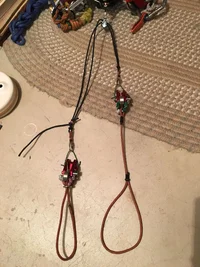
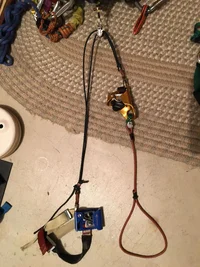
New (possibly) knee ascender

Don'the know how I missed this video. Two things that strike me:
1. Look how high the "knee" ascended rides, more like a waist ascender.
2. No multicender to gum up the works, just rope 4 rope grabs and a chest pulley during ascent.
 
That is very similar, minus the bungee. It is not surprising that someone has done something like this before, as it is a simple setup. Thanks for finding that, you seem to have a reference for just about everything discussed on here. I know I have studied a few of your hitch drawings in the past when trying to tweak a system. I appreciate the info here and in other post. Thanks again

As for the working in unison, it is very natural (at least after using a rope walker setup) for the required action to make this work. I've had a SAKA since they were still being sold at treestuff, so its possible that it is a little more intuitive for me to pick up that sequence than maybe someone who is trying it out for the first time.
You guys have a look at the ProTips section here? Ascending video is a rope walker setup I've been using for a long time.
http://portal.treebuzz.com/pro-tips
 
Does the foot ascender even need to be strapped on your boot at all in this setup? Just as long as it is in the loop.
 
Yes, it needs to be attached to the boot. Only the bungee cord is looped to double the pull power. A single stronger bungee could also be used. The feet just seesaw through the pulley, with the foot ascender aiding the knee ascender. A solid rope might also work?
 
Just another thought on this. If one were to make a version with two ascenders on it, one side down low like a foot ascender and the other side up by the knee, with rated carabiners all you would need for a powerscender would be the $10 HAAS connection plate on each spur. This would work well for anyone who wanted to avoid having a foot ascender constantly on their spur while working. You could make your own detachable foot loops for when pruning.
 
She is using a more traditional method that was used before foot ascenders came out. The right foot croll, as well as the knee ascender need bungees to advance. She has both ascenders working independently with separate cords. The regular double bungee system connects the two ascenders so that they help each provide tension.
When using a foot ascender, only the knee ascender needs tension provided.
I use a similar system when using 9mm to eliminate toothed ascenders.
IMG_0761.webp
 
One area where a lot of rope walking systems can improve is the amount of distance between each foot in an upward motion, and fully engaged in a downward step.
I see a lot of videos where people look like they are aggressively pedaling a unicycle slowly up a tree, this is caused by the amount of slop before the foot engages.
Mark's protip video has the least of this I have seen, so I can assume the upward tension on each foot was really dialed in to minimize the amount of slop.

I say this because I am questioning how much movement is in my own system, even a tight foot ascender can have 4-5 inches of slop between up and down. With both feet I am probably climbing 2 feet for every 1 I move up the rope.

Could the old school ascenders that float above the foot be more efficient?

 
They probably are more efficient because they don't flop down as long as the system is dialed in where the bungee doesn't become slack. It is also easier on the ankle, as the pull is straight off the top of the foot.
 
... I say this because I am questioning how much movement is in my own system, even a tight foot ascender can have 4-5 inches of slop between up and down. With both feet I am probably climbing 2 feet for every 1 I move up the rope.

Could the old school ascenders that float above the foot be more efficient?
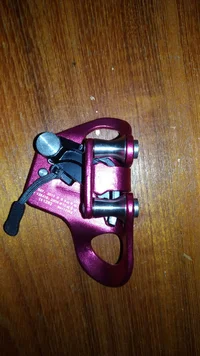
Something is not right with your setup if you are getting any set-back at all. That is the beauty of toothed ascenders.
Old school foot loop foot ascenders have both pros and cons. The big pro is that there is no side twist applied to your ankle as you step. On the con side, you lose space as it is higher up on the rope and generally they are less convenient to leave in place while working.
 

New threads New posts

Back
Top Bottom