New device from ISC

Here goes at an attempted explanation. On bending/friction type devices the dimensions and angles dictate how much occurs. Case in point RW the space between the bollards and the angle of the lever arm determines how aggressive it is. On a zigzag or that family of devices the chain structure balances space between the bollards and how much bend is shoved into the rope path, with the zig angle being like the RW lever angle. So you could picture the angle relaxing if the effective bollard gap was on the wider side or conversely the rope being on the thinner side. There's also some range of drag induced per amount of bend in rope between different ropes. Tuning this stuff is the art of designing. On one device I made I was tweaking 10's of thousandth's of an inch on a bollard-spacing-like dimension that also controlled "lever angle" though it wasn't RW bend lever type exactly. I concluded that I needed field tweakable dimension and couldn't get it into the design. I'd wager that the devices we're talking about are facing that same hurdle of getting a wide enough sweet spot out of perhaps fixed basic dimensions on key parts and wear in the 10's thousandths or maybe even less could quite reasonably be expected to cause noticeable performance changes. This could be even more pronounced in a series multi element device where friction compounds like in the bollard equation ie exponential per linear change. The links in the zig structure are an example of this. The buildup of friction loss in a multi pulleys block and tackle assy is another example, but doesn't have the secondary changing-the-lever effect.

Too much time on my hands. ;-)
 
Last edited:
Most of the gear sites had 20% off sales over the last few days, so I tried to apply that to a pre-order Reflex but none would allow it. Impulse buy denied.
Same story at Christmas sales.
I went to the Ohio Tree Care conference saying "if anyone will give a discount I'm buying it". Got 10% show disband think I got the last one there....amd maybe anywhere for now. Looks like it's back ordered everywhere I've seen.
 
So today (in a weak moment) I sprang for yet one more shiny new climby thingy. Gotta say Reflex is slick me thinks.
Tried SRT Reflexing around on:
Blaze 11
Scion 11.5
Voyager 11.8
Found these all REALLY jerky to get started. The Force is not strong with these ropes it seems.

Midway easy:
Squir 11.5
KM III 11.0


Drayer StatX 11.5 however was wonderful and,
Tachyon 11.5 (pleasant surprise !!)
Cherry Bomb (1) 11.5


Hypothesis then, is this thing might be way more comfy on newer "hard" (or full) 11.7's, 11/8's and 11.9's and up. Haven't tried it on 11.5 Tachyon yet - will add this when I try it out (above on day II).

However, for the ropes in the upper list, I did try out a wrench on top but it didn't seem to ameliorate the first jerkiness until the wrench elongated and engaged anyway. What did offer some relief though was a good 'ole flat top biner and Munter on the leg loop or lower "D", if it was stretched up tight before you started descent. Bit'ta bump then but not nearly as much - tolerable. Hope this is some useful Beta. Cheers.

Addenda (day II): Some of these trials I would maybe attribute to first use and getting used to/watching hand position. However the last three ropes (above) I did not even pay too much attention to hand position and I still got smooth SRT descent. If the 11.8's are like that too, it's going to be a real pleasure to use the Reflex in work at height (where you can be busy with other things). (All these trials are in the Cave of Wonders on snow days).
 
Last edited:
When you say "jerky" @ghostice is that just when you start the descent? I found if you just tap the top lever, yeah your gonna drop! (Yale Immori...and I tried it on a friend's rope, didn't even pay attention to which rope it is). But grabbing the rest of the friction devices iny whole hand gives good control.
Yup just starting down - am working the rest of the zig zag links but it still seemed to release more suddenly than I liked. On one of the ropes it kinda kept going too (similar to Kevin's comment above). It looked like with "smaller" diameter ropes, the links spread out more vertically or more elongated, which is kinda the same experience I've had with the zigzag links and zillons. Also found I had to watch where my glove was a bit so it didn't get sucked into a pinch point (in common with the zig zag and a loose fitting glove). It's an interesting device and the easy on and off is super. The StatX was great so if you get the right rope for your weight it's going to be a nice device. Cheers
 
When you say "jerky" @ghostice is that just when you start the descent? I found if you just tap the top lever, yeah your gonna drop! (Yale Immori...and I tried it on a friend's rope, didn't even pay attention to which rope it is). But grabbing the rest of the friction devices in my whole hand gives good control.
that's how I use a zz too
 
I've had my Reflex for a little over a month but I've only gotten to climb on it a few times. As we're actually having a real winter here in Southern New England this year.
I've been playing around a bit in the house in the meantime. The weather has also given me an unusual amount of free time so I figured I'd do a little write-up on first impressions with the Reflex.

The ISC Reflex is a brilliantly designed device, it just works! SRS/MRS…. Midline attachable fairly quickly, no chance of the rope coming out unintentionally, no adjustments, no sit back, zero drag on ascent, stays in place on the rope unloaded, no added friction devices necessary for most applications but works wonderfully with them if necessary, (particularly with the small Ultralink capturing the wrench tether), built-in swivel attachment that is removable, multiple attachments for MRS allowing other positioning configurations, (possibly a V-rig?). Rated for rescue applications and by far the easiest to modulate repelling of any device I've used so far in SRS! (Haven't tried the Blackbird yet, still waiting since last May, hopefully in a few weeks).

It’s intuitive and has a great feel/feedback in hand. A couple millimeters of squeezing the links and you can go as slow or as fast as you want with very little effort whether it's 100% loaded or barely loaded and it's super easy to pull out slack when it's unweighted. There's only a little spring in the very top link which takes minimal effort to compress.
Some of the other most excellent devices available can be a little harsh on the hands initiating descent, this is completely the opposite, there is no hand fatigue, so little effort is needed yet the modulation is so smooth. There is the consideration of something unintentionally bumping the top of the links and causing a small unintended drop, but that is not unlike many other devices, including a hitch-based system.

I weigh 175 lbs without gear and it has worked perfectly on every rope I've tried it on, at least hanging and repelling a few feet from my pull-up bar. So far I've tried LimeLite 11.7 (type A poly/nylon version of Yale's XTC 24 Blue Moon), Scandere 11.7, Kernmaster 11, Kalimba 11.9, Tachyon 11.5, and Safety Braided Blue T-Vee 12.7. The Kernmaster has a little faster action than the others but still holds. The couple opportunities I've had to actually climb on it in the field I used the Scandere and it worked perfectly.

The trick with this device, as far as I have observed, is that the lower arm from the links leverages on a pulley that compresses against a plate for the lower friction point. The more the device pivots the more compression on it.
So when it's in MRS mode and there's a carabiner holding up the back of the device it has less friction in the lower compression point. When it's in SRS mode the device pivots and more friction is on that compression point. And when rope walking everything is completely aligned and the lower compression pulley then acts like a chest pulley.

The MRS attachment holes are also very well designed with the little orientation aid that protrudes into both. I have tried several different carabiners and most of the carabiners I've tried are easily rotated but also adequately held in place upright by the orientation aid allowing for the opening of the carabiner being up and in place. So if you're detaching and reattaching your termination advancing your system you don't have to look for it, it's just there standing up ready to attach, similar to the Zigzag or Spiderjacks.
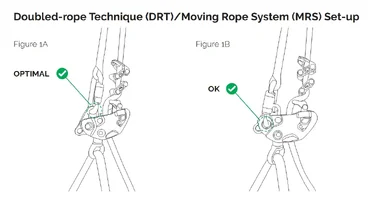
When you utilize the upper “optimal” attachment hole (which apparently aligns everything better then the lower”okay” hole) for your MRS termination, I imagine the lower MRS attachment could be used for attaching another system or moving your lanyard to it, etc. Although I'd be careful not to do that in SRS where the pivot of the device is essentially a wrench below the links. It could also make for a brilliant V-rig, although I'm not sure how much the leverage on the lower compression point would change with the angles. The more the links are pulled away from the center the more compression on the lower friction point.

I also really like the detachable attachment point. It takes the ring or other bridge attachment and the carabiner completely out of the equation, making the system extremely compact. Way more so than any other device that requires a carabiner.
It's shaped to fit nicely on a double rope bridge, a larger diameter rope bridge or a webbing bridge.
It's fairly quick and easy to get the attachment point on and off whether a rope is in the device or not (more so in SRS, noted below), and the lower friction plate is spring loaded against the attachment swivel with a keyway that the swivel snaps into. So zero concerns about the safety of the attachment point even with the device fully open.
You have to unweight the device, push rope up into the device which moves the links over to the right out of the way, orientate the swivel attachment point straight down, (the swing plate cannot open with the attachment swivel loaded), rotate the swivel parallel with the device, depress the spring loaded safety cover, depress the spring loaded locking button, open the swing gate completely, move the lever arm pulley away from the friction plate and then lift the spring loaded friction plate away from the swivel attachment point pulling the key way out of the groove to get it out.
It sounds like a lot written here but in practice it's just a couple quick motions. To put it in you create basically the same scenario (the device completely open and no pressure on the lower friction point) and then just push it on and it snaps into the keyway.
Not as fast as unclipping a carabiner but it's fast enough I wouldn't mind leaving the swivel attachment on my bridge with the advantage of having the system being so much more compact and no chance of a carabiner loading funny or anything. It takes me about 5 seconds to attach or unattach.
The exception is in MRS where both termination attachment holes block the swivel plate from opening. You can however keep the tending point clipped to an accessory carabiner if you wanted to hang it from your tending point while you took your swivel off or put the rope in and out of the device.

So while in SRS you could unload, pop your swivel off, throw it over redirect and reattach fairly quickly. In MRS you would have to take the termination carabiner attachment off and on too. In practice it took me about a minute to pass the device over a branch in MRS with the swivel on my bridge.
I find this unfortunate because I really really like the detachable swivel attachment and eliminating the carabiner and ring. But I still think that little extra time is worth the other benefits.
So far for the few climbs I've done I'm just leaving the swivel on my bridge.
I've heard that the swivel attachment is replaceable so you can get multiples and have different setups. I will probably get another swivel so I have one on a carabiner for when that makes sense.

For me personally, up till now all these new devices have been more about having a better performing SRS device more than anything as I find the ART devices for MRS just so nice with the one-handed self tending, even the zig zag self-tends somewhat well with some rope weight. If I'm doing a climb mostly MRS I usually still switch to one of the Spiderjacks or the Zigzag after ascending but we'll see how well this thing self-tends. It may just be the one to rule them all….

Sure is an exciting time to be a climber!
 
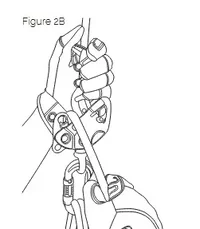
At lunch today I sat down with the little manual/ instructions that comes with it. There's a bunch of use tips in there about hand position, and gloves (leather not rubber surfaced) that should help with different ropes. Instructions also state: "recommended that EN 1891-A rope, made of Nylon, Polyester and with Kernmantle construction" (pp15). Worth a read for sure so we don't reinvent the wheel I guess.
Is it a guy thing to read the instructions tho? :-) Change is hard . . .
 
Last edited:
I've had the Reflex for about 3 weeks and did a few climbs. I climb mostly MRS, but wanted to get a good SRS climb before writing a review. Did that today. The other devices I "normally use for comparison:
*Unicender has been my primary device for MRS climbs for about 6+ years.
*Zigzag...I've liked climbing on the ZZ better than Uni, but didn't like fussing with feeding rope through every time, so I used Uni more.
*Hitch cord+wrench has been my preferred SRS system - never really liked the Unicender for that mostly because not a great place to clip into chest harness. Just my preference.

OK, so to some comparisons:
*Slightly less intuitive than the Unicender to hook into the rope...not hard, just took a few times to figure out aligning the friction points correctly. After maybe 10 uses, its just as fast.
*Smoother than Unicender. Maybe not as smooth as the Zigzag, but its close.
*No setback. Others weren't bad, Reflex is better.
*I probably do like descending the the Unicender a touch better - a little more control when you wrap the rope over the top. I like small rope movements while limb walking on the Reflex better.

As of now, I cannot imagine wanting to go back to either Zigzag, Unicender or wrench=hitch cord/climber. Not that I dislike those, just like the Reflex more.

Things I don't like:
*I don't like that the MRS attachment hole has to use a ISC Small Oval. Nothing against the Small Oval, just didn't love having to buy another carabiner for that.
*More than that, I don't like how tight that small oval fits in there. I'm assuming there is a reason it cannot flop around. Maybe it causes the friction points to release when it does? But being in a tough spot in the tree, wanting to reposition the tie in point, it is not enjoyable to fight with that tight fitting carabiner.
*When I get down and want to unhook everything, I need to take out that same tight fitting carabiner to open the gate and get the rope out. It's not a bad thing that it keeps the gate from opening accidentally...but again, It's a little annoying to wiggle that out just to unclip.
(So I guess everything I don't like is the MRS attachment point..maybe I should try climbing from the "OK" hole instead of the "Optimal" hole...didn't really think of that until I put this into words and looked back at the instructions).

MRS.webp
 
At lunch today I sat down with the little manual/ instructions that comes with it. There's a bunch of use tips in there about hand position, and gloves (leather not rubber surfaced) that should help with different ropes. Instructions also state: "recommended that EN 1891-A rope, made of Nylon, Polyester and with Kernmantle construction" (pp15). Worth a read for sure so we don't reinvent the wheel I guess.
Is it a guy thing to read the instructions tho? :-) Change is hard . . .
manual? whaaaaat?

Seriously, though. I looked through it before even putting the thing on a rope and I found I needed to play with it a little on my own. The video somebody linked above from TCIA was helpful instruction.

Anyhow, I learned "on my own" that it really matters how you place you hand descending. The video talked about holding the whole chunk of friction pieces in your hand. I figured out that putting fingers between each helps reduce the possibility of squeezing them too far. I also "figured out" that you want your pinkie on the "outside" not "inside" so the rope isn't running against it. Then you go mentioning the manual and I see that the proper way is pictured in there. I was gonna post that recommendation as if I discovered a useful tip LOL.

hand placement.webp

"The REFLEX must be used with EN 1891 Type A rope..." (pg 14). Had to look that one up:
Apparently, that's most 24 strand arborist ropes?

I've been using it on Imori. I mentioned above, I used another friend's rope for one climb. I'll have to see what that was. Both of those were great.

I'll try it on an old piece of Tachyon and Bluemoon (or another Yale 11.7mm cousin) in the next week or two. I also have some Tango Ivy that I'll try. I think that is a exclusive SherrillStuff rope and their websites don't say much about its certifications that I can find so not sure if its EN1891A?

I cannot find whether Arborfreak is EN1891A either... except this excerpt from American Forestry (under the difference between climbing and rigging lines): "Arborist climbing ropes must be certified to EN1891. This should be marked on the rope, along with a serial or identification number." Is that true...are all arborist climbing lines meeting that standard?
 
Looking at that picture in my above post again... it looks like the are wrapping the rope over the top of the device (kinda like a Unicender wrap?) for SRS descent? I did not do that and felt very in control coming down. Will have to try that... @ghostice did you do that when you felt it too jerky?

I'm at home in front of the computer, not with a rope right now...but trying to picture getting into that position. You'd have to either unclip and pass the rope across or feed the whole length of the tail over your bridge to hold it that way, right?
 
Good review @Bill_N ! I'll have to try the swivel directly to bridge. I'm not sure I want the device that low - have you clipped it into a chest attachment like that? I guess a longer bridge fixes that...

Hooking into a carabiner and the swivel on my bridge has worked for me, so I didn't even think of trying the swivel by itself.

I've never climbed with a Spiderjack...but as I mentioned just above, I think this will replace my Zigzag.
 
Is that true...are all arborist climbing lines meeting that standard?
No not all arb ropes are EN1891A - I believe it requires a rope with a nylon core or something to get a bit more bounce (maybe giving rise to ISC's statement in the "manual" about not using rope that's too static but using one that has a bit more give or bounce).
There are two things that gave me pause a bit - the not recommended rubber surfaced gloves thing - I never climb in leather gloves (or. even belay alpine in leather gloves really - they get too wet). And the other is trying to visualize myself using the over the device loop on descent. If the rope is down between my feet or to one side, how am I going to get a loop over the device without throwing the rope over my head behind me and still have it tail down the stem? Or am I missing something? That one gave me pause (so haven't tried it, just a munter). But I guess I am missing something. Anyway, still one heck of a step forward and I'm sure way way better climbers than me will be using it to whiz all over the treetops. What a time to be involved in the treework world!
 
No not all arb ropes are EN1891A - I believe it requires a rope with a nylon core or something to get a bit more bounce (maybe giving rise to ISC's statement in the "manual" about not using rope that's too static but using one that has a bit more give or bounce).
There are two things that gave me pause a bit - the not recommended rubber surfaced gloves thing - I never climb in leather gloves (or. even belay alpine in leather gloves really - they get too wet). And the other is trying to visualize myself using the over the device loop on descent. If the rope is down between my feet or to one side, how am I going to get a loop over the device without throwing the rope over my head behind me and still have it tail down the stem? Or am I missing something? That one gave me pause (so haven't tried it, just a munter). But I guess I am missing something. Anyway, still one heck of a step forward and I'm sure way way better climbers than me will be using it to whiz all over the treetops. What a time to be involved in the treework world!
Personal preference...I always use leather gloves. My hands get stinky (OK...more stinky!) in latex palms, and I've had a few times where they get pulled into the friction device or hitch cord. So I use leather. There are a few I've like, but Wells Lamont Hydrahyde have become my go to. Comfortable. Wear pretty well. Not too loose (the insulated ones are...but regular ones are not) and not too expensive. $15/pair at Menards or Costco usually has them for $30ish for 3 pair. They are "supposed" to be waterproof. Not the backs, for sure. The leather may soak through slower than other gloves.
 

New threads New posts

Back
Top Bottom