More things broken

So why do we continue to have rope bridge failures, that's what has me baffled. People are doubling their bridges and losing trust in a rope bridge, some are afraid to even buy a harness with a rope bridge, that is absolutely nuts to me, it's the best component.
I wonder if there is a common thread on these failures? Are they new saddles? Are the bridges new? Are the climbers actively inspecting before use? That part we may never know in the case of fatality? Are the knots being used tied right? maybe the bridges are being soaked in fuel? Will that rot the material? Maybe the bridge plates have a sharp surface that wasn't cleaned up after manufacturing? this I highly doubt.
 
That is why I have a DON'T TREAD ON ROPE policy! because of the fiber damage you may not see. Also why I suggest that if a climber works on a large crew, Changes trucks regularly?, that he use his own ropes... he will know the history. Also keep track of the age of a rope, regardless of its use because textiles degrade over time, they become brittle and shitty.
I had an old pair of ski boots that fit me awesome disintegrate on me while skiing back country, I was standing in my boot liners in 4 feet of powder! The plastic just degraded. Rope does the same thing.

Interestingly, and this is a hard one to swallow because the rule has been around a long time in all rope disciplines, testing has shown that treading on ropes does nothing to diminish rope strength over time and doesn't significantly introduce dirt/grit into the core fibers. Grit gets into ropes just fine without our help walking on them. But... big but (not butt) this "truth" is very similar to a parent telling their child, "Don't touch baby birds in their nest, your scent will cause the bird's parents to reject them". Very few bird species have a sense of smell and the ones that do don't nest in your backyard unless you happen to have an albatross or turkey vulture in your backyard. Point being, false rule but very effective at keeping kids from disturbing bird nests, and getting bird lice on their hands ;-)

Likewise with your rope, stepping on it means you're not paying attention, you're not respecting that which keeps your life safe and you're probably not paying attention to a bunch of other things you should be paying attention to besides your rope. False story but very useful way to help climbers respect their ropes and pay attention to their surroundings. Very effective story, that's why both myths have stuck around for a long time, they produce good results.
-AJ

Edit: Not every myth produces good results, people still think they should stick some, anything into the mouth of a person suffering a grand mal seizure so they won't bit their tongue or choke on it. Doesn't happen but seizure victims still get injured because someone believes they must jam something in their mouth. A compelling myth dies hard.
 
Last edited:
In my researching of shelf life of ropes, I discovered some things that surprised me... the polymers don't degrade over time nearly as much as "shelf life" numbers would lead you to believe. Most of those figures are rather arbitrary, because OEMs have no idea what conditions the rope will be stored. Also, there are very few chemicals that adversly affect the rope, and those are listed on several websites.

The really big one, and it really should be no surprise to anyone, is the high UV levels of sunlight. This is probably the most destructive thing on the planet... it has as much to do with the erosion of mountains and degradation of matter on earth as wind, rain and temperature extremes.

I've become very picky about never leaving anything I climb on or rig with out in the sun for any longer than necessary. I keep it all in large, clean, plastic toolboxes (big ones).

This helps with one other thing that I accidentally discovered is really bad for ropes. Rodents.

The failing rope bridge thing is rather baffling to me, too. I don't actually use one, because none of the rope bridge saddles I've tried really appeal to me. To each his own, I guess. But I would think that it would make sense that on a week when you get a fat check, a person might want to buy or make about two or three extra ones and keep them with the harness and gear. You could swap out for a new one if the current one looks a little rough, or you have any doubts.
 
Interestingly, and this is a hard one to swallow because the rule has been around a long time in all rope disciplines, testing has shown that treading on ropes does nothing to diminish rope strength over time and doesn't significantly introduce dirt/grit into the core fibers. Grit gets into ropes just fine without our help walking on them. But... big but (not butt) this "truth" is very similar to a parent telling their child, "Don't touch baby birds in their nest, your scent will cause the bird's parents to reject them". Very few bird species have a sense of smell and the ones that do don't nest in your backyard unless you happen to have an albatross or turkey vulture in your backyard. Point being, false rule but very effective at keeping kids from disturbing bird nests, and getting bird lice on their hands ;-)

Likewise with your rope, stepping on it means you're not paying attention, you're not respecting that which keeps your life safe and you're probably not paying attention to a bunch of other things you should be paying attention to besides your rope. False story but very useful way to help climbers respect their ropes and pay attention to their surroundings. Very useful and effective story, that's why both myths have stuck around for a long time, they produce good results.
-AJ

Your post reminds me of this podcats.
https://99percentinvisible.org/episode/ten-thousand-years/
It is about how to warn people of danger 10000 years in the future. The best method: mythology. Why? It works.

Regardless of weather stepping on rope is good or bad, I will continue to follow my mythology of not doing it. I agree that it shows you are probably not paying attention to your surroundings if you do it.
 
All good points, but wear and tear, adds up no matter how you add it. Stepping on gear is not good policy, I won’t ever step on yours— that’s a promise! So don’t ever step on mine! Learn how to manage ropes effectively so you minimize wear and the possibility of entanglement.
 
The effects of fuel on rope thing intrigues me?

From what I've read petroleum products don.t have much effect on polyester fibers, the stuff is very stable. That said who wants bar oil or other similar crap on their ropes? Can't remember the source, it may have been Teufleberger, soaked rope in steel drums full of gasoline or oil can't remember which, left it there for a significant length of time, drained out the fuel, dried the ropes and examined the fibers and tested the strength, no degradation.
-AJ
 
..that's why both myths have stuck around for a long time, they produce good results.

Stepping on gear is not good policy...


Very good points.

I do a number of odd things with gear storage, use and care that are more about focusing on keeping it in safe, working condition than necessity. It's more about developing good habits with the stuff, than any real need to keep it shiny and clean. It's hard to clean and lubricate a pulley without giving it a thorough inspection as a consequence of looking for bug turds wedged in the axle.
 
All good points, but wear and tear, adds up no matter how you add it. Stepping on gear is not good policy, I won’t ever step on yours— that’s a promise! So don’t ever step on mine! Learn how to manage ropes effectively so you minimize wear and the possibility of entanglement.

100% agree, every time I accidentally step on my rope, it's like "Damn!"
 
Very few bird species have a sense of smell and the ones that do don't nest in your backyard unless you happen to have an albatross or turkey vulture in your backyard.

And just for you @moss I'm going to try to remember to snap a photo the next time I'm at the house the wife and I call "the shop"... we have anywhere from half a dozen to three dozen turkey vultures circling the area all the time. Kind of creepy, at times. Hoping it's not an omen.
 
Very good points.

I do a number of odd things with gear storage, use and care that are more about focusing on keeping it in safe, working condition than necessity. It's more about developing good habits with the stuff, than any real need to keep it shiny and clean. It's hard to clean and lubricate a pulley without giving it a thorough inspection as a consequence of looking for bug turds wedged in the axle.

The bug turds unhinge me every time, Christ! Actually not but I can channel that ;-)
 
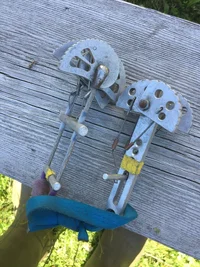
Take note of Soviet model on the right- Metolius model on the left. Build quality is very poor. Bolt with button smash threads vs heavy soldered bond. Granted Metolius made solid stem versions as well. The cable type can bend and are useful in horizontal cracks whereas the solid stem are for overhangs and vertical cracks. I did use the Soviet gear mostly as doubles or back ups. But almost never as life support.
 

New threads New posts

Back
Top Bottom