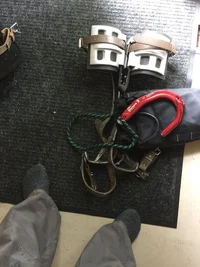
More things broken

Yes, I'd group HTP with most of the other static and kern ropes.

The sewn eyes seem to be a variation of the ones from the Practical Sailor. The Helical, straight through stitches might allow the rope to stretch more than the multiple,tightly packed stitches. The strength of the thread, or maybe cord might be more what holds it together on the other type of sewing.
 
Last edited:
It would be worth looking at one of those static load vector charts or apps, if the angles become too shallow even a static load can jack up pretty high. I believe this more likely a potential issue if MA like a RADS is used on the hook line and the rope angles are driven too shallow. Good opportunity to measure with a load cell to see what’s what.
-AJ
I wonder about the casting of the hook itself? How do they ensure a quality cast? Or do they mill it out of billet stock?
 
I wonder about the casting of the hook itself? How do they ensure a quality cast? Or do they mill it out of billet stock?

The hook is definitely not the weak point in the equation, the thing is bomber as hell. I not so secretly suspect DMM paired it with the 10mm Reep Schnur to scare people out of pushing the hook more out of the box, ie: because it is not a "closed anchor". I would hang my life on the hook all day and then some, Reep Schnur not so much.

It is definitely milled but it may start as a stamped casting, been awhile since I looked at the "origin story" on the DMM site.
-AJ
 
Last edited:
It's actually difficult to find on the DMM site, no fabrication info on their Captain Hook page:
https://dmmprofessional.com/Products/Throwing-Hooks/Captain

But it looks like, since that's what DMM Wales is so well known for, likely hot forged (not "stamped") with a milled finish. There are milling marks on mine. The 18k rating probably relates to where the shackle attaches, looks the weakest point (wild ass guess). I seriously doubt we can convince our good friend Richard to break a Captain Hook ;-) What a waste that would be, I'd sooner break test my right pinkie finger, wait, I did that already.
-AJ
 
It's actually difficult to find on the DMM site, no fabrication info on their Captain Hook page:
https://dmmprofessional.com/Products/Throwing-Hooks/Captain

But it looks like, since that's what DMM Wales is so well known for, likely hot forged (not "stamped") with a milled finish. There are milling marks on mine. The 18k rating probably relates to where the shackle attaches, looks the weakest point (wild ass guess). I seriously doubt we can convince our good friend Richard to break a Captain Hook ;-) What a waste that would be, I'd sooner break test my right pinkie finger, wait, I did that already.
-AJ
image.webp
 
Richard, on the 8104 test RIT, specifically the whipped end; if you feel through the cover where about did the core break in relation to the stitching*? Do you still have the two pieces in you possession and if so would it be possible to see a photo of them laid end to end (as it was before being broken) so I could get a better visual on where the cover / core failed in relation to each other and to the stitching. I'm very interested in hand stitching 8mm RIT.

*Let me word that question a different way, asking for the same info but when I proofread my post it came off a little confusing... Take the whipped end, run your fingers up the remaining cover, how far up from the stitching do you feel core remain?


BTW Who's is it, are they a member here? If so it'd be awesome if they'd add any thoughts about the process, maybe things like what needle, what thread, how far into the core they attempted to grab with each stitch.
Time stamp in the video for which one you are talking about? There were 2 of those and they both broke at the basket bend, core broke same distance from the stitching as the cover.
 
FFFFFF*******CK YEAAAAAH! Ok, sorry for my excitement. I've been through a lot of BS for my heavily documented hand-sewn eye technique. Nick Bonner I never met you but suck it. And I will gladly say that to your face (in a good way) if we ever meet.

See the hand-sewn eye documentation thread in the splicing forum. My contribution to the testing is the retired Velocity 11mm lanyard w/sewn eye. We didn't get to see the strength of the eye but you'll notice it didn't budge as the rope failed. The retired Reep Schnur Captain Hook hand-sewn eye, plus 1 year service, eye didn't budge. And what means the most to me: Ta-da, drum roll please: hand-sewn Globe 3000 bridge, retired, in service more than 4 years on and off on a Petzl Sequoia open ring bridge setup. On inspection I felt that it still had a life but out of due caution I retired it. Bridge broke plus 6000 lbs, sewn eyes didn't budge. Thank you Richard. I can send you a hand-sewn eye in Tachyon with (I hope) rope in good enough condition that we can find out the breaking strength of that eye. Based on testing before Richard's test the Tachyon eye will do very well.

Richard we've all known for a while that you are a treasure to the tree climber community, thank you again.

Edit: In all true seriousness, I actually have nothing against Nick Bonner, he rose up to symbolize attitude without investigation. Something we all have to deal with in all walks of life. Lessons learned, love ya Nick.

-Andrew Joslin
One may think that because I have invested thousands in machines that will sew these things for a profit, that I would not be promoting hand sewn anything. (Did I mention, it's a terrible idea and anyone that tries will surely die) But seriously, and excuse the plug as I know many of you have the same value, I still need to make a profit but I will never put it before innovation or fear innovation. As I have said many many times, innovation is both competitive and disruptive and if you want to play in that game, expect it and go with it.
 
It would be worth looking at one of those static load vector charts or apps, if the angles become too shallow even a static load can jack up pretty high. I believe this more likely a potential issue if MA like a RADS is used on the hook line and the rope angles are driven too shallow. Good opportunity to measure with a load cell to see what’s what.
-AJ
I've measured load at those high angles and my surprise was that in the tree it is difficult to get real high loads as I would have expected. Just too much flex in the wood and tree structure above the base. (Low to the ground on a very large size tree would be different) For example, at a competition, the speed climb had an auto belay set up on a very tight high line. Loads were in the 800 pound range if I remember right with a climber taking the hardest fall he could.
 
Thought for those blazing ahead with hand sewn eyes.
Sewing machines are powerful and can push thread places your hands will never be able to and in numbers you will never approach. So, if you can't beat them in that game, don't play the game.
First, a stitch (lock stitches use in a machine) is a doubled thread, in other words a doubled rope, double on another rope. Don't think you get twice the load like you do in DmRT, it does not do that. When I have simulated stitches around open pins, it ends up being about half the rated load of the thread.
Second, a machine can make it compact and extremely tight. We like that because that's what a good splice feels like, tight. Pounding thru the rope a machine can span lots of fibers making us feel they are captured.
Think about sewing without a lock stitch, just passing the needle in a circular motion between ropes. ALSO, and this is where I have seen some surprising results, don't try to capture all of the fibers in the ropes. In other words, try that pattern but only with say an 5mm distance down the middle of the eye and don't make it so compact. I can beat any spliced rope in a tug of war by sewing a narrow pattern but a long one. (still not as long as the splice) Note the one I sewed after I unintentionally had one kernmaster break at a stopper knot.)
Hope everything has made some sense, I woke up early and have not yet caffeinated.
 
Last edited:
I've measured load at those high angles and my surprise was that in the tree it is difficult to get real high loads as I would have expected. Just too much flex in the wood and tree structure above the base. (Low to the ground on a very large size tree would be different) For example, at a competition, the speed climb had an auto belay set up on a very tight high line. Loads were in the 800 pound range if I remember right with a climber taking the hardest fall he could.

Awesome! Science is a beautiful thing.
-AJ
 
I would think, being optimistic of course, that static loading would be well below the rated max in a traverse. It may not handle dynamic loading to your specific needs?

Yeah, dynamic loading doesn't exist the way I implement my Hook. For a hand sewer I'm still paranoid about gear. I didn't like seeing the lightly used Reep Schnur break so low.
-AJ
 
Moss, was the end of the Reep sealed by melting when you got it, and did you ever have to milk it to remove excess cover. I'm trying to figure out the lower than expected breaking strength. One possibility is extra cover got trapped in the tested area, causing the core only to take the load. Another possibility is the spot where it broke was compromised during, or after manufacturing.
 
Thought for those blazing ahead with hand sewn eyes.
Sewing machines are powerful and can push thread places your hands will never be able to and in numbers you will never approach. So, if you can't beat them in that game, don't play the game.
First, a stitch (lock stitches use in a machine) is a doubled thread, in other words a doubled rope, double on another rope. Don't think you get twice the load like you do in DmRT, it does not do that. When I have simulated stitches around open pins, it ends up being about half the rated load of the thread.
Second, a machine can make it compact and extremely tight. We like that because that's what a good splice feels like, tight. Pounding thru the rope a machine can span lots of fibers making us feel they are captured.
Think about sewing without a lock stitch, just passing the needle in a circular motion between ropes. ALSO, and this is where I have seen some surprising results, don't try to capture all of the fibers in the ropes. In other words, try that pattern but only with say an 5mm distance down the middle of the eye and don't make it so compact. I can beat any spliced rope in a tug of war by sewing a narrow pattern but a long one. (still not as long as the splice) Note the one I sewed after I unintentionally had one kernmaster break at a stopper knot.)
Hope everything has made some sense, I woke up early and have not yet caffeinated.
Would you say the rope shipped with the hook is unsafe to use?
 
Moss, was the end of the Reep sealed by melting when you got it, and did you ever have to milk it to remove excess cover. I'm trying to figure out the lower than expected breaking strength. One possibility is extra cover got trapped in the tested area, causing the core only to take the load. Another possibility is the spot where it broke was compromised during, or after manufacturing.

Cover and core were balanced, there could’ve been a nick or two in the cover.
-AJ
 

New threads New posts

Back
Top Bottom