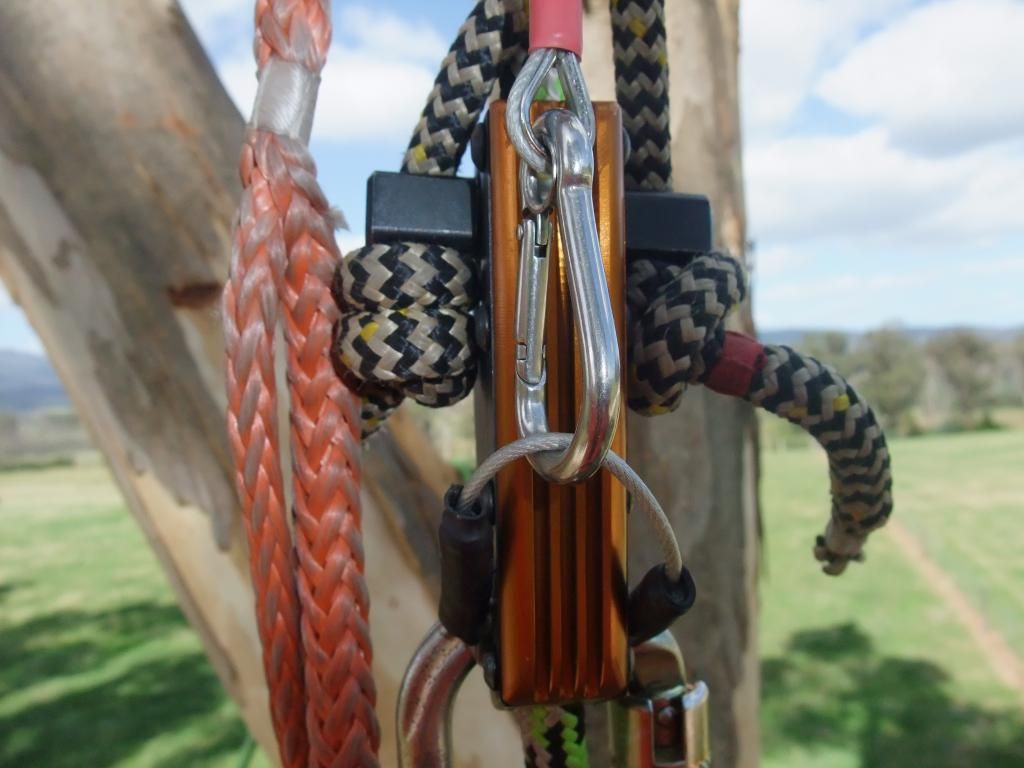
Hitch Hiker

Hey Adam,
It all depends. If I have a tree that I may have to go up and down for extended periods (15-20') without branches, then I will keep it handy and just store the excess on my harness, keeping it attached to my ring and the HH. The neat thing about the daisy chain configuration is that it can be stored fairly concise.
If I can get to my PSP (Primary Suspension Point)and know that I will not need to tether the HH, then I may just take it off and store it on the back of my harness.
Its never hard to take off and put back on if need be, and it requires one piece of gear (Monster daisy chain or Chain Reactor) besides the HH itself, ok and a foot ascender.
The other beautiful thing about the daisy chain configuration is that is multifunctional. If i take it completly off the HH, then I can use it for redirects if there are no natural redirects (branches or branch unions).
REMEMBER THAT THE STERLING CHAIN REACTOR'S INDIVIDUAL LOOPS ARE ONLY RATED FOR 14kN. That will soon change as Sterling is working on a rated Chain Reactor.
On a side note, the Metolius Monster daisy chain can also be used as a basal anchor by girth hitching a rated ring on the large loop end and girthing it around the base of the tree, allowing for multiple connection points. Similar to the ART Snake anchor.

Donny
 
[ QUOTE ]
this thing looks awesome. where can i order it from pctree?

[/ QUOTE ]

It can be purchased at ropetekwraptor.com
 
tends slack perfectly - no slop like the wrench, from the gap between the wrench tether and the knot. . don't know about that new stiff tether, but limb walking SRT with the HH is a breeze - no need to tickle or dress the knot when you want it to bite. I hear you on the bucket of stuff you don't use - get ready to chuck your hitchclimber in there once you get this thing!
 
Hello folks,
I would like to revise my last post. I stated some wrong kN ratings for the Chain Reactor. In talking with Dave Werdelin from Sterling Rope, he clarified some of the ratings and how Sterling uses the 3 sigma MBS tests. here is what is posted on the back of Sterling's product catalog:

Sterling Rope is a certified ISO 9001 company and all of our certified products must pass third-party testing to the standards we identify. Sterling also maintains a rigorous in-house testing program. All minimum break strength (MBS) numbers listed here are from a 3-Sigma MBS test results or are listed at the corresponding standard’s minimum requirement--we do not list average breaking strengths. A 3-sigma MBS is based on a statistical analysis of the breaking strengths of a product and is reported at 3 standard deviations below the average breaking strength. Safe Working Load (SWL) is the designated maximum working load for a piece of equipment or system based off a pre-determined safety margin and the equipment’s minimum breaking strength. Agencies and/or users should establish their own SWL guidelines for individual components
and for rigged systems.

This is what Dave enlightened me on in regards to the Chain Reactor:

The Chain Reactor is tested end to end and we list the 3 sigma MBS at 14kN (3150lbs ). This is the weakest configuration so it would be much higher tensile if it was used in a basket hitch. Each individual loop (stand alone) is 22kn. Textile on textile pinching causes the lower breaking strength. Just as when a bend is introduced into a rope or cord, it loses strength due to the fibers being compressed. Users should determine if an MBS of 3150lbs gives them an acceptable safety margin based on the working load. The other factor for users to consider is the shock absorption of a personal connection point. The nylon fiber of the Chain Reactor does provide good shock absorption compared to dyneema, or other high tenacity fibers.

This handy little tool is a great piece to have on your harness. The uses are only limited to the end user's ability to devise new configurations. Great company with yet another great product.

Cheers,
Donny
 
Either way; both products, the Metolius PAS or Sterling Chain Reactor, are both great products. They especially shine in other non-treework related rope work applications. I will have to get mine out and do some experiments.
 
I will admit I did not read every post to the beggining of the thread...

I am impressed with the simple ingenuity of the HH, although am liking it better with HRC.


I wish there were a way to get rid of the whole notion of stopper knots. I appreciate the simplicity, but have to screw around longer than I want to to get the cord short enough to suit me. Makes me appreciate how quick it is to put on my michoacon (drt) with the knotted ends that are already set to length.

Don't know what the solution would be.....
 
[ QUOTE ]
Did you see this video?

http://youtu.be/qL0gbzHnRKk

[/ QUOTE ]

Yes, I have seen every youtube vid with the name in it. Not sure what part of that vid you are referring to.

What I mean is I tie the hitch and stopper knot, and since I like the hitch pretty compact, I have to load the hitch and then get off it and rework a stopper knot. Sometimes a second time again.

With my other hitches, I simply tie and slip the pre tied ends on the biner and I am good to go.

Maybe it's just me. But yesterday I actually grabbed a uni to avoid messing with it.

Don't get me wrong, I like and am very impressed with the HH and hope to get to where I can tie the stopper knot close enough in one go, but so far haven't figure out how.

So I like how the dogbone instead of another biner like earlier versions is overall an improvement, just wish I could figure out a way to have the length fixed before hand.
 
[ QUOTE ]
... But yesterday I actually grabbed a uni to avoid messing with it...

[/ QUOTE ]

Hahaha! I have done the same thing but not because of a fault in the Hitch Hiker. There will be times when a different tool, like the Uni or a ladder, will be a better choice.

As a hitch-based tool the HH comes with all the same problems and benefits associated with their use. So try to remember that the system you have just changed from took some time and tweaking before smoothness was achieved.

The setting of the hitch and stopper knot should not be an issue once the cord gets worn in. If it is, something is still not right, so look at your rope and hitch cord with the understanding that with the right combination both speed and smoothness can be achieved.

Dave
 
[ QUOTE ]
Don't get me wrong, I like and am very impressed with the HH and hope to get to where I can tie the stopper knot close enough in one go, but so far haven't figure out how.

[/ QUOTE ]

How about once you get the stopper knot in the optimal position, do a couple tight wraps of say some red 1/2" wide vinyl tape just above the stopper. That way next time you tie the stopper you'll have an indicator exactly where it should be set. A few stitches of some marker strands would be even better, more permanent.
-AJ
 
Tony posted a pic {link} similar to what you describe ... whipped & frapped instead of tape ... good ideas, both ...

029.jpg
 
In point of fairness, today I was rec climbing some borrowed HTP on my borrowed uni and the uni was slipping so bad I spent the next couple hours back on the HH. Since I have to return some borrowed gear (including the uni) in a couple days I had planned to only use the uni today. Uni does not look particularly worn to me.

Weird as the HTP graps the HRC on my HH even more than I'd like. The HTP is strange rope, it doesn't stretch but it gets rigid. Seems good for mechanical ascenders though.
 
I only asked since you said you hadn't seen all the posts. I tried editing the video link into the original post of the thread but too much time had passed.

Try the whipping or marker thread idea that Tony and Moss proposed. I just tie the hitch as tight as possible every time and dont have any issues with it.
 
I also tie the hitch as tight as possible and after a couple of bounces it's working well.
I have found that the tiniest variation on the hitch cord length makes all the difference, far more so than any other hitch based system I've ever used.

On Friday I experimented by adjusting the stopper knot by fractions, whilst in the tree. I was surprised at how the hitch would change from perfect to 'sporty' to useless with just a millimetre or two of adjustment.
At first this realisation was a bit scary for me but then I realised its a good thing as it's very very easy to tie in exactly my sweet spot every single time.
 
i've been climbing on my HH for about a week now. Almost full time. The only time i didnt use it all day last week was on a crane job monday. I'm brand new to working srt and im really loving it. i normally climb on new england tachyon 11 mm or poison ivy. i think i like the poison ivy HH combo better. i'm just curious to see what ropes you guys have been using with the HH
 

New threads New posts

Kask Stihl NORTHEASTERN Arborists Wesspur TreeStuff.com Teufelberger Westminster X-Rigging Teufelberger
Back
Top Bottom