Help, need advice on with saving tree for shared root system

I have a customer that has a two oak trees (20 dbh) that share a common root structure. One tree is encroaching heavily on his house and needs to be removed. The trees are joined with included bark joint at ground level. Sorry I don't have a good picture available.

For discussion sake lets call the tree that needs to be removed Tree A and tree we are trying to save Tree B

Can I cut clear the soil around the base and cut Tree A at the bottom of the bark joint then use a 30 to jack to separate the trees at the bark joint, treat the open wound then fill in the hole?

OR

Cut Tree A at the bottom of the bark joint and use a stump grinder to remove that part of the root structure?

None of these sounds really good, just looking for the least destructive method.

Thanks
 
Last edited:
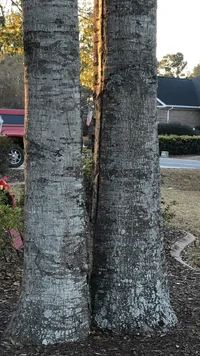
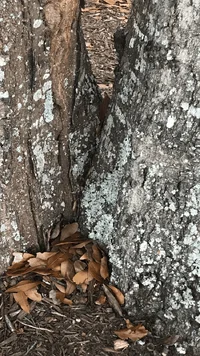
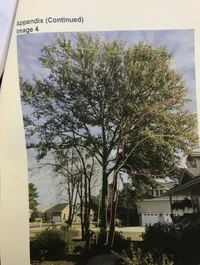
Rather than the subject being two trees with a shared root structure, might you have a single tree with two large and low codominant stems? That might not affect the management decision but would likely affect the outcome. We (or at least I) really need sharp, clear photos from around the joined stems and on overall picture of the tree(s) and setting would help.
 
I have a customer that has a two oak trees (20 dbh) that share a common root structure. One tree is encroaching heavily on his house and needs to be removed....

What species of Oak tree and how long has it been sharing its root zone with the house? Define encroaching.
 
The tree is a darlington oak and the tree hazard assessment report prepared by a ISA certified arborist identifies the trees as two separate trees and does not indicate a co-dominant stem. He recommends this tree be removed which aligns with the homeowners wishes because it encroaches on his roof.
The homeowners changed his mind about stump grinding and will allow it to be cut off near the ground.
 

Attachments

  • Photo Dec 30, 8 19 21 AM.webp
    Photo Dec 30, 8 19 21 AM.webp
    287.2 KB · Views: 30
  • Photo Dec 30, 8 20 15 AM.webp
    Photo Dec 30, 8 20 15 AM.webp
    378 KB · Views: 32
try to take pics with a ruler/yard stick, tool, phone, anything placed against the stem to give perspective.
I am going to guess he will not be satisfied with the pruning even if the leader over the roof is ctg and the remainder reduce/pruned. I think it obvious no one explained the value of tree or we are missing some key information.
If lead is ctg, the remaining will be compromised with potential for failure. hoow much potential? who knows, pics are insufficient many more observations need to be made.
the tree should be considered one organism and with the creation of a large wound at ground level will create a significantly higher potential for failure.
ISA certified arborist tree hazard report has more to say?
You really should take the advice of members in retention opinion as the best advice.
Tree adds thousands of dollars to the property value and destroying that is dumb
 
Last edited:
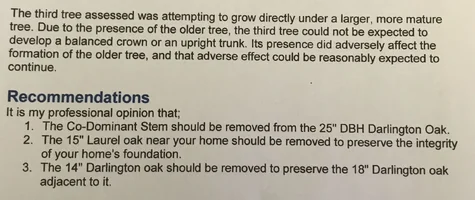
Eric wagner report excert.webp This is from the report prepared by an ISA certified arborist. We are discussing tree 3. My original question was how best to to treat the stump when tree 3 is removed, as that is the homeowners intention.
 
Thanks Mr. Treemonkee, the images help a lot. My main concern was how large a wound would be made on the remaining stem by removing the stem not desired by the homeowner. With care, that should be possible with minimal damage.
I'd leave the ground-level stump "as is". There are things you could do to encourage its decay, but I'd probably leave it. Don't be surprised if you get differences of opinion expressed here! Even in sprout clumps, there is little decay that travels from the decay stump into elite sprouts. And this is likely to be independent trees, according to the above.
And welcome to the Buzz! I learn stuff here all the time.
 
The concern is the decay and dieback below ground . Compromising the root system. What you can't see until it blows over. Potentially upto 50% root damage which most likely will result in crown dieback in the remaining lead.
 
RopeShield, we must be looking at two different pictures. I see two trees, the smaller of which should have been removed a long time ago. No root damage to the remaining tree but instead opportunities.
 
I know this might be apples and oranges. Douglas firs commonly root graft. It’s not common but occasionally you will find a stump that is fully occluded. I’ve seen this on stumps upward of 30” in diameter and 10-20’ from the nearest tree. While nutrient/photosynthate sharing is important I haven’t observed direct negative response in the remaining tree. Indirect yes! Such as biodynamics or change in wind patterns, or damage from the initial removal.
No idea how this would play out with a oak, as Doug firs soak in resins into the wood blocking many pathogens.
 
The other observation to make is how much is the tree to remain is being supported by the one to be removed. Easy question difficult answer. Load test the trees together pull in both directions get it to sway and observe root plate for movement and crown buffering dynamics.
This will need to be done again when the stem is removed(hopefully doesn't happen)
 
Many of the whole tree failures I have inspected are of trees in close proximity. Twins, triplets, forest edge impacts from encroachment etc.
Same as removal of large lower limbs that die back with necrosis above and below the wound and many times the wound extending below ground. Hidden by bark for tens of years and then revealed as major seam
 
Take another look at the first pics posted.
Flat spots, lack of taper and root flare on both, inclusions, seam, occlusion.
The trees together balance it all out safely.
With removing the other it will create something undesirable.
 
Agree with rethinking this removal. Does the owner like groves, or specimens? 2-year timeframe, or 20? That would determine the objective.

What does the green line around the crown indicate?

If the laurel oak near the house has roots that are concerning, why not prune them?
 

New threads New posts

Back
Top Bottom