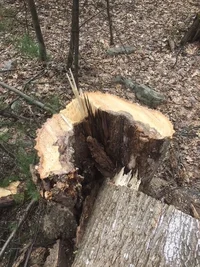
Please tell me your joking?You could pound wedges for an hour and not budge this locust hinge....
heavy side leaner over the house...
Nothing too special really, but few around here would have the skill and confidence fall the tree

Navigation
Install the app
How to install the app on iOS
Follow along with the video below to see how to install our site as a web app on your home screen.
Note: This feature may not be available in some browsers.
More options
You are using an out of date browser. It may not display this or other websites correctly.
You should upgrade or use an alternative browser.
You should upgrade or use an alternative browser.
Healthy Tree...Accident Happens
- Thread starter Kenny Sanchez
- Start date

Evo
Been here much more than a while
- Location
- My Island, WA
Nope he isn’t... I’m going to start making popcorn, the show is going to be great!Please tell me your joking?


You could yard on a pull line for 7 hours and never get this Redwood........Perfectly straight and over nothing........You could pound wedges for an hour and not budge this locust hinge....
heavy side leaner over the house...
Nothing too special really, but few around here would have the skill and confidence fall the tree
Very few men west of the Mississippi possess the skills, pornstar endowments, or movie star good looks to fall such a simple tree!

Sorry, but i’m an asshole and couldn't resist!
Last edited:

Daniel
Carpal tunnel level member
- Location
- Suburban Philadelphia (Wayne)
That's OK... we all are!
I wish I had my pics organized better
I wish I had my pics organized better
That's an interesting requirement. Do you still have to have two lines if you're felling the tree directly away from the conductors?
Yep, it was a requirement brought in last year after an incident where a crew falling a tree took down the lines. I’m sure there are crews who use only one line or none, of something went wrong they would be up shit creek pretty quick though
As much as I’m enjoying this conversation of such earth shattering techniques as pull/tag lines, anchors, plunge cuts, swinging Dutchman’s, and pie-cost-ya’s, they are all pretty irrelevant to the OP’s vid.
Its obvious from the vid that sub-par work at the stump was the problem. The moment the tree got into its undercut it was clear that he had missed his lay, and his tree was headed for a direct center punch of the other tree. Why? Because that’s where his undercut was gunned. He also compounded the problem by cutting his hinge. Super simple stuff really.
Its obvious from the vid that sub-par work at the stump was the problem. The moment the tree got into its undercut it was clear that he had missed his lay, and his tree was headed for a direct center punch of the other tree. Why? Because that’s where his undercut was gunned. He also compounded the problem by cutting his hinge. Super simple stuff really.

- Location
- Retired in Minneapolis
When I worked in NOLA after Katrina I had to write reports when there was either damage or when a drop went wrong. Our team took to calling them CSIs...Cut Scene Investigations. Many times I'd be left with a stump cut, splinters and sawdust. Never had video like here to help with a report. Knowing what the evidence was saying gave me a feeling of Columbo or Holmes. It was surprising to see how many times I could take notes and draw a conclusion then talk with the sawyer. I'd ask a few questions and share my conclusion. Most times the Sawyer didn't know why things went bad. It was always a good learning process. Some of the reports were shared at the weekly tailgate meetings

cerviarborist
Very stable member
- Location
- Florida, USA
I think the original post highlights why a 5 step felling plan should be outlined before any removal work is begun, rather than once the climber is on the ground and the spar is all that remains. When looking at the lay into which the OP tree was felled, it appears that there's room all over the place to drop a spar....providing that the climber takes another ten feet off the spar while in the tree.
It's great to be a hot shot precision feller....but if you can change your work plan up front so that pinpoint felling precision isn't required at the end of the job and you can dump the spar fast and easy, it makes for a more efficient day.
Sometimes you raise the bridge, other times it's easier to lower the river.
It's great to be a hot shot precision feller....but if you can change your work plan up front so that pinpoint felling precision isn't required at the end of the job and you can dump the spar fast and easy, it makes for a more efficient day.
Sometimes you raise the bridge, other times it's easier to lower the river.
Daniel
Carpal tunnel level member
- Location
- Suburban Philadelphia (Wayne)
I was wondering about that... It's not always easy to tell from video... It's clear that once the face closed, there was no hinge on the right side (op error) and the tree rotated (twisted or rolled whatever you want to call it) left, but not sure that threw the tree off the lay.... Again tough to tell from the video, but it looks like there was plenty of room to drop the tree everywhere in that direction except directly at the struck tree. So ya, if the notch was gunned better, it wouldn't have laid anywhere near the struck tree... Perhaps Kenny misjudged the height, but we may never know.... he went AWOL on this thread...As much as I’m enjoying this conversation of such earth shattering techniques as pull/tag lines, anchors, plunge cuts, swinging Dutchman’s, and pie-cost-ya’s, they are all pretty irrelevant to the OP’s vid.
Its obvious from the vid that sub-par work at the stump was the problem. The moment the tree got into its undercut it was clear that he had missed his lay, and his tree was headed for a direct center punch of the other tree. Why? Because that’s where his undercut was gunned. He also compounded the problem by cutting his hinge. Super simple stuff really.

Kenny Sanchez
New member
- Location
- Small part of the world
As much as I’m enjoying this conversation of such earth shattering techniques as pull/tag lines, anchors, plunge cuts, swinging Dutchman’s, and pie-cost-ya’s, they are all pretty irrelevant to the OP’s vid.
Its obvious from the vid that sub-par work at the stump was the problem. The moment the tree got into its undercut it was clear that he had missed his lay, and his tree was headed for a direct center punch of the other tree. Why? Because that’s where his undercut was gunned. He also compounded the problem by cutting his hinge. Super simple stuff really.
You hit the nail on the head. Conventional notch, i got lazy and my under cut didn't match the other side and i went too far past my sight. I did have a tag line but by cutting the far right side hinge off and the sight off by it bit it was all took to hit the other tree and land about 5 feet off my original target. What I meany by accident was hitting the other tree and that top easily breaking off, the tree had no sign of decayed.
This thread escalated very quickly. But thank you all for the inputs, tips, advices, etc. This is why I like to share my work and hope that others do likewise so we can learn form each other. Much love and kindness to you all.
Kenny Sanchez
New member
- Location
- Small part of the world
I was wondering about that... It's not always easy to tell from video... It's clear that once the face closed, there was no hinge on the right side (op error) and the tree rotated (twisted or rolled whatever you want to call it) left, but not sure that threw the tree off the lay.... Again tough to tell from the video, but it looks like there was plenty of room to drop the tree everywhere in that direction except directly at the struck tree. So ya, if the notch was gunned better, it wouldn't have laid anywhere near the struck tree... Perhaps Kenny misjudged the height, but we may never know.... he went AWOL on this thread...
Hi Daniel, thanks for all your inputs. Yes my sight was off by 5-6ft and i cut my hinge far right side. I did have a tag line as well.
Kenny Sanchez
New member
- Location
- Small part of the world
I think the original post highlights why a 5 step felling plan should be outlined before any removal work is begun, rather than once the climber is on the ground and the spar is all that remains. When looking at the lay into which the OP tree was felled, it appears that there's room all over the place to drop a spar....providing that the climber takes another ten feet off the spar while in the tree.
It's great to be a hot shot precision feller....but if you can change your work plan up front so that pinpoint felling precision isn't required at the end of the job and you can dump the spar fast and easy, it makes for a more efficient day.
Sometimes you raise the bridge, other times it's easier to lower the river.
You're correct! which is why i didn't care much for my undercut to be off a bit from my original sight as i had space to fell this spar pretty much in any direction, what i was not expecting was for that tree top to split in half when impacted by the poplar. Tree looked healthy.

Talon Tree Service
New member
- Location
- Bargersville
Coming from a timber cutter, who started climbing, then contract climbing, and now owning a tree service, I definitely agree. At least around here, a lot of the tree guys, even ISA certified ones, couldn’t fall a tree to save their life. I’ve walked on multiple jobs contracting for experienced foremen, being told to bring rigging gear to rig out limbs off houses/fences/pools, and ended up wedging and pulling the tree with just a maasdam and going home in 45 minutes for a whole day’s pay. I don’t think I would’ve needed wedges or the pulled either, I did it for safety. I’m sure it varies, but that is my experienceActually its quite the opposite. Much of the arborist world would greatly benefit from a season or 2 working with a good faller. Far to many folks in the tree care industry don't have a very good grasp on the proper mechanics of cutting. You teach a good climber to become a kickass cutter/faller and you have the makings of a great tree-man. Mr. Beranek, August, and Reg all come to mind!
Daniel
Carpal tunnel level member
- Location
- Suburban Philadelphia (Wayne)
Yes I see signs of falling incompetence all over the place, but it's good to make a distinction between falling techniques that work in the woods and falling techniques that work in the backyard.
Of course if you don't have a clue how to cut a basic notch and backcut, anything you learn will be a huge improvement
Of course if you don't have a clue how to cut a basic notch and backcut, anything you learn will be a huge improvement
Yes I see signs of falling incompetence all over the place, but it's good to make a distinction between falling techniques that work in the woods and falling techniques that work in the backyard.
Hogwash. Good falling/cutting skills are the same whether in the woods, backyard, or otherwise.

Jehinten
Been here much more than a while
- Location
- Evansville
Hogwash. Good falling/cutting skills are the same whether in the woods, backyard, or otherwise.
I'v got to say that I have been mixing in a few differet cuts as of late that has saved a lot of extra time and work. Triple hinge and sizwheel have both eliminated a lot of rigging over obstacles since it allows those leaning trunks to swing into open spaces.
I've used traditional cuts and tag lines to pull those leaners the right way, but the above cuts cut down on extra setup.

Windwalker
New member
- Location
- Pine Grove, Pa
Don't feel bad, I missed my lay on this one too. 30" poplar, 100' tall. There was a house 50' behind the tree, and some small hemlocks in the drop zone the homeowner wanted to retain. This was in a wooded area that had just been logged. The biggest concern was the house. I missed my lay by a good bit and landed on the other side of the small hemlocks with no damage. This was a project a logger was working on removing poplar trees. There were 7 large trees that he was too nervous to fell, so the homeowner called me. The other 6 were back leaning towards her house and over the service lines. All had pull lines set high in the canopy and two of them that were in the 36" range had two lines set. I did the 6 with good precision and then they showed me this one. I was just happy to at least get it started towards the lay with some control to make a quick escape.
Attachments
New threads New posts
-
test
-
 Alternatives to standard asphalt around roots
- Started by southsoundtree
- Replies: 4
-
-

-

-
 For Sale: 2018 Vermeer BC1000XL Chipper | 918 Run Hours | Deutz Diesel
- Started by Blue Ribbon Tree
- Replies: 2
-

