
Matias
Been here much more than a while
- Location
- Silicon Valley
Of course. How could I forgetAt this point they're one and the same

Follow along with the video below to see how to install our site as a web app on your home screen.
Note: This feature may not be available in some browsers.
Of course. How could I forgetAt this point they're one and the same

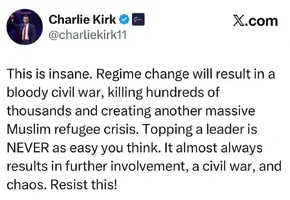
Trump, the Self-Declared Peace President, Goes to War Seeking Regime Change
President Trump has become increasingly willing to assert American power overseas, a decade after propelling himself to the highest office by promising to focus on “America first.”
When he first ran for president in 2016, Donald J. Trump disavowed the military adventurism of recent years, declaring that “regime change is a proven, absolute failure.” He promised to “stop racing to topple foreign regimes.”
When Mr. Trump ran for president in 2024, he boasted of starting “no new wars,” and asserted that if Kamala Harris won, “she would get us into a World War III guaranteed,” and send the “sons and daughters” of Americans “to go fight for a war in a country that you’ve never heard of.”
Barely a year later, Mr. Trump is racing to topple foreign regimes, and is sending American sons and daughters to wage another war in the Middle East. The self-declared “president of PEACE” has chosen to become the president of war after.
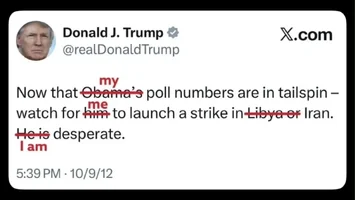
Charlie Kirk would be so proud!
View attachment 101182

Dude should just step down and become the Iranian king… he fits the job description better.Currently, in the White House:
Trump, in the middle of a Medal of Honor ceremony where he is explaining his rationale on deposing Iran’s supreme leader, starts talking about his White House ballroom project.
After just a few minutes, Trump has moved on from his war in Iran to the curtains he’s picked out for the White House and his new ballroom. “I picked those drapes in my first term,” he says. “I always liked gold.” There’s light chuckling in the room.


Par for the course with your excellent and concise analysis.claims that iran is going the way of venezuela are naive at best. it has a modern economy and developed civil bureaucracy in ways venezuela absolutely does not. the closure of the strait of hormuz not only cuts china off from iranian oil, but cuts one fifth of the entire oil output of the planet, most of which would go to india and west asia. gulf coast countries demand us dollars for their oil, which is a major prop underpinning the value of the dollar and thus the american economy. now they cant move it
the second and third order consequences of war with iran may be far from what the american government can imagine. afghanistan/iraq led to twenty years of occupation, millions dead, the creation of isis (the leadership of which passed through american prisons during the iraq war), destruction of the civil societies of libya and syria. and costs over a trillion dollars when you add all americas middle east wars together.
does anyone really believe war with iran will be less consequential than war with iraq?
unanticipated and immediate consequence of the moment: massive disruption to the fertilizer production and supply chain right before planting seasonPar for the course with your excellent and concise analysis.
I'd really rather not. Do we have to?unanticipated and immediate consequence of the moment: massive disruption to the fertilizer production and supply chain right before planting season
The Middle East supplies a huge amount of the world’s fertilizer. Conflict in the region has sent prices soaring ahead of the critical spring planting season.
Global oil and gas prices have skyrocketed following the US attack on Iran last weekend. But another key global supply chain is also at risk, one that may directly impact American farmers who have already been squeezed for months by tariff wars. The conflict in the Middle East is choking global supplies of fertilizer right before the crucial spring planting season.
“This literally could not be happening at a worse time,” says Josh Linville, the vice president of fertilizer at financial services company StoneX.
The global fertilizer market focuses on three main macronutrients: phosphates, nitrogen, and potash. All of them are produced in different ways, with different countries leading in exports. Farmers consider a variety of factors, including crop type and soil conditions, when deciding which of these types of fertilizer to apply to their fields.
Potash and phosphates are both mined from different kinds of natural deposits; nitrogen fertilizers, by contrast, are produced with natural gas. QatarLNG, a subsidiary of Qatar Energy, a state-run oil and gas company, said on Monday that it would halt production following drone strikes on some of its facilities. This effectively took nearly a fifth of the world’s natural gas supply offline, causing gas prices in Europe to spike.
That shutdown puts supplies of urea, a popular type of nitrogen fertilizer, particularly at risk. On Tuesday, Qatar Energy said that it would also stop production of downstream products, including urea. Qatar was the second-largest exporter of urea in 2024. (Iran was the third-largest; it’s also a key exporter of ammonia, another type of nitrogen fertilizer.) Prices on urea sold in the US out of New Orleans, a key commodity port, were up nearly 15 percent on Monday compared to prices last week, according to data provided by Linville to WIRED. The blockage of the Strait of Hormuz is also preventing other countries in the region from exporting nitrogen products.
“When we look at ammonia, we're looking at almost 30 percent of global production being either involved or at risk in this conflict,” says Veronica Nigh, a senior economist at the Fertilizer Institute, a US-based industry advocacy organization. “It gets worse when we think about urea. Urea is almost 50 percent.”
Other types of fertilizer are also at risk. Saudi Arabia, Nigh says, supplies about 40 percent of all US phosphate imports; taking them out of the equation for more than a few days could create “a really challenging situation” for the US. Other countries in the region, including Jordan, Egypt, and Israel, also play a big role in these markets.
“We are already hearing reports that some of those Persian Gulf manufacturers are shutting down production, because they're saying, ‘I have a finite amount of storage for my supply,’” Linville says. “‘Once I reach the top of it, I can't do anything else. So I'm going to shut down my production in order to make sure I don't go over above that.’"
remember the cost of lumber during the pandemic as all those mills shut down 6-12 months for maintenance, lets do that with fertilizer
I should rewatch The Fog of War, I forgot that the music was written by Philip Glass.


